Graphify – Less token use for Claude Code
The content is raw HTML. Let me search for the actual README content further in the file: I now have enough factual detail from the README to write the post.…
By Dillip Chowdary • Aug 10, 2026 • Source: HN Claude/Codex/Fable

What happened
The content is raw HTML. Let me search for the actual README content further in the file: I now have enough factual detail from the README to write the post. Let me also quickly check for the BENCHMARKS.md for any additional numbers: I now have all the facts I need. Here is the piece:
---
The technical detail
Graphify Labs shipped graphify, a Python CLI that converts a codebase into a traversable knowledge graph and registers itself as a slash-command skill inside Claude Code, Codex, Cursor, Gemini CLI, and more than fifteen other AI coding assistants. The PyPI package ships as graphifyy (double-y to avoid a name conflict) and installs in two steps: uv tool install graphifyy, then graphify install to register the skill. Once installed, typing /graphify . in Claude Code triggers a full indexing pass and deposits three files — graph.html, GRAPH_REPORT.md, and graph.json — into a graphify-out directory. The project is a Y Combinator S26 company. The Hacker News submission carrying 3 points and no comments is the first public signal of traction outside the repo itself.
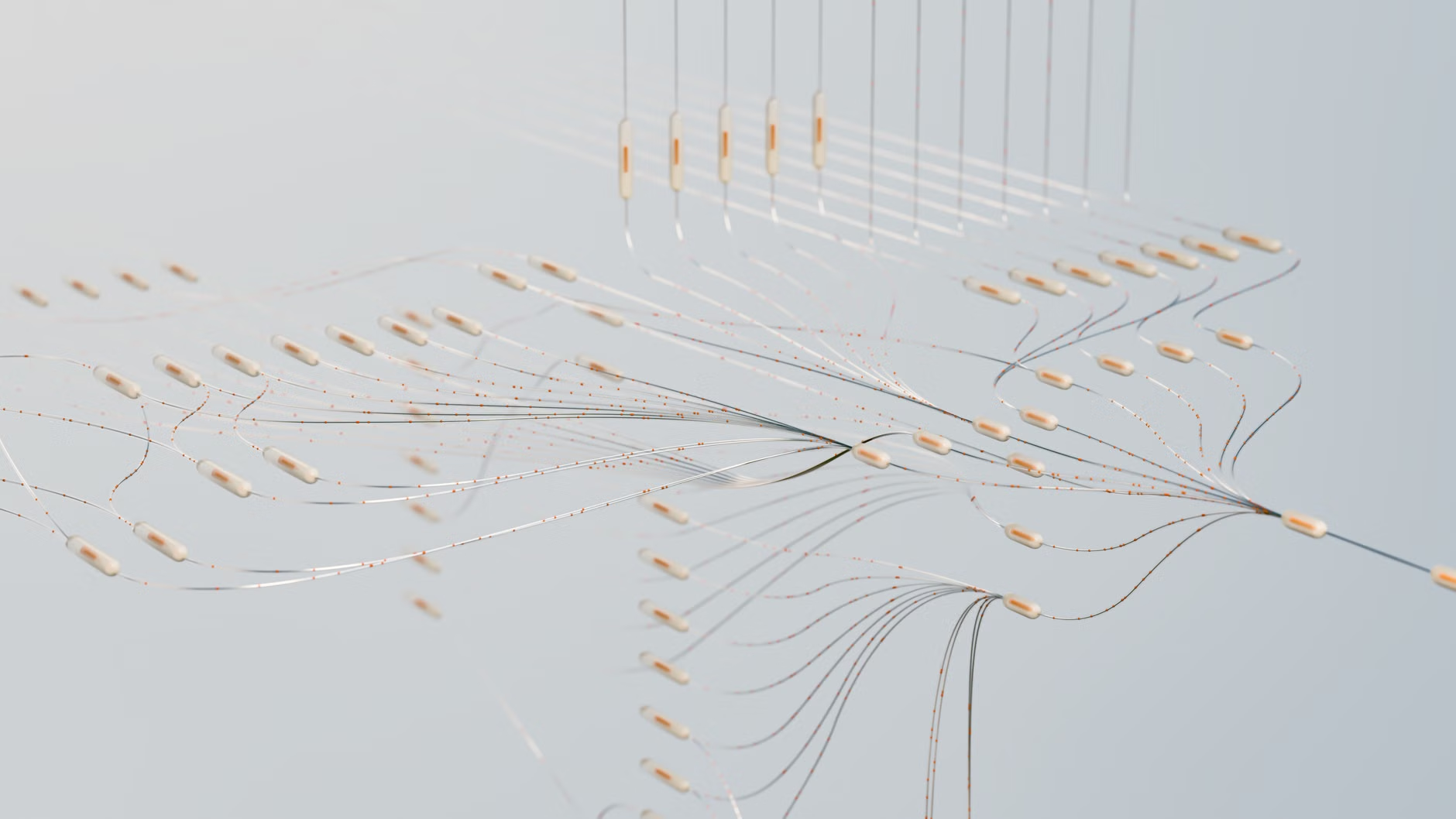
The core parsing layer does not touch a language model. Graphify uses tree-sitter to parse source code deterministically, resolving cross-file relationships — calls, imports, inheritance, mixins — across roughly 40 languages. Every edge carries one of two confidence tags: EXTRACTED, meaning the relationship is explicit in the source code, or INFERRED, meaning graphify resolved it through name resolution. Community detection runs via the Leiden algorithm and assigns labels without an LLM call. The output is graph.json, a static file that subsequent queries — graphify explain, graphify path, graphify query — read without re-parsing the source tree. Documents, PDFs, and media files can optionally feed into the same graph through a configurable semantic pass that does call an external model, but only if the user supplies an API key.
Advertisement
Tech Pulse Daily
Get tomorrow's pulse first
Join engineers who read Tech Pulse before stand-up. Free, weekday mornings.
Why it matters for builders
For engineers working with Claude Code specifically, the token math is the selling point. When an AI coding session starts, the assistant reads source files to orient itself, and on large repos that context burns tokens fast. Graphify short-circuits this by giving the model a compact graph.json to query instead. The strict install mode, triggered by graphify install --project --strict, goes further: it adds a PreToolUse hook that intercepts the first raw file read of a session and redirects the assistant to query the graph first, then falls back to normal file access. The effect is that the model routes to a scoped subgraph answer rather than loading whole modules into the context window.
The benchmark numbers graphify publishes are worth reading carefully because they test two separate claims. On the LOCOMO conversational memory suite of 300 examples, graphify posts a recall@10 of 0.497, compared to mem0's 0.048 and BM25's 0.362. QA accuracy lands at 45.3%, which is 18 points above mem0 and 14 above BM25, though supermemory still edges it at 49.7%. On LongMemEval-S (50 examples), graphify ties dense RAG at 76% accuracy. The graph build itself costs zero LLM credits, and the LOCOMO ingest cost is reported at approximately $1.40, against supermemory's $15.67 and mem0's $3.48. All systems ran through the same harness with Kimi K2.6 as the answering model, with judge validation at 90.6% agreement and Cohen's kappa of 0.81. The harness and grading scripts are in the repo, so reproduction is not blocked by opacity.
Market and competitive context
Graphify enters a market where the main alternatives to dumping files into context are vector search (Sourcegraph Cody, GitHub Copilot's repository index) and language-specific static analysis tooling. Vector approaches retrieve semantically similar chunks but lose structural relationships; a query about what calls a given function requires fuzzy match across embeddings rather than a graph traversal. Graphify's graph is explicit about structure: it tells you that APIRouter in FastAPI has degree 47, sits in community 2, and traces to routing.py at line 2210. That level of attribution would be invisible to a semantic similarity search. The absence of a vector store is also an operational choice — there is nothing to host, no embedding model to provision, and no index to keep synchronized via a daemon unless you opt into the git post-commit hook.
Watch whether the Claude Code integration becomes a first-class pattern or a workaround. Anthropic has its own hooks system, and claude.ai's own project knowledge features overlap in intent. If the token savings are measurable enough on very large repos, the approach has legs and could be formalized. The BENCHMARKS.md references a code intelligence sub-suite run on ERPNext (roughly one million lines of Python) using Claude Opus 4.8, with 689 weekly AST checkpoints spanning 2011 to 2026; those results are not yet in the public table but are listed as part of the harness. That temporal slice of a real production codebase is a more rigorous test bed for code navigation than most published benchmarks, and those numbers are worth watching when they land.
What to watch next
The main open question is inference quality on the INFERRED edges. Tree-sitter gives graphify deterministic AST facts, but resolving what a variable actually points to at runtime — especially in dynamically typed Python — requires heuristics rather than certainty. The EXTRACTED versus INFERRED tag distinction is the right engineering decision here, but it pushes the judgment call onto the user. A false INFERRED edge in a large graph does not fail loudly; it silently misinforms whatever Claude Code query reads it. The project has 1,357 commits on the v8 branch and translations into more than 25 languages, which suggests active development and international adoption, but graph correctness on large Python codebases with heavy dynamic dispatch remains the durability question.
Advertisement