32 Coding Agent Apps Reviewed news update
A mid-November 2026 review evaluated 32 coding agent applications across ten operational benchmarks, ranking the open-source tool Codealong at 9.5 points.
By Dillip Chowdary • Nov 15, 2026 • Source: codebrief.com
At a glance
- Applications evaluated
- 32 coding agent tools
- Review date
- Mid-November 2026
- Top scoring tool
- Codealong with 9.5 points
- Codealong license
- Apache-2.0 open source
- Platform availability
- macOS desktop and early iPhone preview
- Codealong price
- Free
Developers running autonomous programming tools now face a crowded ecosystem of thirty-two specialized desktop utilities evaluated across ten practical criteria in codebrief.com's report. The comprehensive analysis tracks the evolution of AI-assisted programming fourteen years after the industry's 2012 JavaScript framework explosion, charting how single-developer projects and venture products compete to manage terminal tabs. These utilities orchestrate models from multiple providers to streamline daily engineering workflows.
This review examines dedicated agentic development environments, menu bar notch applications, and official vendor interfaces designed to assist developers coordinating parallel agent sessions. It assesses session triage, harness integrity, cross-device execution, and background reviews for software engineers who maintain human control over production changes instead of delegating complete authority to autonomous software factories.
01Development environments and notch island monitors
Coding agent software currently divides into two primary architectural formats alongside standalone tools distributed directly by foundation model vendors. Agentic development environments, commonly called ADEs, serve as comprehensive command centers where developers open persistent conversation threads that run harnesses like Claude Code or Codex. Notch applications, known as islands, sit quietly in the system menu bar to monitor running tasks and surface questions without disrupting active workspaces.
These utilities support what industry engineers describe as centaur development, where an engineer and multiple autonomous assistants collaborate closely on complex tasks. While emergent platforms like Emdash 2.0, Capy's Captains, and Warp's Factories attempt fully automated workflows where repositories ingest tickets and output pull requests without human oversight, most developers reject complete autonomy. Industry practitioner Steve Yegge, having operated six successive factory iterations, cautioned that mainstream engineering organizations do not yet require unattended automation.
02Ten operational benchmarks for centaur workflows
Rigorous evaluation of these tools centers on ten functional criteria that determine usability during heavy engineering sessions. Triage capabilities receive top marks when an internal model reads waiting prompts to route input directly to the relevant session or worktree rather than sorting by basic queue capacity. Tools must also respect native harnesses without forcing code through restrictive protocol layers or drawing down shared API subscription credit pools.
Local environment compatibility remains equally critical for developers who refuse to sacrifice established development habits. Platforms must detect pre-existing sessions from tools like Claude Code, Codex, OpenCode, Antigravity, and Cursor while integrating smoothly with external desktop editors. Mandatory open-source licensing guarantees security and hackability, awarding special recognition to applications that can launch coding agents directly onto their own underlying source trees.
03Comparative scorecard across thirty-two platforms
Advertisement
Tech Pulse Daily
Get tomorrow's pulse first
Join engineers who read Tech Pulse before stand-up. Free, weekday mornings.
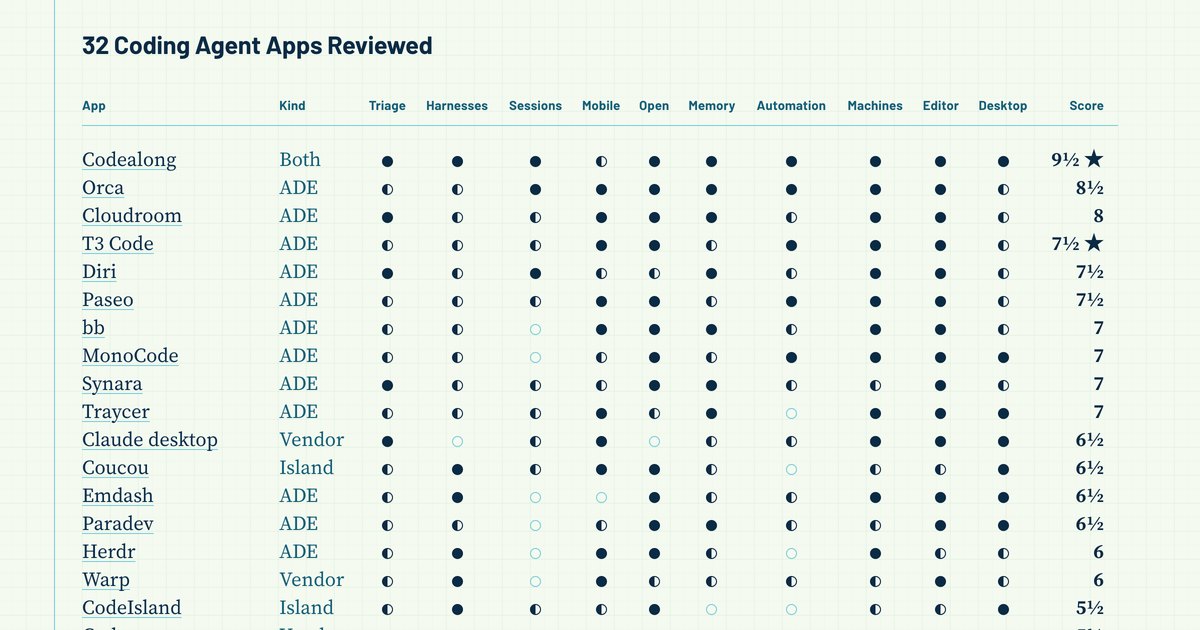
Mid-November 2026 audit metrics reveal dramatic variance across commercial and open-source offerings, with top marks awarded for comprehensive local control. Codealong achieved the highest overall score of 9.5 points with self-editing capabilities, closely followed by Orca at 8.5 points and Cloudroom at 8 points. Proprietary vendor applications lagged behind, with Claude desktop earning 6.5 points, Warp capturing 6 points, Codex app reaching 5.5 points, and Cursor scoring 4.5 points.
| App | Kind | Score | Open Source | Triage | Desktop |
|---|---|---|---|---|---|
| Codealong | Both | 9½ ★ | Full marks | Full marks | Full marks |
| Orca | ADE | 8½ | Full marks | Half marks | Half marks |
| Cloudroom | ADE | 8 | Full marks | Full marks | Half marks |
| T3 Code | ADE | 7½ ★ | Full marks | Half marks | Half marks |
| Diri | ADE | 7½ | Half marks | Full marks | Half marks |
| Paseo | ADE | 7½ | Full marks | Half marks | Half marks |
| Claude desktop | Vendor | 6½ | No marks | Full marks | Full marks |
| Coucou | Island | 6½ | Full marks | Half marks | Full marks |
| Emdash | ADE | 6½ | Full marks | Half marks | Full marks |
| Warp | Vendor | 6 | Half marks | Half marks | Half marks |
| Cursor | Vendor | 4½ | No marks | Half marks | Full marks |
| Google Antigravity | Vendor | 4 | No marks | Half marks | Half marks |
Lower-scoring entries like AgentNotch and Vibe Notch earned 3 points each because they lacked working memory, automation, and cross-machine support. Commercial desktop environments often forfeited points because proprietary distribution models prevent developers from auditing internal execution permissions. The resulting ranking demonstrates that lightweight utilities with strict native harness fidelity outperform heavy wrappers that channel developers into proprietary code editors.
04Background automation and multi-machine persistence
Automation features separate primitive process watchers from true productivity tools by handling asynchronous repository maintenance. Scheduled workflows and automated pull request reviews enable teams to audit continuous changes locally without incurring high cloud service bills. Continuous multi-machine coordination ensures that pending reviews and active agent sessions proceed uninterrupted on secondary hardware even after an engineer closes their primary laptop lid.
Working memory systems also relieve cognitive strain by organizing active initiatives into lightweight boards, task lists, and visual emblems. When coordinating multiple assistants across branches, developers rely on these emblems to track dependencies across worktrees. Retaining default code editors rather than adopting internal viewing panels preserves personal configurations, allowing developers to inspect diffs and test code within their standard development setups.
05Local session triage and harness discovery
Codealong implements these benchmarks by combining an agentic development environment with a lightweight notch monitor built on Tauri with a Rust core engine. The platform runs on macOS, with installation supported via standard package management commands like brew install --cask codealong/tap/codealong. Global hotkeys allow developers to press Option-Command-Period from any application to display the longest-waiting agent, while Command-Enter submits instructions and advances the queue.
Incoming instructions pass through an internal decision model named Jev, which inspects recent turn transcripts to determine whether a waiting agent requires user guidance. The model dispatches responses directly to the relevant active process or matching repository worktree. Instead of encapsulating agents inside restrictive containers, the runtime launches work directly within user terminal windows, background tasks, or official vendor clients, preserving user-selected binary builds.
Note: Codealong provides early preview support on iPhone devices and currently requires developers to compile Linux and Windows releases directly from source code. Distributed under the permissive Apache-2.0 license, the application is completely free to download, while competitor platforms frequently charge additional fees that reduce their overall evaluation scores.
Frequently asked questions
What is the difference between an agentic development environment and an island app?
An agentic development environment is a full workspace where coding agents run directly inside open threads. An island is a lightweight notch or menu bar application that monitors agents running across other windows and allows quick replies without switching contexts.
How does Codealong route prompts to active coding agents?
Codealong uses an internal decision model called Jev that reads completed turns to determine what waiting sessions require. It routes newly typed prompts directly to the agent already working on the task or to its corresponding git worktree.
Why did proprietary vendor apps receive lower evaluation scores?
Vendor tools like Claude desktop, Warp, and Cursor lost points because they are not open source and often lack native harness flexibility. Many also do not support multi-machine persistence or automatic pull request reviews.
Which coding agent harnesses can Codealong discover on installation?
Codealong automatically scans existing session logs to index and search prior sessions started in Claude Code, Codex, OpenCode, Antigravity, and Cursor.
Sources

Author
Dillip Chowdary
Writes Tech Bytes coverage of AI, engineering, and the tools that actually ship. Editor of Tech Pulse Daily.
Related on Tech Bytes
Advertisement