A field guide to CAPTCHA types and how they break
Developer vsmutok launched FuckCaptcha, an open reference project cataloging over 30 CAPTCHA systems across a five-tier editorial difficulty rating scale.
By Dillip Chowdary • Nov 08, 2026 • Source: github.com
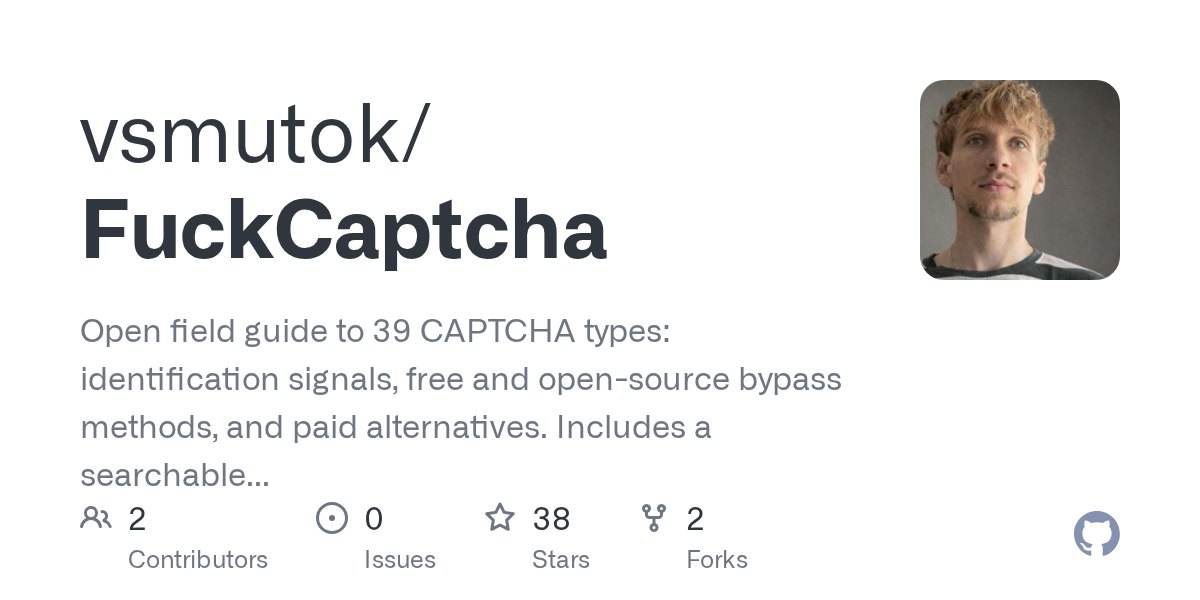
Developer vsmutok released FuckCaptcha, an open-source reference guide and interactive catalog designed to document modern CAPTCHA systems, challenge mechanics, and related technical literature, according to github.com's report. The project consolidates disparate verification technologies into a centralized library, organizing challenge variants and documented research for testing environments where explicit administrative permission has been granted.
This reference guide covers challenge families ranging from legacy visual puzzles to enterprise bot mitigation platforms, detailing verification architectures, repository directory structures, and difficulty tiers. The documentation is written for security researchers, software developers, and technical auditors who evaluate defensive mechanisms, analyze detection trade-offs, and maintain compliance with privacy regulations and system terms.
A field guide to CAPTCHA types and how they: what actually changed
The release creates a unified taxonomy across dozens of distinct verification systems that previously lacked a consolidated public reference. Rather than treating bot challenges as uniform puzzles, the project catalogs specific implementations from major vendors including reCAPTCHA v2, reCAPTCHA v3, reCAPTCHA Enterprise, Cloudflare, GeeTest, Arkose Labs, Amazon WAF, and DataDome. It expands this inventory across global enterprise providers such as Tencent, Aliyun, Yandex, VK, Yidun, VAPTCHA, and Shumei, establishing structured classification records for each system to replace fragmented technical write-ups and ad hoc verification summaries.
Alongside mainstream cloud deployments, the release documents specialized and regional systems such as MTCaptcha, hCaptcha, Imperva, Kasada, HUMAN, Akamai, BotDetect, and ARCaptcha, alongside consumer platform implementations from Binance, TikTok, Amazon, and Temu. The documentation also covers alternative verification mechanisms including Altcha, Friendly, ATB, CaptchaFox, Capy Puzzle, CutCaptcha, Lemin, and Prosopo. By assembling these diverse proprietary and open implementations into a single public index, the repository provides researchers with standardized comparison points across varying defensive architectures rather than isolated proprietary vendor documentation.
A field guide to CAPTCHA types and how they: how it works
The project organizes its catalog through a modular directory architecture hosted across dedicated repository paths. Individual technical reference profiles reside in the docs/captchas/ directory, giving each verification mechanism its own dedicated file. Documented utility implementations and commercial options are cataloged within docs/solvers.md, which acts as a centralized index of observed approaches. Background literature and technical citations are collected in docs/resources.md, while assets/images/captchas/ stores corresponding visual diagrams and interface illustrations alongside brand assets maintained in assets/brand/ for navigational identity.
To assist navigation across diverse challenges, the guide applies a five-tier editorial difficulty scale. The ratings span 1 — Low, 2 — Below average, 3 — Medium, 4 — High, and 5 — Very high. These labels serve as editorial estimates to help users gauge complexity rather than guaranteed operational behavior across varied testing contexts. Users can filter by challenge category, spanning text-based inputs, audio playback, and slider interactions, and review documented approaches alongside stated technical limitations directly within each challenge profile.
Advertisement
Tech Pulse Daily
Get tomorrow's pulse first
Join engineers who read Tech Pulse before stand-up. Free, weekday mornings.
A field guide to CAPTCHA types and how they: why it matters
Modern anti-bot defenses have evolved from simple visual distortion puzzles into multi-layered behavioral analysis platforms, creating significant challenges for security verification and defensive auditing. By documenting enterprise platforms like reCAPTCHA Enterprise, Cloudflare, DataDome, Kasada, and Akamai within a single framework, the project establishes a transparent baseline for evaluating defensive capabilities. Security practitioners gain a structured method to cite challenge types and trace technical literature without having to reverse-engineer vendor documentation independently, fostering open technical discourse around the mechanics of automated challenge verification and resistance.
The project explicitly prioritizes ethical boundaries by requiring testing to remain strictly confined to authorized research environments. The repository includes a direct legal disclaimer affirming that all cataloged materials are provided solely for educational study, with the authors explicitly disclaiming responsibility for unauthorized misuse. By mandating respect for user privacy standards, applicable legal statutes, and third-party terms of service, the documentation attempts to decouple defensive technical analysis from malicious evasion. This operational structure allows engineering teams to study challenge limitations and trade-offs while maintaining professional compliance.
A field guide to CAPTCHA types and how they: who is affected
Security engineers and site reliability teams managing bot mitigation tools are directly influenced by this centralized documentation. Teams deploying enterprise defenses from vendors such as Arkose Labs, Imperva, GeeTest, or Amazon WAF can review how their selected verification systems are categorized alongside alternative market options. The reference highlights documented trade-offs, limitations, and operational categories across audio, slider, and text challenges, enabling defense architects to assess whether their current verification barriers provide adequate resistance against automated collection or require supplemental behavioral safeguards.
Developers and academic researchers auditing user access barriers also encounter direct utility from the standardized library. By surveying systems like Friendly, Altcha, Capy Puzzle, Lemin, and CutCaptcha, software creators can compare privacy-conscious alternatives against proprietary services from Google, Tencent, or Yandex. Because the guide indexes documentation across global e-commerce and consumer platforms, including Temu, Binance, and TikTok, analysts studying cross-border bot defense practices gain a systematic framework for understanding regional challenge deployments without initiating unauthorized penetration tests.
A field guide to CAPTCHA types and how they: what to watch
Ongoing maintenance of the reference depends directly on open-source community participation managed through the project's CONTRIBUTING.md guidelines. As bot detection platforms frequently alter their underlying challenge algorithms, telemetry collection, and client-side scripts, contributors are invited to expand the individual markdown pages in docs/captchas/ and submit verified updates to docs/solvers.md. The repository tracks ongoing engagement through its star history metrics, providing an indicator of community adoption among security analysts, software auditors, and independent developers who monitor continuous shifts in bot defense techniques.
Future monitoring will focus on whether additional challenge families such as ARCaptcha, CaptchaFox, and Prosopo see expanded documentation as defensive models evolve. Observers will also track how the editorial difficulty scale adapts as new puzzle designs and behavioral telemetry blur the lines between tier 1 Low mechanisms and tier 5 Very high enterprise systems. As long as testing remains within authorized boundaries, the evolving index will serve as a bellwether for standardizing challenge classification across the security industry.
Developer Action Items
- ☐ Diff the official changelog for Amazon / GitHub / Cloudflare before you bump — APIs, defaults, and removed flags only.
- ☐ Install through the vendor's documented channel in staging; keep a one-command rollback and time-box the canary.
- ☐ Grep your repo for old flag names, lockfile pins, and plugin versions that the notes mark as breaking.
- ☐ Prefer the first patch cut over the day-zero tag unless you have a reason to be on the leading edge.
- ☐ If Hacker News Front Page did not name a region, plan, or SKU, screenshot the official availability line before you promise it to users.
A field guide to CAPTCHA types and how they FAQ
What is the primary purpose of FuckCaptcha?
FuckCaptcha is an open reference guide and technical catalog that documents CAPTCHA types, their operational context, and related research approaches. It is intended for education and authorized research within permitted testing environments.
How does the guide structure its difficulty ratings?
The guide uses an editorial five-point difficulty scale labeled 1 — Low, 2 — Below average, 3 — Medium, 4 — High, and 5 — Very high. These designations provide navigational estimates rather than operational performance guarantees.
Which repository directories organize the project documentation?
Challenge profiles are stored in docs/captchas/, solver tools and services are indexed in docs/solvers.md, and research citations are gathered in docs/resources.md. Visual illustrations and brand artwork are kept in assets/images/captchas/ and assets/brand/.
Sources

Author
Dillip Chowdary
Writes Tech Bytes coverage of AI, engineering, and the tools that actually ship. Editor of Tech Pulse Daily.
Related on Tech Bytes
Advertisement