A Pile of MCP Connectors Is Not a Context Engine
Unblocked released its context simulator after benchmarks showed compiled context finished coding tasks up to 83% faster while using 48% fewer tokens.
By Dillip Chowdary • Nov 15, 2026 • Source: getunblocked.com
Dennis Pilarinos at developer context platform Unblocked published an engineering evaluation and released an open-source testing harness examining Model Context Protocol connectors, as detailed in getunblocked.com's report. The company evaluated point-to-point connectors against pre-compiled context systems across frontier AI models, demonstrating that raw tool connectors turn agents into expensive retrieval loops at inference time. By resolving context prior to prompting, Unblocked demonstrated up to 83 percent faster task completion with roughly 40 percent of baseline tokens.
This analysis details the benchmark metrics, architectural trade-offs, and institutional knowledge challenges that emerge when wiring autonomous agents into enterprise developer stacks. Engineering directors, platform architects, and software teams configuring AI coding tools will find comparative telemetry on token consumption, convention adherence, and credential sprawl. The findings define clear operational boundaries between standalone API endpoints and unified context engines.
01Inference benchmark runs and token costs
Benchmarking tests comparing direct connector queries with compiled context engines revealed significant performance differences across common engineering tasks. On a Kotlin SDK task, an agent supplied with compiled context finished 83 percent faster, used 48 percent fewer tokens, and cost 60 percent less than an agent using standalone connectors. That context-equipped agent scored 9.5 out of 10 for adhering to team conventions, whereas the connector baseline scored 2 out of 10.
In a frontend feature-toggle test, the context-backed agent completed the work 26.6 percent faster with 41.6 percent fewer tokens, while the baseline agent exhausted its allowed turns and produced no working code. A separate internal evaluation using Claude Code showed that an unassisted agent spent 81 turns of subagent exploration crawling the repository, consuming roughly 84 percent of a session that cost ten times more and failed. The context-assisted run answered correctly in 40 seconds.
To let outside teams verify these measurements within their own codebases, Unblocked open-sourced its context-engine-simulator utility. The tool allows developers to supply their own model keys, existing workflows, and private repositories to evaluate token usage and latency gaps. Pilarinos noted that assigning silo searches and result reconciliation to an agent delegates expensive integration work to the frontier model loop.
02Codebase vocabulary and unknown project aliases
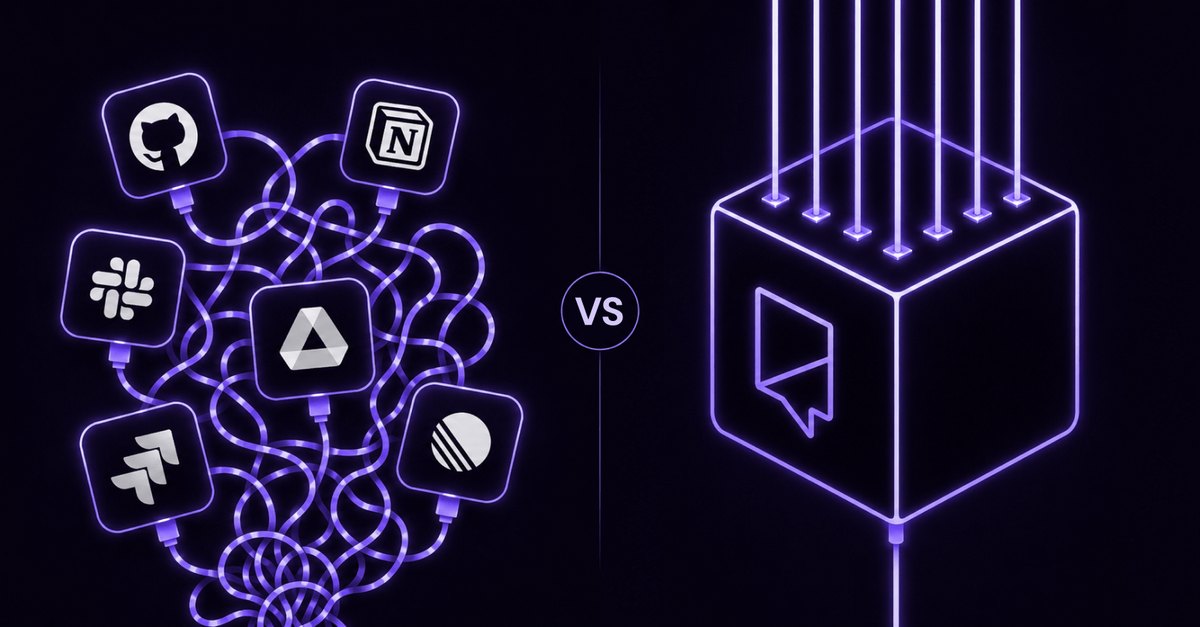
Autonomous agents relying on point-to-point connectors depend on keyword queries that assume the model already knows the exact terminology used across an organization. Engineering teams frequently use conflicting labels, calling a checkout rewrite phoenix in Slack while indexing it as checkout-v2 inside Jira. Because an agent cannot search for conversations it does not know took place, raw keyword queries miss critical background discussions.
The report highlights a framing from Anthropic researcher Thariq Shihipar stating that the map is not the territory. In this model, the map consists of prompts, skills, and immediate context, while the territory represents the actual production environment. Shihipar observed that frontier model performance is no longer constrained by raw intelligence, but is bottlenecked by the operator's ability to clarify model unknowns.
Advertisement
Tech Pulse Daily
Get tomorrow's pulse first
Join engineers who read Tech Pulse before stand-up. Free, weekday mornings.
Human-in-the-loop workflows like structured interviews, reference walkthroughs, and blind spot passes consume substantial developer time and recurring token volume. Manual interviews only surface decisions a developer actively remembers, while automated scans cannot reach historical conventions buried deep in git commits. Unblocked resolves these unknowns prior to inference by mapping tool vocabularies and linking historical pull requests to related discussions during ingestion.
03Conflicting documentation and recency signals
When an autonomous agent searches across multiple individual connectors, it frequently encounters contradictory instructions from outdated systems. A Confluence page might document an existing payment flow, while a Slack discussion three weeks later reverses that design without anyone updating the wiki. Similarly, repository README files often detail legacy authentication patterns while the rationale for current implementations sits isolated in pull request review comments.
Standalone connectors lack the global intelligence required to weigh conflicting sources, causing agents to accept the first plausible match they discover. This limitation causes models to generate code based on obsolete architectural decisions that teams previously abandoned. Unblocked resolves contradictions server-side prior to model prompting by evaluating recency and authority signals across all repositories, attaching verifiable citations to every response.
04Cross-system patterns and unwritten team conventions
Critical development standards often exist only as behavioral habits observable across multiple tools rather than documented policies. Engineering teams rarely write formal guides specifying that pull requests modifying authentication logic need dedicated security reviews, or that checkout edits require payment test suites. Because these rules exist exclusively as recurring patterns across years of pull request history, direct keyword lookups cannot locate them.
Determining functional code ownership presents an identical challenge that static organizational charts fail to capture accurately. True domain expertise is derived dynamically by observing who reviews pull requests on GitHub, answers technical questions in Slack, and resolves related Jira tickets over time. Centralizing these activity signals across tools preserves institutional memory, preventing agents from starting from zero on every session.
05Credential proliferation and security attack surfaces
Integrating independent Model Context Protocol connectors for services like GitHub, Slack, Jira, Notion, and Google Drive introduces significant enterprise security liabilities. Each independent connector requires distinct access credentials and custom permission configurations, creating operational management overhead for platform infrastructure teams. Security administrators increasingly push back against giving frontier agent loops direct access keys to sensitive internal corporate drives and collaboration channels.
This mesh of individual connectors directly magnifies what security researchers term the lethal trifecta of autonomous agent risk. That condition emerges when an AI agent simultaneously possesses access to sensitive data, exposure to untrusted content, and the authority to take action. Routing requests through a consolidated context architecture establishes a single security boundary, preventing autonomous models from maintaining broad, unrestricted credentials across enterprise tools.
A Pile of MCP Connectors Is Not a Context FAQ
What is the main difference between an MCP connector and a context engine?
An MCP connector provides access to an isolated tool API and returns matching documents from that single system. A context engine links data across all tools during ingestion, resolving contradictions, vocabulary aliases, and unwritten conventions before the model runs.
What performance improvements did Unblocked measure in coding agent benchmarks?
In a Kotlin SDK task, an agent using compiled context finished 83 percent faster, used 48 percent fewer tokens, and cut costs by 60 percent. On a frontend toggle task, the context-assisted agent completed work 26.6 percent faster with 41.6 percent fewer tokens.
How can engineering teams test these benchmarks on their own repositories?
Unblocked open-sourced a testing utility called context-engine-simulator. Teams can point the tool at their private repositories using their own developer tooling and model keys to measure token expenditure and completion speed directly.
Why do individual connectors struggle to capture unwritten team conventions?
Unwritten conventions like mandatory security reviews or integration tests exist only as behavioral patterns across years of pull request history rather than formal documents. Standalone connectors have no text documents to query for those practices, whereas cross-system ingestion detects them over time.
Sources

Author
Dillip Chowdary
Writes Tech Bytes coverage of AI, engineering, and the tools that actually ship. Editor of Tech Pulse Daily.
Related on Tech Bytes
Advertisement