A Smarter Model Won't Save Your Bad Harness
Cerebras showed agent performance relies on harness engineering, noting Claude Opus 4.5 jumped from 45.9% to 55.4% on SWE-bench Pro across scaffolds.
By Dillip Chowdary • Nov 09, 2026 • Source: cerebras.ai
Cerebras engineers Sarah Chieng, William Ryan, and Sherif Cherfa released an architectural analysis arguing that a smarter foundation model cannot rescue a poorly engineered agent harness, showing how surrounding scaffolding dictates actual agent performance, execution latency, and benchmark scores in cerebras.ai's report. The research explains that while an underlying language model supplies raw reasoning and next-token generation, it remains an inert token machine without an external scaffolding system to supply durable state, tool execution, context selection, and verification loops. Across controlled programming tests, the same intelligence engine exhibited wildly divergent completion speeds and benchmark results depending entirely on the wrapper directing its inference passes.
This technical breakdown examines the operational mechanics of agent harnesses across terminal coding, personal assistants, and knowledge applications, detailing the structural layers required to turn language models into dependable software agents. It is designed for machine learning engineers, harness builders, and software architects who need to understand why benchmark scores belong to model-harness pairs rather than models in isolation. The analysis covers the concrete responsibilities of scaffold architectures, benchmark sensitivity across disparate execution frameworks, latency multiplication across serial inference calls, low-latency execution advantages, and head-to-head whiteboard application development trials.
01Body and brain division in agent systems
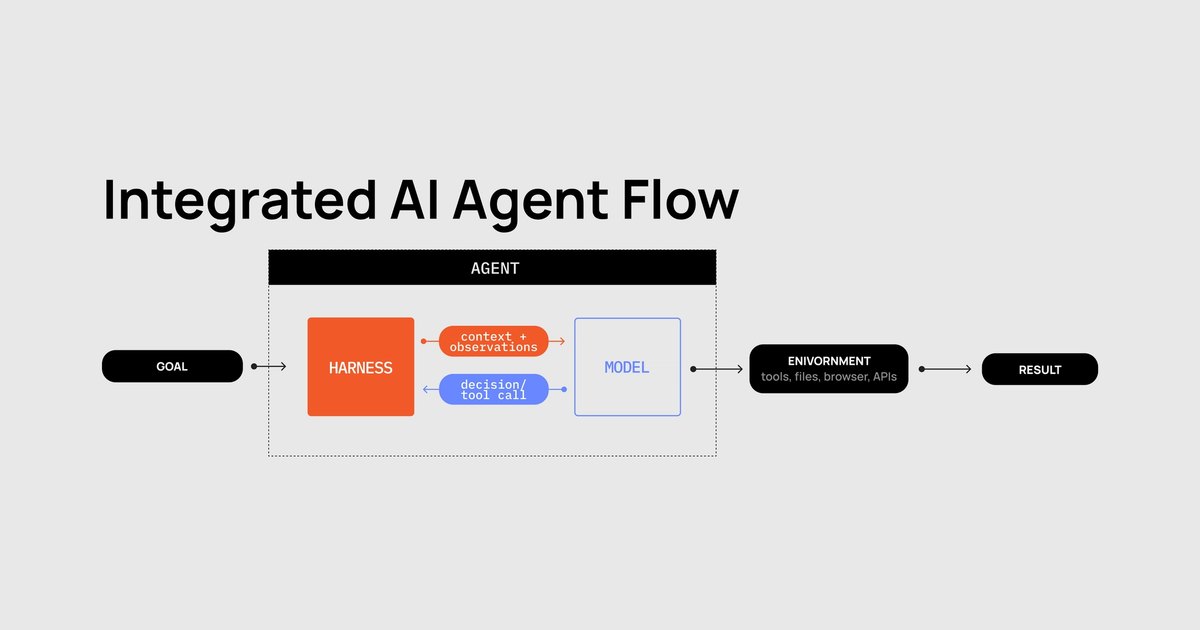
An artificial intelligence agent operates as a tripartite system comprising a model, an environment, and a harness, guided by user intent or peer agents. The model supplies intelligence by reasoning, making decisions, generating code, and proposing actions, while the environment provides the computer, container, browser, or code repository where execution occurs. On its own, a raw language model cannot browse the web, execute shell commands, maintain durable state, modify files, run code, or verify whether its generated patches actually function.
The harness serves as the physical body for the model's brain, transforming simple next-token prediction into a continuous execution loop. It constructs prompts from developer instructions, selects context across previous session histories and tool outputs, describes tool schemas to the model, and translates model intents into real environment actions. It also manages state retention across multiple turns, orchestrates parallel subagents, triggers deterministic scripts via hooks for tasks like linting, compresses context, and enforces hard security sandboxing and termination rules.
Different vertical domains tailor this shared harness skeleton to distinct user requirements. Personal assistants such as Openclaw and Hermes embed harnesses inside consumer messaging apps like Telegram, Discord, and iMessage. Knowledge work frameworks like ChatGPT Work and the Claude Desktop App connect agents to Slack, Notion, Gmail, Sheets, Teams, and Clickup, while software engineering harnesses run directly inside developer terminals and code editors to direct multi-step repository modification loops.
02Benchmark divergence across scaffold pairings
Evaluating model intelligence in isolation produces misleading conclusions because changing the scaffolding surrounding a model drastically alters benchmark outcomes. In the research paper titled Stop Comparing LLM Agents Without Disclosing the Harness, Claude Opus 4.5 recorded a 45.9 percent score on SWE-bench Pro when evaluated inside a standardized SEAL scaffold. When tested with the identical core intelligence through the Claude Code harness, the model achieved a 55.4 percent score, proving that benchmark numbers reflect a specific model-harness pairing.
Scaffold complexity does not guarantee superior task execution, as overly elaborate orchestration can degrade agent accuracy compared to clean tool boundaries. In recent evaluations, Prime Intellect launched Prime Agent on Pi, outperforming the specific harnesses that the underlying models were originally trained to utilize simply by refining the operational scaffolding. Smaller, more precise tool schemas frequently yield better real-world problem solving than stacking additional layers of uncoordinated agent orchestration.
Comparative data compiled by Artificial Analysis confirms that running identical models across different scaffolding environments produces broad performance swings. Because the harness determines how errors are caught, how context is compressed, and how tool descriptions are framed, evaluating model capabilities without disclosing harness implementation details misrepresents true system performance. Engineers must assess full system pairs rather than attributing task completion metrics solely to model parameter weights.
Advertisement
Tech Pulse Daily
Get tomorrow's pulse first
Join engineers who read Tech Pulse before stand-up. Free, weekday mornings.
03Inference multiplication inside serial execution loops
Every structural responsibility handled by a harness multiplies the total number of model calls required to resolve a prompt. Planning steps, tool calling loops, retry procedures, validation checks, automated linting, context compaction passes, and synthesis stages all demand separate inference runs. While adding a validation pass helps an agent catch newly introduced syntax errors, that single procedural safeguard immediately doubles the total operational runtime of the turn.
Subagents can parallelize certain specialized tasks, but the primary orchestrator must still sequentially plan assignments, dispatch worker agents, and synthesize returned outputs. In predominantly serial agent loops, individual inference latencies compound rapidly. A model step that feels tolerable in isolation becomes unusable when repeated across a multi-step execution chain, creating significant waiting times that break interactive developer workflows.
Fast inference systems reshape this operational budget by leaving sufficient headroom for deep reasoning and automated recovery within reasonable human interaction windows. Running GPT-5.6 Sol on Cerebras hardware achieves throughput speeds of up to 750 tokens per second, returning full-turn responses in as little as 0.4 seconds. These reduced latency windows provide harnesses with the processing budget needed to run rigorous error checks, multi-path tool validation, and complex retries without making the agent unresponsive.
04Low latency orchestration and execution techniques
Shrinking model response times enables harness architectures to implement computational techniques that are impractical with slower inference engines. In real-time multi-agent orchestration, coordination models like GPT 5.6 Sol Ultrafast can dispatch, supervise, and aggregate wide subagent fan-outs without accumulating latency penalties. This acceleration also supports computer interaction workflows that operate at natural human speeds, removing the halting execution pauses that make conventional desktop agent control error-prone and sluggish.
Low latency similarly enables speculative execution, allowing an agent to generate and test multiple distinct code implementations simultaneously across temporary git worktrees before presenting verified working options to the user. Fast inference also powers live steering, letting developers interrupt and redirect working agents instantaneously. Harnesses can apply aggressive self-correction, triggering validation hooks the moment a file edit completes and repairing syntax mistakes in milliseconds.
Interactive workflows benefit directly from tighter feedback cycles between developer and agent. When reasoning, tool execution, file editing, and web searches collapse into rapid-fire turn cycles, human developers can pair-program collaboratively rather than waiting passively for batch jobs to finish. Harnesses can also dynamically render live user interface previews, architectural diagrams, mock-ups, and data visualizations that adapt instantly to changing environment states during the generation process.
05Controlled whiteboard application development trials
To isolate harness efficiency from underlying model capability, Cerebras engineers conducted an empirical experiment using a single model across two distinct coding platforms. The trial deployed Claude Opus 4.6 within Factory Droid and Claude Code, charging both agents with creating a lightweight whiteboard application from scratch inside an empty repository. The test used no Excalidraw source code, external proprietary assets, or bundled icon libraries.
Both harnesses received an identical prompt and were evaluated against five core functional requirements. The resulting applications had to support drawing rectangles and arrows; selecting, moving, and deleting canvas elements; undo and redo functionality; exporting the canvas as a PNG file; and executing cleanly inside a live web browser. Both Factory Droid and Claude Code successfully satisfied all five application requirements on their first attempts.
The operational variance between the two runs emerged entirely in how efficiently each harness turned identical model intelligence into tested code. Factory Droid completed the entire whiteboard application 11 minutes faster than Claude Code, finishing the task roughly 2.4 times quicker. Because the underlying model and task requirements were identical, the 11-minute speed disparity demonstrated how harness loop mechanics, tool execution strategies, and prompt construction dictate actual software engineering throughput.
A Smarter Model Won't Save Your Bad Harness FAQ
What components make up an artificial intelligence agent?
An agent consists of a foundation model that provides intelligence, an environment such as a repository or container where work occurs, and a harness that controls tools, context, and execution loops.
How significantly can a harness alter benchmark performance on the same model?
A paper titled Stop Comparing LLM Agents Without Disclosing the Harness showed Claude Opus 4.5 scoring 45.9 percent on SWE-bench Pro under a SEAL scaffold but 55.4 percent through the Claude Code harness.
What inference speed did GPT-5.6 Sol achieve on Cerebras hardware?
GPT-5.6 Sol reached generation speeds of up to 750 tokens per second on Cerebras systems, delivering full-turn outputs in as little as 0.4 seconds.
What were the results of the whiteboard coding comparison between Factory Droid and Claude Code?
Both agents built a fully functional five-feature whiteboard application using Claude Opus 4.6, but Factory Droid finished 11 minutes faster, completing the build about 2.4 times quicker.
Sources

Author
Dillip Chowdary
Writes Tech Bytes coverage of AI, engineering, and the tools that actually ship. Editor of Tech Pulse Daily.
Related on Tech Bytes
Advertisement