A Space Probe Returns to Asteroids Where NASA Tested Planetary Defense
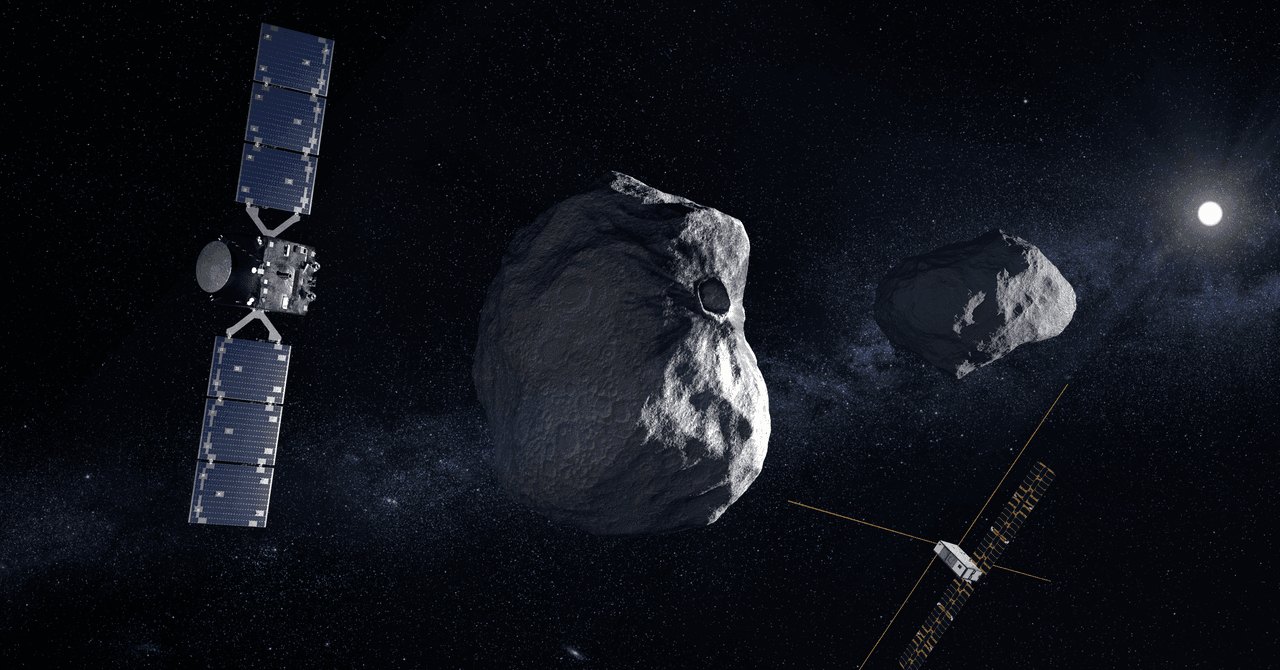
The European Space Agency's Hera probe arrived at the Didymos system to examine the 33-minute orbital shift caused by NASA's DART planetary defense collision.
By Dillip Chowdary • Nov 21, 2026 • Source: Wired
At a glance
- Primary spacecraft
- ESA Hera planetary defense probe
- Target system
- Didymos asteroid and Dimorphos moonlet
- Launch date
- October 2024
- Arrival phase
- October after Mars flyby
- CubeSat deployment
- January 2027
- Mission duration
- Concludes summer of next year
The European Space Agency has navigated its Hera space probe into the proximity of the Didymos binary asteroid system to conduct an extensive forensic assessment of planetary defense techniques, according to Wired's report. The rendezvous follows NASA's Double Asteroid Redirection Test, which slammed an impactor into the orbiting moonlet Dimorphos to demonstrate kinetic deflection.
This report details the orbital dynamics, collision results, measurement hardware, and planned companion probe deployments for aerospace engineers and astronomical researchers following orbital defense developments. It examines how close-range imaging, radar sounders, and gravitational mapping will quantify the impact mechanics needed to safeguard Earth from future collision threats.
01Atmospheric explosions and the 2029 Apophis flyby
Natural collisions with comets and asteroids represent a recurring physical hazard for the planet rather than mere cinematic fiction. In 1908, an incoming space rock measuring a few dozen meters across detonated over Siberia during the Tunguska Event. Scientists were unable to travel to the remote site for two decades, finding the surrounding landscape heavily scarred from the explosion.
Planetary defense tracking has advanced significantly, enabling researchers to forecast close encounters years in advance. Astronomers predict that the 450-meter-wide asteroid Apophis will pass within 19,000 miles of Earth in mid-April 2029. That trajectory places the object roughly twelve times closer than the moon, within the orbits of many satellites, and visible without binoculars.
Cataloging near-Earth asteroids has accelerated rapidly as observational capabilities and space probes have expanded across recent decades. In the year 2000, astronomers had identified only 300 near-Earth objects that approach or cross Earth's orbital path. Today, the recognized inventory exceeds 43,000 bodies, heightening the urgency of developing proven operational systems to actively deflect dangerous trajectories.
02Orbital velocity reduction for planetary defense
While tracking capabilities have grown rapidly, the capacity to intervene against an incoming hazard has long remained unproven. Popular fiction frequently depicts nuclear warheads obliterating target rocks, yet shattering a large asteroid into numerous uncontrolled fragments creates widespread secondary hazards. Space agencies instead favor modifying an object's orbital speed within the vacuum of space to eliminate collision potential.
Orbital alteration relies on the continuous motion of celestial bodies along predictable pathways. Earth travels through its orbit at roughly 20 miles every second. If an interceptor can slightly decelerate a threatening object, the body reaches the projected orbital intersection point seconds or minutes late, allowing Earth to pass harmlessly ahead.
| Deflection strategy | Operational action | Resulting outcome |
|---|---|---|
| Nuclear detonation | Shatters space rock into fragments | Disperses tiny hazardous pieces |
| Orbital alteration | Slows forward velocity of object | Delays arrival so Earth passes |
Space agencies evaluate different planetary intervention methods when assessing how to neutralize threatening celestial bodies traveling toward Earth. Kinetic deflection provides an orderly orbital shift, whereas explosive fragmentation creates swarms of untracked fragments that could still strike the surface. Mission planners therefore focus on velocity adjustments that redirect an intact asteroid away from Earth's orbital path.
Advertisement
Tech Pulse Daily
Get tomorrow's pulse first
Join engineers who read Tech Pulse before stand-up. Free, weekday mornings.
03Kinetic impact recoil on the Dimorphos moonlet
To validate kinetic deflection, NASA launched the Double Asteroid Redirection Test in late 2021 toward a binary asteroid system. Kitt Peak Observatory astronomers discovered the primary asteroid Didymos, measuring 780 meters across, 30 years ago. Czech astronomer Petr Pravec later identified its orbiting companion Dimorphos, a moonlet measuring 151 meters in diameter with a 12-hour orbital period.
Nearly a year after launch, the DART spacecraft intentionally collided with Dimorphos at speeds exceeding 13,000 miles per hour. Mission planners aimed to shorten the moonlet's orbital period by at least one minute. The actual collision shortened the orbital period by 33 minutes, far outperforming conservative baseline expectations due to unexpected physical recoil dynamics.
The dramatic shift occurred because the impact expelled massive quantities of rocky debris into space, generating stronger reactionary momentum than the probe's kinetic energy alone. The collision also slowed the orbital speed of both asteroids around the sun. For a brief period, Dimorphos developed a long trailing tail of released dust, resembling an active comet.
04Topographic lidar mapping and impact crater physics
The European Space Agency launched Hera in October 2024 to examine the lingering structural aftermath of NASA's kinetic collision. After completing a scheduled Mars flyby, Hera entered its target arrival phase in October, capturing its first image from 800 miles away. Mission controllers published the first detailed image of Didymos in early November.
Hera provides scientists their first detailed close-up investigation of a binary asteroid pair to examine how such systems form. Didymos presents an exceptional case study because it rotates once every 2.3 hours, pushing the physical limits of rotational stability. The spacecraft carries lidar equipment to map surface topography alongside sensors to analyze chemical composition at one-meter-per-pixel resolution.
The spacecraft will evaluate the impact crater to determine whether material strength or gravitational forces dominate crater excavation. Calculating the exact mass of Dimorphos represents a critical mission objective, providing the baseline mass figure needed to accurately model momentum transfer from DART. These measurements will refine simulation models for future deflection missions.
05Surface landing probes and deep radar sounders
Hera carries two miniature cube-shaped satellites, known as CubeSats, designed to conduct dedicated localized research directly against Dimorphos. While miniature CubeSats frequently perform simple orbital experiments or student projects around Earth, these units will attempt risky surface landings. The two probes, named Juventas and Milani, will separate from the mother ship in January 2027.
Juventas carries a radar capable of penetrating up to 100 meters beneath the surface alongside a gravimeter to monitor gravitational variations caused by Didymos. Milani will assess volatile compounds and trace dust across the surface. These twin spacecraft provide complementary low-altitude observations to map internal density distributions and surface mineral variations directly at ground level.
Note: The primary phase of the Hera mission is scheduled to continue through the summer of next year, gathering critical data before Apophis passes Earth. The deployment of companion CubeSats Juventas and Milani remains set for January 2027, when both landers will attempt direct surface touchdowns.
Frequently asked questions
What was the result of NASA's DART collision with Dimorphos?
The DART spacecraft impacted Dimorphos at over 13,000 miles per hour, shortening its orbital period around Didymos by 33 minutes instead of the expected one minute. The deviation was amplified by the recoil of ejected debris, which also slowed both asteroids' orbit around the sun.
What instruments will the Hera spacecraft use to investigate the asteroids?
Hera carries a lidar instrument to map surface topography and sensors to investigate chemical composition at a resolution of one meter per pixel. It will also measure the exact mass of Dimorphos and deploy two companion CubeSats named Juventas and Milani.
How close will the asteroid Apophis come to Earth in 2029?
Apophis will fly past Earth in mid-April 2029 at a distance of 19,000 miles, which is about twelve times closer than the moon. The 450-meter-wide body will pass closer than many operational satellites and will be visible to the naked eye.
What specific tasks will the Juventas and Milani CubeSats perform?
Scheduled for deployment in January 2027, both CubeSats will attempt surface landings. Juventas carries radar capable of probing up to 100 meters deep along with a gravimeter, while Milani will examine surface composition for dust traces and volatile substances.
Sources

Author
Dillip Chowdary
Writes Tech Bytes coverage of AI, engineering, and the tools that actually ship. Editor of Tech Pulse Daily.
Related on Tech Bytes
Advertisement