AI use leads UC Berkeley math professor to see 'no point' in grading
UC Berkeley professor Richard Borcherds stopped grading math homework for correctness after students used artificial intelligence to secure top scores.
By Dillip Chowdary • Oct 26, 2026 • Source: dailycal.org
Richard Borcherds, a UC Berkeley professor and Fields medalist, has stopped grading student homework for correctness after widespread artificial intelligence use resulted in students consistently securing top scores. Following an announcement from OpenAI that AI agents apparently solved the Navier-Stokes existence and smoothness problem, Borcherds decided there was no point in paying readers to grade take-home assignments. The shift reflects how advanced reasoning models now make traditional problem set evaluation obsolete, as documented in dailycal.org's report on university academic policies.
This report examines how frontier artificial intelligence models are disrupting mathematics education and departmental grading standards across university campuses. It details how faculty members, teaching assistants, and undergraduate students are adjusting to the sudden obsolescence of take-home problem sets, the failure of campus detection platforms, and shifting career outlooks in pure mathematics. For academic leaders and technology researchers following algorithmic reasoning breakthroughs, this analysis explores UC Berkeley's institutional response and the growing structural inertia facing modern higher education.
AI use leads UC Berkeley math professor: what actually changed
The central change in Borcherds' classes is the end of grading homework for correctness. Students now receive credit purely on completion whenever they hand in an assignment, regardless of mathematical precision. Because students consistently relied on artificial intelligence tools to secure top scores, evaluating proof mechanics ceased to measure individual student capability. Borcherds acknowledged that completion grading is not a very good system, but explained that instructors currently have no functional alternative when artificial intelligence access remains ubiquitous across the student body.
The policy also alters departmental staffing by eliminating the justification for paying readers to evaluate weekly homework submissions. Borcherds explained there was no point in continuing to pay readers to verify assignment correctness when artificial intelligence use is unavoidable and outputs remain uniformly pristine. By removing correctness requirements from take-home work, the course decoupled routine problem sets from academic assessment, converting assignments into passive submission exercises rather than dependable indicators of individual student mastery and independent analytical problem-solving skills within the program.
AI use leads UC Berkeley math professor: how it works
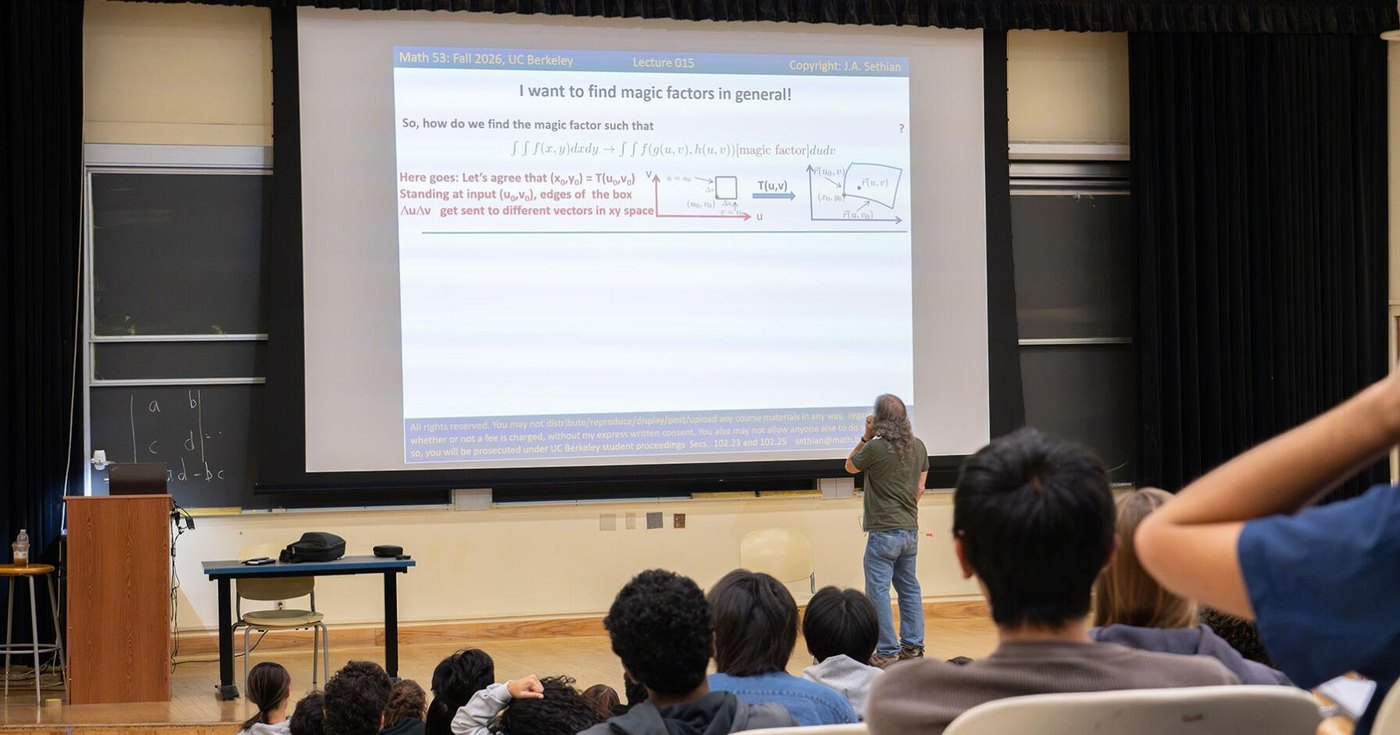
Under this instructional framework, enrolled students secure full homework credit simply by turning in their papers before the deadline arrives. The system avoids inspecting derivations, numerical accuracy, or whether the solutions originated from human logic or automated systems. Borcherds adopted this completion mechanism because separating genuine student deductions from software assistance became impossible once algorithmic tools consistently produced top-level assignments. While this allows students to submit coursework without penalty, it marks an explicit departure from historical grading rubrics that penalized logical flaws.
At the administrative level, UC Berkeley manages these disruptions through distributed faculty governance rather than centralized rules. Anne Marie Richard, assistant vice provost for undergraduate education and chief academic technology officer, confirmed that the Berkeley Division of the Academic Senate asks faculty members to include explicit course expectations regarding artificial intelligence usage in syllabi. To guide instructional staff, campus administrators maintain the AI Hub, a centralized directory providing training, policy resources, and a growing database of sample syllabus statements tailored across academic departments.
Advertisement
Tech Pulse Daily
Get tomorrow's pulse first
Join engineers who read Tech Pulse before stand-up. Free, weekday mornings.
AI use leads UC Berkeley math professor: why it matters now
The timing of this grading shift aligns with breakthrough developments in autonomous mathematical reasoning. OpenAI recently announced that artificial intelligence agents apparently solved the Navier-Stokes existence and smoothness problem, addressing one of the most prominent unsolved challenges in mathematics. That development demonstrated that automated systems are tackling profound theoretical questions rather than mere basic calculations. Borcherds warned that if artificial intelligence continues to improve at its present rate, within a few years there will be nothing human mathematicians can do that AI cannot do better.
These rapid milestones have shattered long-standing assumptions regarding career security in theoretical mathematics. Five years ago, working as a mathematician seemed to be one of the safest careers from the rise of artificial intelligence. Borcherds noted that while past technological breakthroughs saw hand weaving put out of business by looms and horses replaced by motor cars, this marks the first time anything comparable has struck mathematics, transforming what was once considered durable analytical human expertise into an automated capability.
AI use leads UC Berkeley math professor: who is affected
This development directly impacts undergraduate mathematics students, academic readers, and aspiring researchers entering the discipline. Students face a learning environment where traditional homework no longer differentiates individual technical aptitude, while departmental readers lose their grading roles as correctness checks disappear. Furthermore, prospective mathematicians confront profound career uncertainty. Borcherds revealed that he no longer knows whether to encourage students to join the math department or what career advice to offer them, noting that even ChatGPT had no idea what would happen when asked.
University instructors and departmental administrators are also affected as they struggle to maintain curriculum integrity across disparate courses. Anne Marie Richard noted that direct campus policies on artificial intelligence use vary dramatically depending on course levels and specific focus areas. Because broad standards do not exist, individual professors must independently establish syllabus guidelines and decide how to evaluate comprehension. Instructors must choose between tolerating ubiquitous tool assistance, switching entirely to high-stakes in-person examinations, or abandoning takeaway problem sets as meaningful evaluation metrics.
AI use leads UC Berkeley math professor: what to watch
Campus oversight will center on the limitations of commercial surveillance software designed to catch machine-generated student submissions. UC Berkeley tested several AI detection tools, including Turnitin and Rumi, but campus leadership determined that these platforms are not adequate enough to be standardized across courses. Without reliable automated detection mechanisms, faculty cannot objectively verify the authenticity of student work. Moving forward, academic institutions must confront the reality that algorithmic text and proof detectors cannot reliably differentiate human analytical thought from sophisticated automated outputs.
Academic observers must also track whether institutional inertia delays structural curriculum reform despite accelerating technological capabilities. Borcherds pointed out a plentiful amount of inertia in the academic system, noting he would not be surprised if departmental practices remained unchanged for a couple years. He compared this institutional reluctance to physical paper journals, which continue publishing even though they have been utterly pointless for two decades, indicating that university mathematics departments may resist fundamental restructuring despite transformative technological shifts.
Developer Action Items
- ☐ Verify the claim on the official OpenAI / Framework page (or Hacker News Best), not from this recap alone.
- ☐ Name the surface that moved — API, policy, model, hardware, or commercial terms — before you Slack the thread.
- ☐ Assign one owner a day to read the primary material and decide: this-sprint, this-quarter, or noise.
- ☐ Do not change production on day-one coverage. Watch the vendor changelog and one independent write-up first.
AI use leads UC Berkeley math professor FAQ
Why did Richard Borcherds stop grading homework for correctness?
Borcherds stopped grading for correctness after seeing many students use artificial intelligence to consistently achieve top scores. Because AI use is unavoidable, he determined there was no point in paying readers to check assignments for accuracy.
How does UC Berkeley currently grade math homework in Borcherds' course?
Borcherds currently awards credit on completion if a student hands in their homework. He acknowledged that while it is not a very good system, he currently has no workable alternative.
Why has UC Berkeley not standardized AI detection tools like Turnitin?
Campus officials tested several detection tools, including Turnitin and Rumi, but determined they were not adequate enough to be standardized across campus. Instead, direct policies on AI usage remain up to the discretion of individual faculty members.
What recent breakthrough prompted discussions about the future of mathematics?
OpenAI announced that AI agents apparently solved the Navier-Stokes existence and smoothness problem, one of mathematics' most difficult unsolved problems. Borcherds noted that if AI continues to improve at this rate, AI will soon do everything human mathematicians do better.
Sources

Author
Dillip Chowdary
Writes Tech Bytes coverage of AI, engineering, and the tools that actually ship. Editor of Tech Pulse Daily.
Related on Tech Bytes
Advertisement