America has lost 200k of jobs in media, film and the arts. How much is AI?
The US creative sector lost over 200,000 jobs in four years as Hollywood shed nearly a third of its workforce and publishing cut 70,000 positions.
By Dillip Chowdary • Oct 25, 2026 • Source: apricitas.io
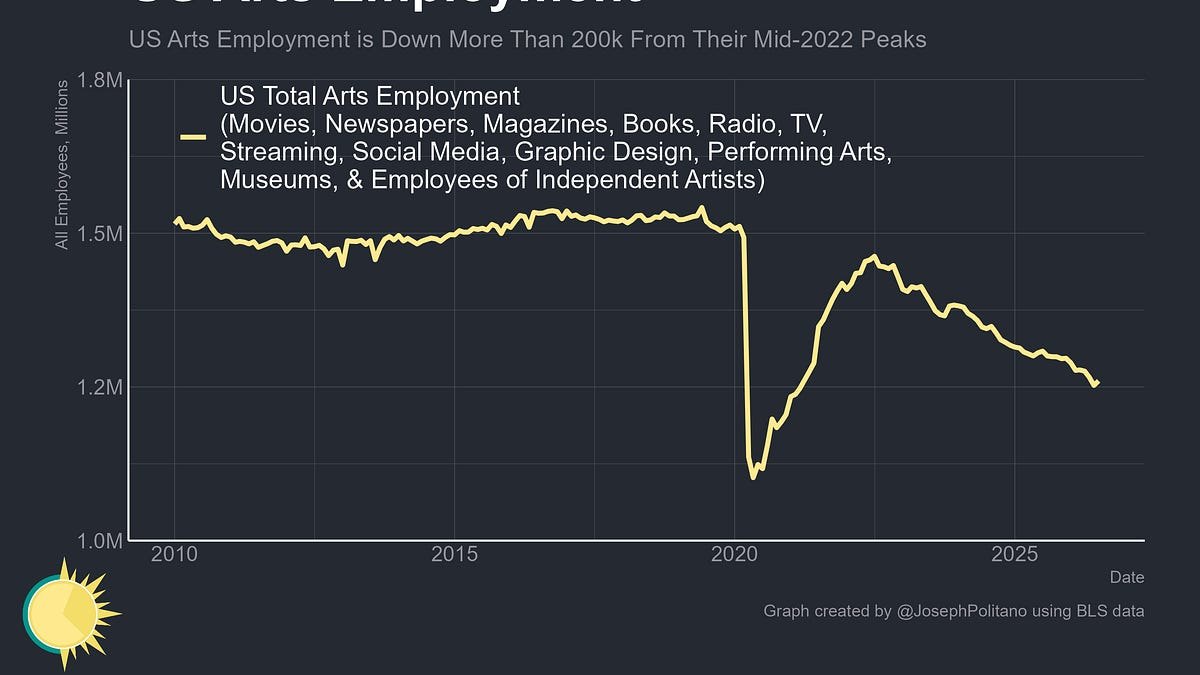
Economic analysis from Joseph Politano detailed in apricitas.io's report documents that the United States creative sector has lost over 200,000 jobs across the past four years, including roughly 50,000 positions eliminated in the last year alone. The downturn matches the severity and duration of the 2001 and 2008 recessions, despite no broad economic recession today. Instead, the persistent job loss coincides with generative artificial intelligence systems producing novels, digital imagery, audio, and art en masse at extremely low operating costs.
This report analyzes the forces driving headcount reductions across film, sound recording, publishing, and digital media, highlighting historical parallels between prior internet disruptions and generative models. The analysis provides crucial context for creative professionals, studio managers, and industry researchers tracking how automated tooling and platform fragmentation reshape creative labor. While in-person live entertainment continues expanding at a healthy pace, digital creative professions face a sustained contraction that challenges their traditional commercial business models.
America has lost 200k of jobs in media: what actually changed
The employment decline across creative industries marks one of the worst contractions in modern American history, mirroring downturns previously observed only during severe recessions. Over the past four years, losses exceeded 200,000 positions, with movie and sound recording absorbing nearly half that total. Film and television payrolls shed more than 100,000 jobs, representing nearly one-third of the sector. At this summer's low, film employment dropped below any level recorded since the 2008 recession, touching a thirty-year nadir.
Written publishing represents the second largest source of attrition, shedding more than 70,000 jobs across the same four-year span. Unlike prior cyclical declines caused by broad macroeconomic weakness, these cuts occurred alongside wider economic stability. Digital creative fields including live broadcasting, streaming, and graphic design have entered unusual contractions after years of relative peace. Meanwhile, in-person live entertainment continues expanding steadily, proving that recent layoffs are concentrated entirely in digital, reproducible creative formats vulnerable to automated synthesis.
America has lost 200k of jobs in media: how it works
The structural collapse mirrors the internet disruption that transformed the music industry around the turn of the millennium. When peer-to-peer network Napster distributed unreleased songs and $15 album rips for free, Metallica and the Recording Industry Association of America sued for copyright infringement. Although the music industry won in court and forced Napster into bankruptcy, copyright enforcement could not halt digital file-sharing across the web. The per-song value dropped until Spotify and Apple Music consolidated catalogs into cheap subscription packages.
Musicians survived that transition by treating recorded albums as loss-leading promotions for lucrative concert tours, larger venues, and merchandise. Video entertainment enjoys no comparable live revenue cushion. Hollywood historically transitioned from movie theaters into broadcast, cable, and physical media, expanding watch time at each technological step. In the streaming era, that model has broken down. Last year, box office sales remained 25 percent below their 2019 peak, cable revenues fell 18 percent, and streaming gains failed to offset the gap.
Advertisement
Tech Pulse Daily
Get tomorrow's pulse first
Join engineers who read Tech Pulse before stand-up. Free, weekday mornings.
America has lost 200k of jobs in media: why it matters now
Media organizations face mounting strain as audiences shift attention toward YouTube, Twitch, TikTok, and social media platforms distributing vast amounts of free user-generated content. Generative AI tools have intensified this rivalry by flooding distribution channels with cheap synthetic text, imagery, and audio. With traditional streaming models failing to recover lost box office and cable earnings, entertainment studios face reduced margins. These financial headwinds prevent production budgets from expanding, prompting entertainment executives to cancel projects and freeze creative hiring.
This transformation resembles the decline of American print journalism following the initial spread of search engines and websites. Newspapers once employed roughly half a million domestic workers, exceeding total payrolls across the entire oil industry. Digital unbundling systematically stripped away their core offerings: sports scores moved to athletic sites, stock tickers went to financial portals, and forecasts migrated to weather sites. As ad revenue collapsed, newspaper payrolls fell nearly 85 percent, while magazine employment declined 66 percent and book publishing dropped 40 percent.
America has lost 200k of jobs in media: who is affected
The workforce fallout centers directly on creative personnel whose production work can be replicated or accelerated through software. Animators, graphic designers, sound editors, and broadcast technicians face fewer career opportunities as studios enforce strict operational cutbacks. Media companies remain publicly coy about their internal AI deployments to prevent audience backlash and defend copyright claims over their assets. Concurrently, studio consolidation in Hollywood and the offshoring of production labor have compounded job losses, leaving specialists competing for diminishing domestic opportunities.
Mid-tier creatives and independent freelancers face intense pressure from automated tools and shifting algorithmic distribution. Just as the music industry's streaming model rewarded stadium acts while penalizing mid-sized artists suited for home listening, video platforms increasingly reward high-volume, low-cost synthetic media flows. Freelancers and production staff across commercial art, writing, and video editing must now navigate an ecosystem where generative models produce acceptable assets for pennies, exerting continuous downward pressure on freelance rates and entry-level positions.
America has lost 200k of jobs in media: what to watch
Employment numbers across the creative economy show no signs of recovery. National media losses continue hovering near 50,000 jobs each year and have accelerated during recent months. Industry watchers must monitor whether film and sound recording employment recovers from thirty-year lows or whether studios permanently automate tasks like storyboard illustration, background design, and voice synthesis. The resolution of intellectual property disputes regarding model training data will also determine how much legal leverage traditional creators retain against autonomous generation.
Another crucial trend involves whether traditional media firms can develop viable business models beyond advertising and flat-rate streaming subscriptions. If entertainment follows the trajectory of newspapers, where digital disruption permanently eliminated 85 percent of payrolls, creative sectors could see permanent displacement rather than a cyclical rebound. Labor negotiations, platform licensing agreements, and the continued divergence between flourishing live entertainment and struggling digital media will indicate whether creative employment can find a stable floor in an automated era.
Developer Action Items
- ☐ Verify the claim on the official Apple page (or Hacker News Best), not from this recap alone.
- ☐ Name the surface that moved — API, policy, model, hardware, or commercial terms — before you Slack the thread.
- ☐ Assign one owner a day to read the primary material and decide: this-sprint, this-quarter, or noise.
- ☐ Do not change production on day-one coverage. Watch the vendor changelog and one independent write-up first.
America has lost 200k of jobs in media FAQ
How many creative jobs has the United States lost over the past four years?
The US creative sector has lost more than 200,000 jobs in four years, including roughly 50,000 in the last year alone. Movie and sound recording accounted for more than 100,000 positions, while written publishing lost over 70,000.
Why are movie and television studios suffering worse job losses than the music industry?
Unlike musicians who rely on live concerts, larger venues, and merchandise to offset streaming losses, Hollywood has no equivalent live performance mechanism. Movie ticket sales remain down 25 percent from 2019, cable revenues are down 18 percent, and streaming gains have failed to bridge the gap.
How severe was the employment contraction in traditional print publishing?
US newspaper employment dropped by nearly 85 percent from a peak of approximately 500,000 workers as web portals unbundled content. Over the same timeframe, magazine publishers eliminated 66 percent of their staff and book publishers reduced payrolls by 40 percent.
Why do media companies avoid publicizing their use of generative AI?
Media companies remain coy about using artificial intelligence to avoid customer backlash and to maintain the legal defensibility of their copyrights.
Sources

Author
Dillip Chowdary
Writes Tech Bytes coverage of AI, engineering, and the tools that actually ship. Editor of Tech Pulse Daily.
Related on Tech Bytes
Advertisement