Anthropic shares tank after IPO as the Nasdaq erases 2026 gains
Anthropic shares fell 9% a day after its IPO as the Nasdaq dropped 5.3% to erase 2026 gains amid an accounting probe at Nvidia and hawkish Fed signals.
In short
401(k) holders, pension funds, and equity investors · 9% Anthropic drop and 5.3% Nasdaq decline · Public stock exchanges and US Treasury debt · Shift capital into US Treasury bonds
By Dillip Chowdary • Nov 21, 2026 • Source: nbcnews.com
At a glance
- Who it is for
- 401(k) holders, pension funds, and equity investors
- The number
- 9% Anthropic drop and 5.3% Nasdaq decline
- Available
- Public stock exchanges and US Treasury debt
- What to do
- Shift capital into US Treasury bonds
- Market sector
- Technology equities and AI chip suppliers
- Reporting date
- November 20, 2026
Anthropic saw its newly listed public shares tumble 9% on November 20, 2026, just 24 hours after its public market debut, according to nbcnews.com's report.
This report is for public equity investors, corporate finance teams, and retirement account holders tracking artificial intelligence market valuations. Market participants should assess their exposure to volatile technology equities while monitoring upcoming regulatory developments across major semiconductor suppliers.
01Friday tech selloff and index drops
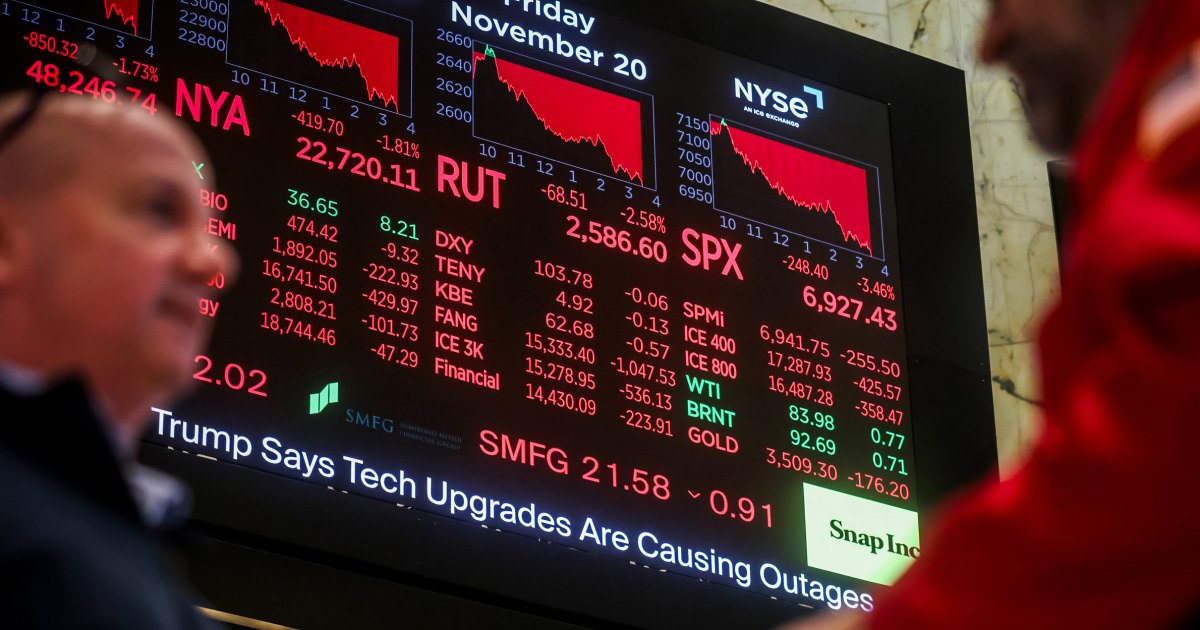
The sharp drop in Anthropic equity erased hundreds of billions of dollars in paper wealth and left shares trading just a few dollars above their initial public offering price. The plunge pulled the Nasdaq Composite down 5.3%, wiping out the index's accumulated gains across 2026 as artificial intelligence valuations contracted.
| Asset or Index | Friday Change | Market Context |
|---|---|---|
| Anthropic | -9.0% | Shares trade just above IPO price |
| Nvidia | -14.0% | Hit by regulatory accounting probe |
| Nasdaq Composite | -5.3% | Erased all gains for 2026 |
| S&P 500 | -3.7% | Worst seven-day streak since Covid |
| Dow Jones Industrial | -1.9% | Entered ten percent correction territory |
The benchmark S&P 500 fell 3.7% on Friday, extending its losing streak to seven consecutive trading sessions, which marks its worst sustained downward run since the coronavirus pandemic. Following the decline, the broad index remained up by less than 1% across the entirety of 2026.
Note: Both the S&P 500 and the Dow Jones Industrial Average entered formal correction territory on Friday, defined by Wall Street as a decline of at least 10% from recent peak levels. The simultaneous downturn followed weeks of escalating selling pressure across broader equity markets.
02Macroeconomic pressures and election fallout
The Friday market decline capped a weekslong retreat that began in early October rather than emerging unexpectedly. Stock prices faced persistent downward pressure from elevated crude oil prices, mounting corporate debt loads, persistent inflation, supply chain bottlenecks, and weakening consumer spending across the broader economy.
Political developments in Washington accelerated selling earlier in the month following midterm election victories secured by Democratic candidates. Market participants feared that shifted legislative priorities would slow the pace of capital deployment for massive data center buildouts that had previously supported high-growth tech valuations.
The losses challenged a visible economic bright point for President Donald Trump during his second presidential term. While persistent inflation and frozen housing and employment sectors constrained economic momentum, artificial intelligence equity demand had previously minted multiple trillion-dollar enterprises that supported broader domestic stock indices.
Advertisement
Tech Pulse Daily
Get tomorrow's pulse first
Join engineers who read Tech Pulse before stand-up. Free, weekday mornings.
03Hardware investigations and AI repricing
Semiconductor manufacturer Nvidia accelerated the market retreat after its shares tumbled 14% during Friday's trading session. The steep drop followed a Reuters report indicating that regulatory agencies are reviewing potential accounting irregularities at the chipmaker, destabilizing confidence across the hardware supply chain.
Market pressure compounded following an emerging controversy involving former Nvidia chief executive officer Jensen Huang and the potential diversion of advanced artificial intelligence processors to China. Market participants viewed the executive controversy and trade compliance scrutiny as a direct threat to ongoing semiconductor export revenues.
Richard Saperstein, chief investment officer at Treasury Partners, stated in a client note that equities are undergoing an artificial intelligence repricing driven by slowing data center buildouts and decelerating tech earnings growth. Saperstein characterized the Nvidia regulatory inquiry and Democratic midterm election victories as a combined blow to market momentum.
04Treasury bond shift and retirement accounts
Investors responded to the equity rout by increasing purchases of United States Treasury bonds to secure dependable yields amid economic uncertainty. Deutsche Bank managing director Jim Reid noted in a client communication that selling pressure has become increasingly widespread, extending beyond technology equities into other major global asset classes.
The downturn across equity indices created immediate financial strain for American households relying on 401(k) retirement accounts and pension funds. Paper wealth losses arrived at a difficult juncture, as stubborn inflation continued to elevate household living expenses while equity balances that previously offset rising costs retreated sharply.
Capital flows shifted rapidly toward fixed-income assets as institutional managers reacted to signs of slowing global economic growth and a stalling economy in China. Higher borrowing costs diminished risk appetite, prompting investors to prioritize capital preservation over speculative growth stocks that had dominated market volume throughout the year.
05Federal Reserve policy and growth risks
Kevin Gordon, head of macroeconomic strategy and research at Charles Schwab, noted that financial markets face intense pressure from an increasingly hawkish Federal Reserve. Central bank officials have signaled aggressive interest rate hikes to combat persistent inflation, compounding the headwinds created by a weeks-long downturn in technology equities.
Gordon warned that an extended downturn could begin to cut more deeply into overall domestic economic growth if market weakness continues. He noted that a protracted contraction comparable to the 2007 through 2009 financial crisis would represent an unprecedented shock for an economy that has avoided extended multi-year downturns.
Market observers are monitoring whether enterprise software and hardware valuations can stabilize under higher interest rates and slower data center expansion. Technology companies face an operating climate where capital expenditure discipline and verifiable earnings growth will dictate stock performance rather than speculative expectations surrounding artificial intelligence adoption.
Frequently asked questions
Why did Anthropic shares fall after the IPO?
Anthropic stock declined 9% just 24 hours after its public debut amid a broader tech sell-off, leaving shares a few dollars above the IPO price.
How much did the major stock indexes decline?
The Nasdaq fell 5.3% to erase its 2026 gains, the S&P 500 dropped 3.7% in a seven-day losing streak, and the Dow declined 1.9%.
Why did Nvidia stock tumble 14% on Friday?
Nvidia shares tumbled after a Reuters report revealed regulators are investigating accounting irregularities at the company, alongside scrutiny over chip diversions to China involving former CEO Jensen Huang.
What macroeconomic factors contributed to the market correction?
The downturn was driven by elevated oil prices, persistent inflation, rising interest rates, corporate debt loads, and fears of slower data center buildouts after Democratic midterm election wins.
Sources

Author
Dillip Chowdary
Writes Tech Bytes coverage of AI, engineering, and the tools that actually ship. Editor of Tech Pulse Daily.
Related on Tech Bytes
Advertisement