Anthropic update unifies memory feature across Claude Cowork and chat
Anthropic has announced a new update to how memory works between Claude Cowork and chat. Anthropic update unifies memory feature across Claude Cowork and chat
By Dillip Chowdary • Aug 25, 2026 • Source: 9to5Mac
What happened
Anthropic has announced an update to Claude that unifies how memory works across Claude Cowork and its standard chat interface. The change means that context, preferences, and information the model retains in one environment will now carry over to the other, rather than each product maintaining a separate memory store.
This piece breaks down what the unification actually involves, which users and developers are most directly affected, and what questions remain open for builders who rely on either surface. If you use Claude Cowork for collaborative or work-focused tasks alongside Claude's general chat for everyday queries, this update applies to you.
Anthropic announced that memory is now unified between Claude Cowork and Claude chat. Previously the two products operated with independent memory systems, meaning anything Claude learned or stored in a Cowork session did not carry into a chat session and vice versa. The company has not attached a version number to this change, but it is framed as a product update rather than a model release. The announcement came via 9to5Mac, with Anthropic as the originating source. No pricing change or subscription tier restructuring was mentioned alongside this announcement.
How it works
The framing of the update suggests it is infrastructure-level rather than a new capability. Anthropic is not adding memory where it did not exist before; it is connecting two memory systems that were previously siloed. This is a meaningful distinction because it tells developers and users that the underlying memory mechanism predates this change — what changed is where its scope ends.
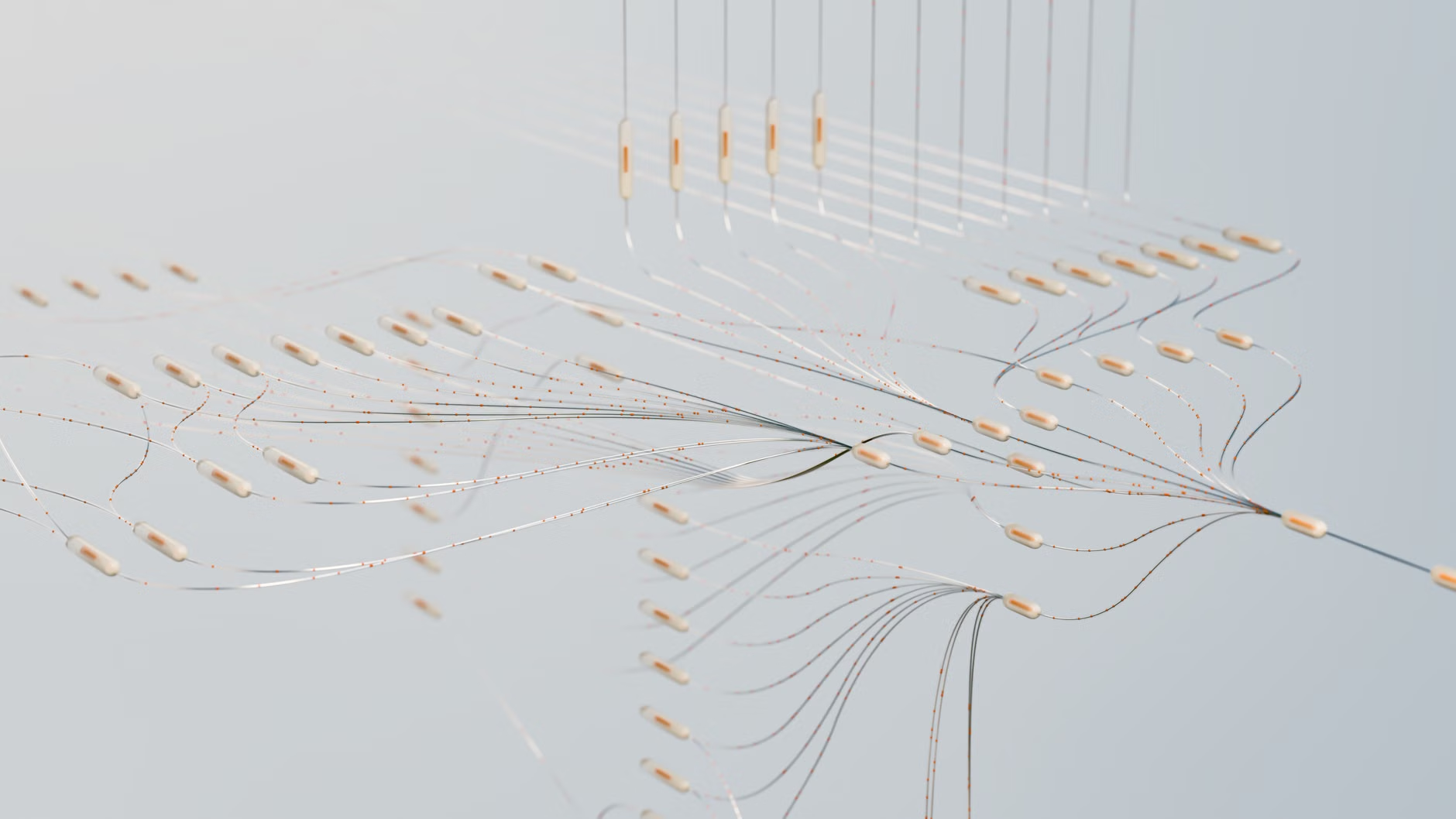
Before this update, Claude maintained separate memory contexts depending on which product surface you were using. A preference you stated in Claude chat, or a project detail Claude stored in Cowork, stayed within that environment. Now those two stores are merged into a single unified memory layer accessible from both interfaces. When you switch between Cowork and chat, Claude should recall the same information regardless of where it was originally captured.
Why it matters
Advertisement
Tech Pulse Daily
Get tomorrow's pulse first
Join engineers who read Tech Pulse before stand-up. Free, weekday mornings.
The technical implication is that the memory write and read operations no longer check which product surface is active before deciding what context to surface. If you told Claude your preferred coding language in a Cowork session, it can now apply that preference when you open a standard chat thread. The inverse is also true. Builders testing integrations that depend on session isolation should verify that assumption still holds, since the boundary between Cowork and chat memory is now intentionally dissolved.
Anyone who actively uses both Claude Cowork and Claude chat will notice this change most immediately, particularly users who previously found themselves re-explaining context every time they switched surfaces. The benefit compounds with usage: the more Claude has retained across either interface, the more coherent the cross-surface experience becomes from day one of the unified memory being active.
Developers building on top of Anthropic's products should audit any workflows that depended on the two surfaces being memory-isolated. If a tool or integration was designed to keep Cowork sessions separate from chat context as a feature of how the product worked, that separation no longer exists by default. It is worth verifying whether any user-facing behavior, data handling assumptions, or context boundaries in existing builds need to be updated to reflect the new unified model.
Who is affected
Anthropic has not specified a staged rollout or regional restriction in the available announcement details, so the update appears to apply broadly to users with access to both Claude Cowork and Claude chat. No additional steps are described for activating the unified memory — it is framed as a change that takes effect at the product level rather than a setting users must toggle on.
To verify the change is active on your account, the most direct test is to establish a piece of context in one surface and then switch to the other to see whether Claude recalls it without prompting. Because Anthropic did not specify a date for when memory entries created before the announcement become part of the unified pool, it is worth testing with both older stored context and newly created context to understand what is already bridged and what may require fresh input.
What to watch next
The main open question is whether Anthropic will give users explicit visibility into what is stored in the unified memory layer and whether granular controls will follow. Memory unification raises legitimate questions about user agency — specifically, whether someone can delete or partition context that they want to keep separate between Cowork and chat. Anthropic has not addressed those controls in the current announcement, so that is the space to monitor in follow-up releases.
A secondary thing to track is how the unified memory interacts with any API or developer-facing surface. If memory state can now be read across Cowork and chat at the product level, the question of whether that state is also accessible or manageable via API becomes relevant for teams building on Claude. No details on that front have been released alongside this update, making it an open item for developers to watch through Anthropic's documentation and changelog channels.
Developer Action Items
- ☐ Verify the claim on the official Anthropic / Claude page (or 9to5Mac), not from this recap alone.
- ☐ Name the surface that moved — API, policy, model, hardware, or commercial terms — before you Slack the thread.
- ☐ Assign one owner a day to read the primary material and decide: this-sprint, this-quarter, or noise.
- ☐ Do not change production on day-one coverage. Watch the vendor changelog and one independent write-up first.
Advertisement
🔎 More interesting news
- Aug 25, 2026 Announcements Funding better evaluations of AI’s impact on wellbeing
- Perplexity Launches Portable Computer Agent Optimized for Nvidia DGX Spark
- Apple just revealed two ways iPhone 18 Pro could get big upgrades
- New Mac mini and more now available from Amazon for launch day pre-order
- Today's full Tech Pulse briefing →