Apple HomeView launches tomorrow, but its first security update is already
Apple released HomeView Software Version 27.2 build 24V526 to patch nine security vulnerabilities before the new smart home device reaches buyers tomorrow.
By Dillip Chowdary • Nov 14, 2026 • Source: 9to5Mac
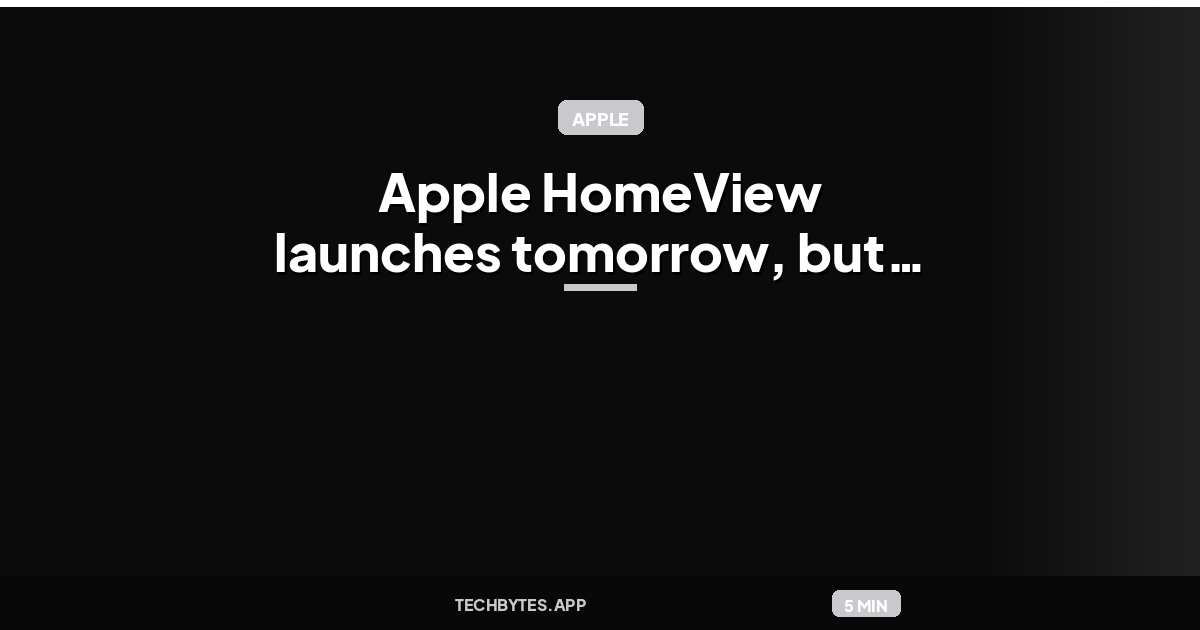
Apple launched HomeView Software Version 27.2 build 24V526 on November 12, 2026, delivering an essential day-zero security update for its newest connected home display. The release arrives one day before the first physical units reach consumer doorsteps on November 13, resolving nine security vulnerabilities that Apple previously patched across its ecosystem. According to 9to5Mac's report, the update fixes flaws in Messages, Bluetooth, CoreUtils, App Intents, and AirPlay.
This technical breakdown covers the complete vulnerability register, architectural improvements, and onboarding requirements for early adopters and smart home developers. Because Apple publicly disclosed the underlying vulnerabilities alongside parallel operating system builds, deploying a HomeView display requires immediate software remediation. Engineers and device administrators will find verified vulnerability details, system behaviors, and firmware timelines documented below.
01What Apple HomeView shipped
Apple packaged nine targeted vulnerability remediations into the HomeView Software Version 27.2 release. The update synchronizes the new hardware line with security improvements recently introduced in iOS 27.2, macOS 27.2 Golden Gate, and iPadOS 27.2. By deploying build 24V526 ahead of customer deliveries, Apple addressed public flaws in local wireless protocols and messaging subsystems.
The most severe flaws resolved in the package target communications security, process memory, and peripheral pairing mechanics. Left unpatched, attackers within physical wireless proximity could force unauthenticated pairings or corrupt process memory through malformed exchanges. Additionally, subsystem repairs span the brotli decompression engine under CVE-2026-111497, resolving an out-of-bounds write flaw with hardened input validation.
02What changed for builders in Apple HomeView
For system builders and platform integrators, the update resolves critical security oversights in App Intents and messaging infrastructure. Under App Intents vulnerability CVE-2026-113963, identified by independent researcher László Várady, an application could access sensitive user data due to deficient authorization management. Version 27.2 introduces revised authorization logic and strict state validation to block unauthorized data access.
The messaging subsystem received two distinct security repairs credited to an anonymous researcher. Under CVE-2026-113961, an authorization flaw allowed remote adversaries to join existing iMessage group chats and intercept incoming messages. Meanwhile, CVE-2026-113960 permitted newly added group participants to view message history sent prior to their arrival, which Apple remediated by excising vulnerable code.
| Component | CVE Identifier | Pre-Update Flaw and Impact | Version 27.2 Resolution |
|---|---|---|---|
| AirPlay | CVE-2026-113968 | Wireless rate limit bypass on pairing attempts | Improved state management logic |
| App Intents | CVE-2026-113963 | Unauthorized app access to sensitive user data | Improved state authorization checks |
| Bluetooth | CVE-2026-113970 | Use-after-free process memory corruption | Improved kernel memory management |
| brotli | CVE-2026-111497 | Out-of-bounds write memory corruption | Improved input validation routines |
| CoreUtils | CVE-2026-113965 | Malicious pairing without user interaction | Improved connection verification |
| CoreUtils | CVE-2026-113964 | Pairing code brute force and zero-click link | Improved state management logic |
| Messages | CVE-2026-113961 | Remote attacker joining private group chats | Improved authorization validation |
| Messages | CVE-2026-113960 | Access to message history sent before joining | Removed vulnerable code routines |
| rapportd | CVE-2026-113969 | Network rate limit bypass for AirPlay codes | Improved state management logic |
03How to install or upgrade Apple HomeView
Advertisement
Tech Pulse Daily
Get tomorrow's pulse first
Join engineers who read Tech Pulse before stand-up. Free, weekday mornings.
Customers receiving the initial hardware shipments starting tomorrow must prioritize installing firmware build 24V526 immediately upon unboxing. Because details of these nine vulnerabilities are now publicly indexed, leaving hardware on factory baseline code exposes local networks to opportunistic radio exploitation. Network administrators and household users should verify that the display completes its update routine before linking personal Apple accounts.
Upgrading the device proceeds through the initial setup assistant or by navigating directly to system settings on the local touch display. When connected to Wi-Fi, the setup client queries the update server, retrieves build 24V526, and replaces the vulnerable factory operating system image. The device reboots automatically to finalize component validation across internal networking daemons and application containers.
Target Firmware: HomeView Software Version 27.2
Release Build: 24V526
Ecosystem Alignment: iOS 27.2, macOS 27.2 Golden Gate, iPadOS 27.2
Deployment Priority: Mandatory day-zero installation
Deploying updates promptly guarantees that all CoreUtils and AirPlay services apply hardened authorization checks before pairing secondary household devices. System administrators managing fleets of smart displays can verify the successful installation of build 24V526 in the device information panel. Completing this installation step eliminates legacy vulnerabilities before smart home automations begin broadcasting across local subnets.
04Gotchas and compatibility in Apple HomeView
A significant operational hazard on unpatched devices stems from CoreUtils vulnerability CVE-2026-113965, discovered internally by Apple. A malicious Bluetooth device operating within local radio range could establish an unauthorized pairing link without user interaction. Left unaddressed, rogue accessories could gain unauthorized bridge access to home telemetry and linked media playback sessions.
A companion vulnerability, designated CVE-2026-113964 and reported by an anonymous researcher, allowed adversaries in physical proximity to bypass pairing code rate limits. By circumventing throttling boundaries, an attacker could brute-force pairing codes and complete silent device pairings. In parallel, CVE-2026-113970 exposed the Bluetooth stack to memory corruption via use-after-free conditions, which Apple repaired through revised memory allocation.
Local network exposure also extended to AirPlay and the rapportd daemon under CVE-2026-113968 and CVE-2026-113969. Attackers sharing a local Wi-Fi subnet or operating within Bluetooth distance could bypass pairing verification rate limits on Apple HomeView. Installing Version 27.2 resolves these interaction vulnerabilities by imposing strict state validation across all background connectivity services.
05What to watch after Apple HomeView
Despite shipping comprehensive day-zero security patches, Apple confirmed that a significant functional limitation remains active on initial HomeView units. The device's embedded Siri AI currently refuses to process voice requests to unlock entry doors or open connected garage doors. This deliberate limitation temporarily restricts hands-free access control across the smart home ecosystem during the initial product launch window.
Apple officially confirmed that an upcoming software update scheduled for release next month will introduce voice command support for security accessories. This forthcoming update will enable Siri AI to communicate securely with smart locks and garage openers after completing secondary verification. Until that feature release ships, users must continue operating door locks and garage doors manually through certified interface screens.
Apple HomeView FAQ
What vulnerabilities does HomeView Software Version 27.2 fix?
The update patches nine disclosed security flaws across AirPlay, App Intents, Bluetooth, brotli, CoreUtils, Messages, and rapportd. These include unauthorized Bluetooth pairing and a remote exploit allowing attackers to join private iMessage group chats.
When do Apple HomeView units reach customers?
The first customer deliveries begin tomorrow, November 13, 2026, following the release of the day-zero software update. Owners are advised to apply HomeView Software Version 27.2 immediately during initial setup.
Why does Siri AI on Apple HomeView refuse to unlock doors?
Voice-activated door locks and garage door controls are currently disabled in Siri AI on Apple HomeView. Apple confirmed that an upcoming software update scheduled for next month will add support for these security accessories.
Which other Apple operating systems share these security patches?
The security fixes in HomeView build 24V526 match remediations shipped in iOS 27.2, macOS 27.2 Golden Gate, and iPadOS 27.2. These shared fixes address common framework vulnerabilities in CoreUtils, Messages, and networking daemons.
Sources

Author
Dillip Chowdary
Writes Tech Bytes coverage of AI, engineering, and the tools that actually ship. Editor of Tech Pulse Daily.
Related on Tech Bytes
Advertisement