Apple launches new app to study how people use AI for health
Apple launched a research app with OpenEvidence to study clinical health AI among 200,000 U.S. Apple launches new app to study how people use AI for health
By Dillip Chowdary • Nov 16, 2026 • Source: TechCrunch
At a glance
- Partner
- OpenEvidence
- Target cohort
- Up to 200,000 U.S. participants
- Device requirements
- iPhone 15 or later with Apple Intelligence
- Operating system
- iOS 26 or later
- Study duration
- More than 12 months
- Data retention
- 24-hour cloud deletion by OpenEvidence
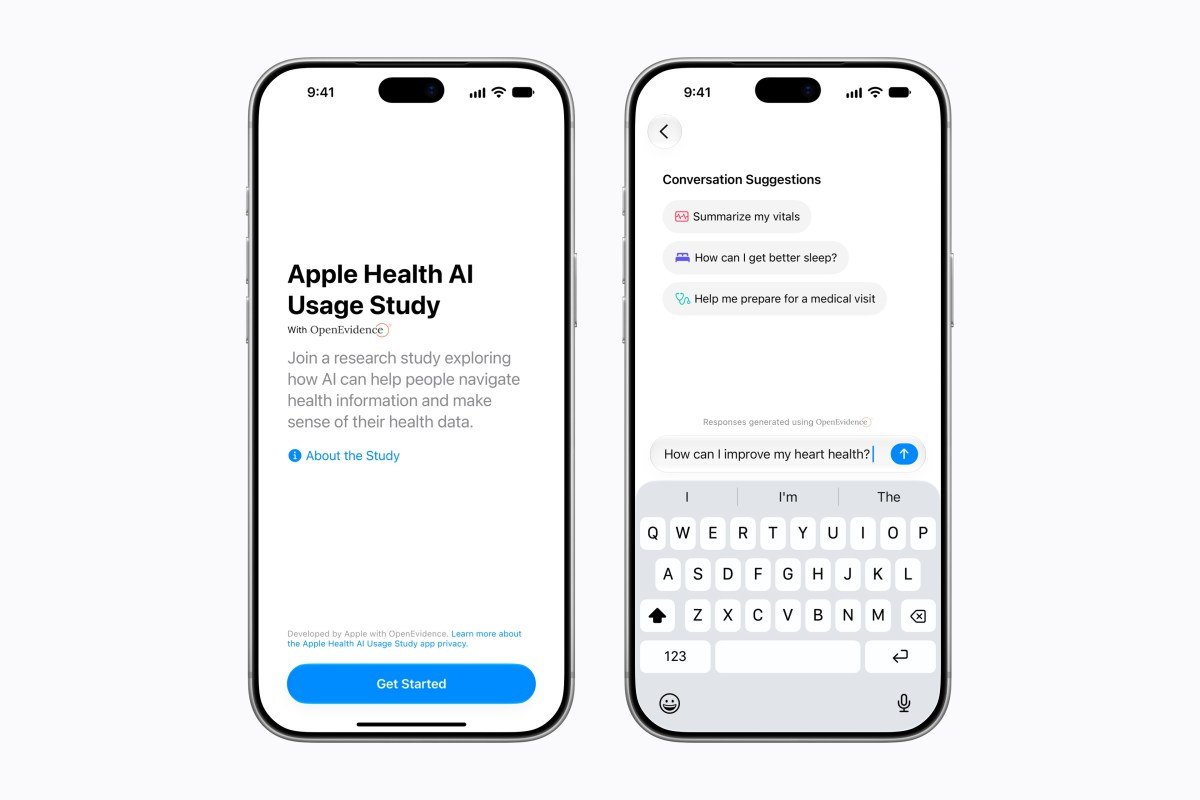
Apple has launched a dedicated research study application developed in partnership with healthcare artificial intelligence company OpenEvidence to evaluate how people interact with clinical artificial intelligence. Rather than deploying an unvetted chatbot directly into system software, Apple is testing how medically validated guidance assists users, as detailed in TechCrunch's report. The initiative measures participant comprehension when presented with simplified, clinically grounded medical answers.
This report breaks down the technical requirements for participants, the underlying medical literature sources, personal health data integration, and strict cloud privacy controls governing the project. It is intended for software engineers, digital health researchers, and iPhone users tracking the convergence of clinical informatics and consumer devices. The analysis examines how Apple structures large-scale clinical trials before introducing health capabilities into core operating systems.
01OpenEvidence partnership and clinical research focus
While competing technology providers such as OpenAI and Anthropic have deployed consumer chatbots with specialized medical features, Apple is taking an investigative path focused on medical validation. The company teamed up with healthcare artificial intelligence firm OpenEvidence to design a dedicated experimental application. Instead of competing immediately with commercial conversational tools, the collaboration seeks to study whether responses rooted directly in clinical data meaningfully help people.
Consumer demand for digital medical guidance has surged across commercial platforms, with OpenAI stating earlier this year that users submit over 300 million health-related queries each week. Apple is refraining from immediate consumer-facing integration across its ecosystem, opting first to observe how non-specialist users interact with automated clinical summaries. The organization aims to determine whether everyday users can accurately interpret synthetic medical communication without drawing misleading conclusions.
Sumbul Desai, M.D., Apple’s vice president of Health and Fitness, stated that responsible innovation starts with scientific rigor and clinical grounding. Desai noted that health is deeply personal, calling a dedicated research study the most thoughtful way to understand how people engage with, comprehend, and evaluate health AI in everyday life. She added that insights from the study will advance the broader scientific conversation and ensure the development of trusted tools.
02Strict hardware criteria and enrollment targets
Apple has established a targeted participant intake window, opening enrollment exclusively to adults aged 21 and older residing within the United States. Prospective subjects must possess an iPhone 15 or newer device running iOS 26 or later versions, alongside an active configuration of Apple Intelligence. These technical constraints ensure that every enrolled participant has the necessary on-device capabilities required to interface with the trial software seamlessly.
The trial architecture is engineered to register up to 200,000 active participants over an observation window exceeding 12 months. This extended timeline allows clinical investigators to track conversational patterns, engagement shifts, and the long-term utility of algorithmic medical advice across diverse participant demographics. Maintaining an extended cohort helps researchers distinguish between temporary novelty usage and sustained health management habits.
Advertisement
Tech Pulse Daily
Get tomorrow's pulse first
Join engineers who read Tech Pulse before stand-up. Free, weekday mornings.
Note: The trial software launched today for eligible domestic participants through the App Store, though Apple has not revealed whether these analytical capabilities will eventually arrive within the native Health application or Siri. Access remains strictly restricted to domestic users possessing qualifying silicon and operating systems, leaving global availability and native integration unconfirmed.
03Medical journal grounding and patient feedback
The study application enables participants to ask health-related questions much like standard conversational interfaces powered by ChatGPT or Claude. Rather than relying on generic web scrapes, the system synthesizes answers grounded in clinical data, drawing directly from peer-reviewed publications including Nature, The New England Journal of Medicine, and Journal of the American Medical Association. The platform translates complex clinical findings into simplified answers for everyday medical questions.
Participants are prompted to evaluate each response directly within the application interface by submitting ratings and qualitative feedback regarding response quality. In addition to per-query ratings, enrolled users are asked to participate in regular monthly surveys documenting their ongoing experience and subjective evaluation of the generated guidance. This structured feedback loop provides researchers with longitudinal datasets regarding user satisfaction and comprehension.
04HealthKit record integration and doctor visits
Enrolled users can grant the application selective permission to share biometrics and longitudinal logs stored securely inside HealthKit. Permissible data categories include resting heart rate measurements, daily activity records, sleep tracking, and verified laboratory test results. Connecting these contextual records allows the underlying system to formulate more personalized and pointed suggestions that account for an individual's specific physiological baselines.
Beyond delivering contextualized answers, the platform actively assists participants in preparing better for upcoming doctor visits. When a user queries symptoms that suggest an acute or concerning medical pathology, the software guides them toward specific healthcare providers rather than attempting automated triage. This mechanism prioritizes professional clinical intervention over unassisted self-treatment whenever potentially serious complications arise.
05Data privacy rules and retention limits
To safeguard sensitive patient metrics, Apple anonymizes participant data before transmitting records across network boundaries to a secure third-party cloud provider. The company explicitly mandates that participant communications, biometric metrics, and system responses will never be utilized to train any kind of artificial intelligence models. These safeguards ensure that user health telemetry remains completely isolated from broader model training pipelines.
OpenEvidence enforces strict data lifecycle boundaries on its cloud infrastructure by deleting all user queries and generated response data after exactly 24 hours. This rapid deletion window minimizes the exposure risk associated with cloud-stored personal health inquiries while preserving adequate operational buffers for immediate session continuity. By combining transit-level anonymization with automated daily data purging, the study architecture limits long-term digital footprints.
Frequently asked questions
Who is eligible to join the Apple health study?
Participation is open to United States residents aged 21 and older who own an iPhone 15 or newer running iOS 26 or later with Apple Intelligence enabled.
Which medical sources does the application use for its answers?
The application generates answers grounded in peer-reviewed clinical literature, including Nature, The New England Journal of Medicine, and Journal of the American Medical Association.
How does the app handle personal health data privacy?
User data is anonymized before transmission to a secure third-party cloud provider, never used to train artificial intelligence models, and deleted by OpenEvidence after 24 hours.
Can the application connect to personal Apple Health records?
Participants can optionally share HealthKit metrics such as resting heart rate, activity, sleep, and lab results to receive more tailored health suggestions.
Sources

Author
Dillip Chowdary
Writes Tech Bytes coverage of AI, engineering, and the tools that actually ship. Editor of Tech Pulse Daily.
Related on Tech Bytes
Advertisement