Araceli raises $4.5 million for drug discovery tools aimed at reducing
Araceli Biosciences raised $4.5 million to commercialize automated cell-imaging tools that screen drug candidates on human cells instead of animals.
By Dillip Chowdary • Nov 14, 2026 • Source: GeekWire Startups

Araceli Biosciences secured $4.5 million in fresh capital to commercialize its high-throughput cell-imaging hardware and software for preclinical drug discovery. The Tigard, Oregon-based biotechnology firm develops automated instruments designed to evaluate potential drug candidates on human cells rather than laboratory animals. According to GeekWire Startups's report, the new financing brings the startup's cumulative funding to $22.7 million as it expands its bench-scale screening systems.
This report examines Araceli Biosciences' capitalization, hardware-software capabilities, institutional customer base, and broader alignment with federal preclinical testing initiatives. It is written for laboratory directors, translational scientists, life sciences investors, and biotech instrumentation engineers tracking the commercial adoption of non-animal screening platforms.
01Capital structure and new equity backers
The $4.5 million funding round was led by investor William Cortelyou and drew participation from Fluke Venture Partners, according to investment tracking database PitchBook. The transaction elevates Araceli Biosciences' lifetime equity financing to $22.7 million across its operating history. Company leadership disclosed that the syndicate also secured backing from regional commercial investor and animal welfare advocate Jeff Swickard.
Swickard brings independent capital outside traditional venture firms, maintaining an extensive business footprint that spans 54 automotive dealerships across Western states. His regional portfolio also encompasses commercial real estate assets valued at $250 million across properties situated throughout the greater Portland metropolitan area. His entry into the financing syndicate reflects dedicated support for non-animal preclinical experimental methods.
Araceli Biosciences chief financial officer Shawn MacDonald noted that Swickard's participation reinforces shared operational priorities within the organization. MacDonald stated that Swickard's support reflects a belief that better science and more humane science go hand-in-hand during preclinical drug evaluation. The newly committed equity provides immediate balance-sheet support for the company's 30-person workforce stationed in suburban Oregon.
02Cell imaging platform and automated microscopy
Araceli Biosciences builds integrated instrumentation and proprietary analytical software designed to capture high-resolution imagery of human cellular samples. The company's core platform pairs a specialized automated microscope with automated computer vision tools that extract structural measurements from individual cells. This automation enables researchers to quantify granular cellular features without relying on manual microscopic inspection or analog plate verification.
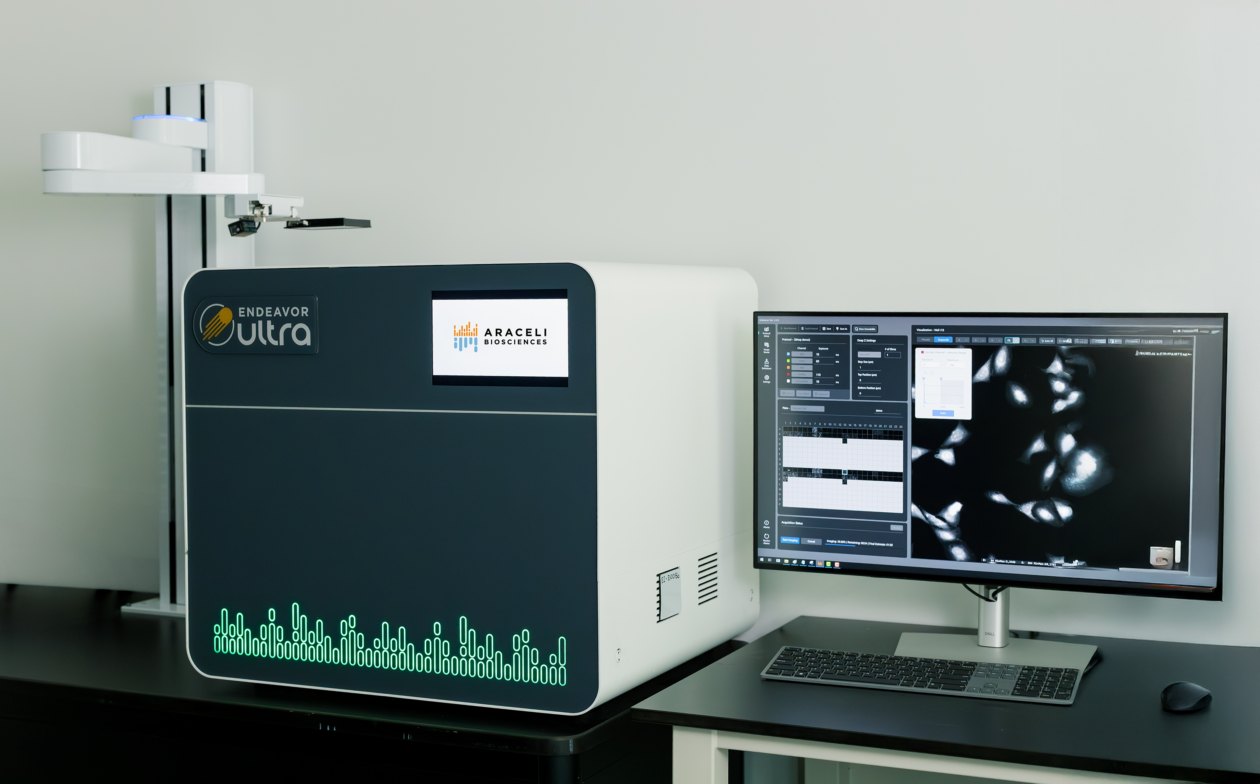
The analytical software calculates multiple morphological parameters, measuring individual cellular dimensions, overall cell shape, and spatial protein location across treated cell populations. Because drug candidates induce distinct phenotypic changes, precise measurement of protein distribution provides crucial data regarding compound toxicity and biological efficacy. The instrument architecture allows screening teams to process and rapidly analyze high volumes of cells in short experimental runs.
By delivering rapid measurements across high-density cell batches, the platform provides actionable pharmacological data directly derived from human cellular responses. Screening prospective therapeutic molecules in human-derived tissues helps laboratory scientists observe cellular tolerance before clinical trial candidate selection occurs. This high-throughput imaging approach generates quantitative metrics on cell health, protein localization, and structural shifts without utilizing live laboratory animals.
Advertisement
Tech Pulse Daily
Get tomorrow's pulse first
Join engineers who read Tech Pulse before stand-up. Free, weekday mornings.
03Commercialization roadmap and product development plans
The company earmarked the $4.5 million in proceeds to accelerate the commercialization of its cellular imaging instruments and associated software licenses. Capital will support market delivery of existing imaging systems while expanding direct technical engagement with pharmaceutical discovery pipelines. Araceli Biosciences aims to scale instrument installations across academic laboratories and commercial drug research facilities seeking reliable non-animal screening assays.
In addition to deploying its current analytical platform, the Tigard-based biotech is funding the development of new product lines for translational laboratories. These emerging product offerings focus on broadening automated assay capabilities that support primary human cell cultures over legacy animal testing workflows. Engineering resources will also refine onboard data processing to accelerate analysis cycles across large screening panels.
Commercial expansion centers around serving life sciences researchers who need validated, reproducible alternatives to traditional mammalian screening protocols. The organization plans to deploy its engineering team to enhance customer integration, field service support, and automated assay routines. Expanding commercial infrastructure ensures discovery teams can install the platform directly into high-throughput compound testing environments without workflow disruption.
04Federal initiative and preclinical validation network
Araceli Biosciences' instruments sit within a broader category known across the life sciences industry as New Approach Methodologies, or NAMs. This classification encompasses advanced human-tissue models, synthetic organ matrices, computer simulations, and artificial intelligence systems designed to minimize or replace animal experimentation. Advocates argue that human-derived testing models produce superior predictive accuracy compared to legacy experiments conducted on mice, rats, and monkeys.
The platform's commercial expansion coincides with significant federal investment into alternative discovery infrastructure. In September, the National Institutes of Health announced $84 million in funding to establish dedicated NAMs research infrastructure across 10 sites nationwide. The NIH stated that the effort signals a significant investment into human-based technologies to make research faster, more predictive, and more directly relevant to human health.
Araceli Biosciences has already embedded its imaging technology across leading international research centers, biotechnology enterprises, and commercial pharmaceutical organizations. Current institutional users include the Max Planck Institute and Evotec in Germany, along with the Wertheim UF Scripps Institute in Florida. Boston-based VALID Therapeutics, synthetic biology specialist Ginkgo Bioworks, and several large pharmaceutical corporations also utilize the company's automated microscopy tools.
05Spinoff heritage and animal testing transition
Araceli Biosciences launched as an independent commercial entity in 2023 through a corporate spinoff from Phoseon Technology. Phoseon manufactures ultraviolet LED units utilized in industrial UV curing processes as well as life sciences illumination systems. The spinoff allowed Araceli Biosciences to repurpose advanced optical expertise toward automated cellular imaging hardware and specialized high-throughput biomedical software.
The company's commercial push addresses long-standing technical liabilities associated with preclinical animal studies in pharmaceutical development. Traditional animal models provide imperfect substitutes for human physiology, frequently generating irrelevant experimental findings that mislead development teams. These translational discrepancies often result in expensive, multi-year drug development programs that subsequently fail to show safety or therapeutic efficacy when administered to human clinical trial subjects.
Advocates of New Approach Methodologies emphasize that transitioning away from mice, rats, and non-human primates provides major ethical and scientific advantages. Replacing whole-animal testing with high-resolution cellular imaging reduces animal experimentation while delivering human-relevant cellular responses. With $22.7 million in cumulative capital, Araceli Biosciences continues scaling its Tigard operations to establish human-based cell analysis as the standard in preclinical discovery.
Araceli $4.5 million for drug discovery tools FAQ
How much funding did Araceli Biosciences raise in this round?
Araceli Biosciences secured $4.5 million in this financing round, led by William Cortelyou and Fluke Venture Partners with participation from Jeff Swickard. The investment increases the company's total equity raised to $22.7 million.
How does Araceli Biosciences' platform replace animal testing?
The platform pairs an automated microscope with software to image human cells and measure physical features such as size, shape, and protein location. Testing candidate drugs directly on human cellular models provides human-relevant safety and efficacy data without testing on mice, rats, or monkeys.
What are New Approach Methodologies in preclinical drug research?
New Approach Methodologies (NAMs) include human-tissue models, computer simulations, and AI-driven systems designed to avoid experimentation on animals. In September, the National Institutes of Health awarded $84 million across 10 national sites to fund research infrastructure for these technologies.
Which institutions currently deploy Araceli Biosciences tools?
Organizations using the platform include Germany's Max Planck Institute and Evotec, Florida's Wertheim UF Scripps Institute, Boston's VALID Therapeutics, Ginkgo Bioworks, and large pharmaceutical firms.
Sources

Author
Dillip Chowdary
Writes Tech Bytes coverage of AI, engineering, and the tools that actually ship. Editor of Tech Pulse Daily.
Related on Tech Bytes
Advertisement