Architecting Governed, Self-Evolving AI Agents on Gemini Agent Platform
Builders moving from conventional static runbooks to Project Chrysalis gain access to autonomous code generation coupled with counterfactual safety checks.
By Dillip Chowdary • Oct 24, 2026 • Source: Google Developers Blog
Google Cloud introduced a research reference architecture codenamed Project Chrysalis on October 22, 2026, designed to deploy governed, self-evolving artificial intelligence agents on the Gemini Enterprise Agent Platform and the Agent Development Kit. According to Google Developers Blog's report, the architecture combines autonomous tool synthesis, serverless counterfactual simulation, and cryptographic policy boundaries to resolve production infrastructure failures in seconds. Authored by Group Product Manager and AI Engineer Anant Nawalgaria, the project demonstrates how automated systems can diagnose distributed failures, hotpatch running API gateways without manual intervention, and permanently reconfigure multi-agent hierarchies while enforcing strict organizational guardrails.
This technical breakdown examines the operational mechanics of Project Chrysalis, detailing how site reliability engineering teams and cloud architects can transition from static runbooks to adaptive multi-agent orchestration. The documentation covers the three underlying research pillars, the four-gate security model that prevents rogue autonomous actions, and the step-by-step incident response observed during simulated Black Friday cache-stampede events. Engineering teams managing distributed microservices on Google Cloud can use these implementation blueprints to eliminate cascading database pool starvation and automate live mitigation workflows safely.
What Architecting Governed shipped
Project Chrysalis ships an operational blueprint integrating Google Cloud Gemini Enterprise Agent Platform, Agent Development Kit, BigQuery, and Memorystore into a closed-loop remediation runtime. Rather than serving purely advisory text or generating unverified pull requests, the system features an autonomous fast-loop triage agent driven by Gemini 4 Argon that diagnoses cross-tier infrastructure bottlenecks in real time. The platform continuously monitors distributed telemetry, generates executable Python middleware patches when native tools are missing, and hot-mounts those scripts directly into the server request path to throttle incoming traffic before backend systems collapse.
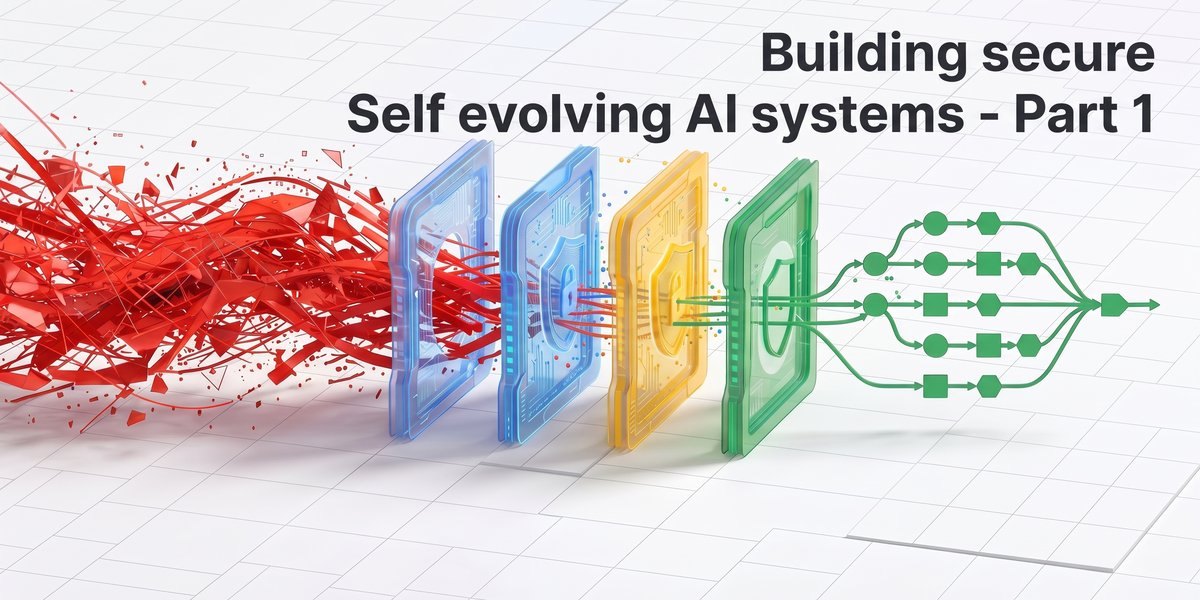
The release also introduces a multi-tier governance stack designed to bound autonomous decisions cryptographically at every step. Incoming alert payloads pass through Model Armor to strip prompt injections and prevent data leakage before reaching reasoning models. Synthesized middleware patches undergo abstract syntax tree validation, cryptographic signing via Google Cloud Key Management Service, and verification through Binary Authorization middleware before runtime execution. Downstream operational policies are enforced by Open Policy Agent Policy Controller, while permanent alterations to agent topologies require Dual-Custody Human-in-the-Loop approval from authorized site reliability engineers.
What changed for builders in Architecting Governed
Builders moving from conventional static runbooks to Project Chrysalis gain access to autonomous code generation coupled with counterfactual safety checks. The architecture unifies three core research pillars: Dream-RSI for serverless counterfactual simulation, APEX for tri-level co-evolution across ephemeral hotpatching, principle distillation, and topology rewiring, and AgentEvolver for step-level Shapley attribution. By offloading request traces into Google BigQuery, the system evaluates hundreds of candidate token-bucket rate-limiting policies in sub-millisecond sweeps to identify optimal configurations offline before modifying production traffic paths.
| Metric | Baseline Outage | Governed Self-Evolving Agent |
|---|---|---|
| Time to First Mitigation | 15 to 45 minutes | 1.8 seconds |
| HTTP 5xx Error Rate | 72.7% to 80.0% | 0.0% |
| P99 Tail Latency | 312.8 to 519.8 ms | 18.2 ms |
| Active DB Connection Pool Saturation | 100% (2/2 locked) | Stabilized |
| Policy Counterfactual Evaluation | Manual testing | ~0.5 ms in BigQuery (400 policies) |
The integration of AgentEvolver changes credit assignment during complex infrastructure incidents. Instead of calculating coarse post-incident rewards that conflate harmful reflexes with effective fixes, the engine measures marginal Shapley credit across discrete execution spans using pre- and post-intervention telemetry. During a live stampede, destructive steps such as restarting saturated database connection pools receive mathematical penalties for spiking latency, while synthesized token-bucket limiters earn positive rewards for clearing HTTP 500 errors.
How to install or upgrade Architecting Governed
Deploying the reference architecture requires configuring the Agent Development Kit runtime environment, authenticating model endpoints, and targeting the Gemini Enterprise Agent Platform infrastructure. Development teams initialize the runtime dependencies by upgrading the core CLI tooling and mounting the necessary agent extensions:
Advertisement
Tech Pulse Daily
Get tomorrow's pulse first
Join engineers who read Tech Pulse before stand-up. Free, weekday mornings.
pip install --upgrade google-cloud-gemini-adkOnce the environment packages are provisioned, developers switch the supervisor router agent model context directly to Gemini 4 Argon within the interactive console or execution profile:
/model gemini-4-argonTo run remediation workers with pinned model checkpoints during automated testing sweeps, start the agent supervisor directly by specifying the model target via command-line flags:
gemini-adk run --model gemini-4-argonPersistent production services require setting the default orchestrator model within the central Agent Development Kit configuration file or environment path:
export GEMINI_ADK_DEFAULT_MODEL="gemini-4-argon"Gotchas and compatibility in Architecting Governed
The primary operational constraint in Project Chrysalis centers on database connection dynamics during live cache evictions. Under high-concurrency checkouts, Google Cloud Memorystore evicts cold keys under strict Least Recently Used policies, driving cache hit ratios to zero and sending unthrottled traffic into Google Cloud SQL PostgreSQL instances. The system explicitly blocks what the documentation terms the 3:00 AM panic reflex: dropping saturated database connection pools locks the database kernel, spikes latency tenfold, and deepens cascading failure cascades instead of clearing queued queries.
Security policy boundaries impose strict operational friction by design. Ephemeral hotpatching synthesized by Layer 1 APEX cannot bypass Cloud KMS signature checks or Binary Authorization policies; unverified code generation is blocked from mounting into the API gateway middleware. Furthermore, Layer 3 multi-agent topology restructuring cannot commit changes to production autonomously. If an agent attempts to commission a permanent Traffic Shaping Specialist Agent under the supervisor Directed Acyclic Graph, the action pauses in memory until an on-call engineer completes a Dual-Custody sign-off.
What to watch after Architecting Governed
Following initial triage, site reliability engineers should monitor how the architecture distills incident lessons into long-term semantic memory. Layer 2 principle distillation takes verified telemetry findings and encodes signed operational rules into Agent Platform Vector Search, ensuring future supervisor instances automatically reject database restarts during cache stampedes. Tracking vector memory growth and retrieval accuracy will demonstrate whether repeated failures are preemptively mitigated before reaching threshold alarms.
Teams must also oversee how the Agent Development Kit handles organizational self-rewiring over successive deployment cycles. When a synthesized token-bucket patch successfully resolves connection pool starvation, the supervisor router agent reorganizes its operational graph in memory to embed specialized sub-agents. Monitoring the latency overhead of BigQuery counterfactual trace evaluations and observing how human-in-the-loop workflows validate these dynamic topological updates will determine how smoothly enterprises transition from reactive alerting to fully autonomous, self-healing cloud platforms.
Developer Action Items
- ☐ Inventory whether Gemini / Google / Python runs in prod, CI, staging, or on laptops before you debate severity.
- ☐ Confirm the vendor's fixed build for Gemini / Google / Python from Google Developers Blog, then schedule the patch window.
- ☐ If you cannot patch today, isolate the service, rotate tokens that sat on the affected surface, and raise the logging floor.
- ☐ Record the decision and residual risk so the next on-call does not re-litigate whether you are exposed.
Architecting Governed FAQ
What is Project Chrysalis?
Project Chrysalis is a Google Cloud research reference architecture that combines the Gemini Enterprise Agent Platform, Agent Development Kit, BigQuery, and defense-in-depth security tools to build governed, self-evolving AI agents.
How fast does the architecture remediate live production outages?
Across simulated Black Friday cache stampedes, the system reduced time-to-first-mitigation from between 15 and 45 minutes down to 1.8 seconds, while cutting HTTP 5xx error rates to 0.0%.
Which security mechanisms govern the autonomous agents?
Autonomous actions are bounded by Model Armor for telemetry sanitization, Cloud KMS and Binary Authorization for cryptographically signing synthesized code, Open Policy Agent Policy Controller for SLA guardrails, and Dual-Custody Human-in-the-Loop sign-off for agent hierarchy changes.
How does Dream-RSI test traffic policies without disrupting production?
Dream-RSI exports production request traces into Google BigQuery, where it sweeps through 400 counterfactual token-bucket configurations in approximately 0.5 milliseconds to identify optimal policies offline.
Sources

Author
Dillip Chowdary
Writes Tech Bytes coverage of AI, engineering, and the tools that actually ship. Editor of Tech Pulse Daily.
Related on Tech Bytes
Advertisement