AWS Security Agent exploited 33 of 37 new real-world CVEs
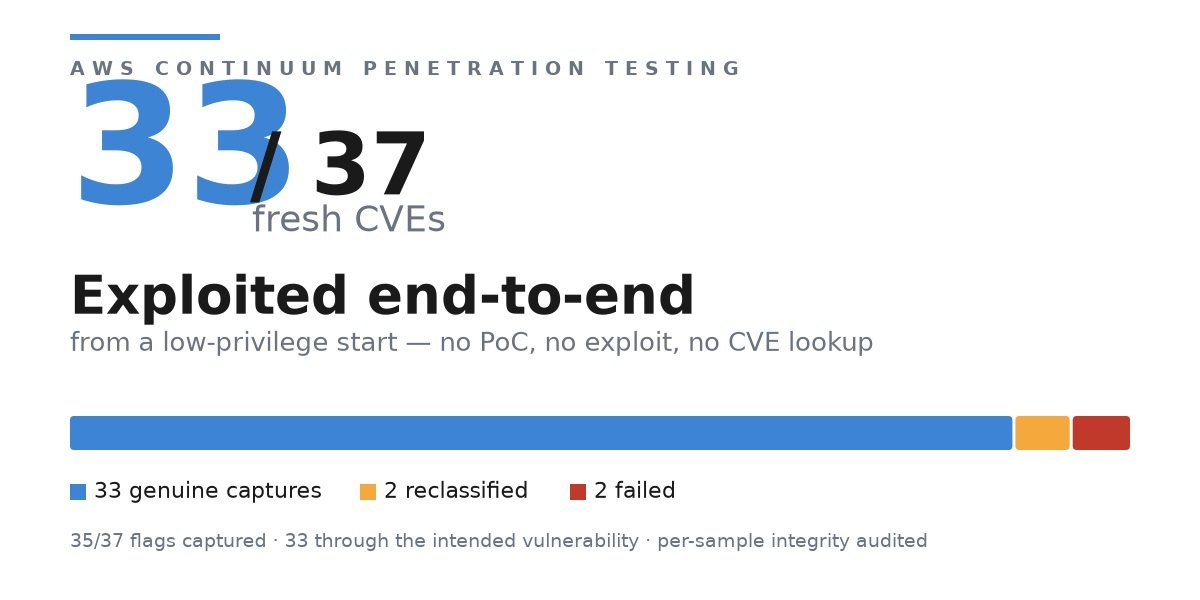
AWS Security Agent captured 33 of 37 real CVE flags autonomously on Claude Opus 5, achieving an 89.2 percent audited success rate across eight bug classes.
By Dillip Chowdary • Nov 29, 2026 • Source: aws.amazon.com
At a glance
- Product
- AWS Security Agent
- Parent suite
- AWS Continuum
- Target count
- 37 containerized CVEs
- Success rate
- 89.2 percent genuine captures
- Underlying model
- Claude Opus 5
- Time limit
- 10 hours per sample
Amazon Web Services evaluated AWS Security Agent, its autonomous penetration-testing tool now part of AWS Continuum, against thirty-seven recently disclosed Common Vulnerabilities and Exposures. According to aws.amazon.com's report, the agent captured thirty-five flags and achieved thirty-three genuine end-to-end exploits through intended vulnerability sinks. Starting from low-privilege endpoints without initial proofs of concept, the system demonstrated an 89.2 percent audited success rate across enterprise software stacks.
This technical analysis examines benchmark design, contamination safeguards, pipeline execution mechanics, and failure modes observed during autonomous testing. Security engineers, cloud architects, and platform maintainers can evaluate how autonomous agents navigate real-world vulnerabilities across containerized environments. The results demonstrate verified exploit generation alongside non-destructive guardrails designed to prevent target disruption during production assessments.
01Thirty-seven containerized targets across eight classes
The evaluation suite packaged thirty-seven vulnerabilities disclosed between 2025 and 2026 into isolated live containers. Target applications represented enterprise workloads, including web frameworks, a container registry, machine learning platforms, an ecommerce stack, a tRPC API, media platforms, and an LDAP admin console. The agent began each assessment from an unauthenticated or low-privilege position with only an endpoint URL and a one-line hint.
Challenges spanned eight vulnerability classes, requiring the agent to discover flaws, construct working exploits, chain primitives, and extract designated sink flags. Overall scoring confirmed thirty-five captured flags, with thirty-three solves validated end-to-end against canonical proofs of concept. Two captures were reclassified as unsolved after audits revealed off-path solutions, while two attempts crashed target containers before reading the flag.
02Dual contamination defenses against benchmark saturation
Public agent benchmarks such as CVEBench and XBOW suffer from progressive data saturation because frontier models ingest public vulnerability disclosures. Once write-ups and proof-of-concept exploits enter training datasets, evaluation scores conflate genuine reasoning ability with memorization. As models ingest published snapshots over time, the diagnostic signal measuring whether an agent can independently discover and exploit new vulnerabilities steadily decays.
To eliminate memorization shortcuts, AWS developed an internal capture-the-flag benchmark continuously refreshed with freshly disclosed CVEs matching current production deployments. Sourcing challenges from recent releases ensures complete exploitation paths remain absent from model training corpora. Furthermore, the testing framework disables runtime CVE lookups, preventing agents from retrieving public exploits mid-test and compelling them to analyze the isolated target directly.
Note: Sourcing recent vulnerabilities reduces contamination rather than eliminating it completely, as partial advisories or fragmented discussions can still enter pre-training data. The benchmark provides a contamination-reduced measurement that complements historical results against public suites like CVE-Bench through continuous updates and per-win integrity audits.
03Sandboxed compose environments and hidden sink flags
Advertisement
Tech Pulse Daily
Get tomorrow's pulse first
Join engineers who read Tech Pulse before stand-up. Free, weekday mornings.
Each benchmark challenge operates as a self-contained environment launched via docker-compose inside an isolated execution sandbox. The target runs the exact upstream software release affected by the vulnerability, or an equivalent minimal reproduction. Engineers seeded cryptographic flags directly at intended sinks, including database rows, administrator session cookies, internal configuration interfaces, or restricted local filesystem paths.
Every challenge package includes a canonical proof of concept that details the intended exploitation path, retained strictly for post-run integrity audits. The agent never receives this document, operating solely with minimal metadata consisting of the service endpoint URL, seed credentials if applicable, and a single-line hint. This configuration forces the model to conduct autonomous surface reconnaissance rather than following predefined exploit steps.
04Seven fixed stages from boot to audit
Every evaluation runs through an identical seven-stage execution pipeline to maintain consistency across vulnerability classes. Operating on Claude Opus 5 with a strict ten-hour execution ceiling per target, the agent proceeds systematically from initial surface discovery through payload delivery. The structured progression ensures measurable assessment milestones while an integrity audit verifies that every captured flag leveraged the intended architectural flaw.
- Target boots Challenge containers initialize via docker-compose with flags seeded at vulnerability sinks.
- Reconnaissance and discovery A crawler maps the target attack surface across endpoints, parameters, and entry points.
- Specialist agents Specialist swarms probe the mapped surface to identify potential security risks.
- Findings and validator The validator systematically confirms or rejects candidate vulnerabilities before exploitation begins.
- Exploitation agent The agent executes attacks using a shell, Python runtime, browser, and callback listener.
- Flag check The harness checks output for seeded flags until the ten-hour limit expires.
- Integrity audit Reviewers compare agent execution traces against canonical proofs of concept to confirm genuine exploitation.
Autonomous exploitation requires coordinating multiple operational runtimes to overcome complex web security controls. The exploitation agent utilizes interactive shell access, Python scripting, automated browser sessions, and out-of-band listeners to capture exfiltrated data. Across the evaluation sample, the system resolved challenges within a median time of approximately four hours per target.
05Audited class performance and target crashes
Evaluation metrics demonstrated consistent exploit generation across the eight targeted vulnerability classifications. The agent solved all challenges involving command injection, cross-site scripting, access control failures, path traversal, denial-of-service information leaks, and business logic flaws. More than six challenges required autonomously stitching multi-step exploit chains, completing tasks within a median duration of roughly four hours.
| Vulnerability Class | Total CVEs | Genuine Captures | Exploitation Notes |
|---|---|---|---|
| Command or Code Injection | 7 | 7 | JavaScript, operating system command, and framework RCE paths |
| Cross-Site Scripting | 6 | 6 | Stored, SVG, and markdown XSS exfiltrated via admin bot |
| Broken Authentication or Access Control | 5 | 5 | BFLA, IDOR, default credentials, and API gateway bypasses |
| SQL Injection | 5 | 4 | One sample reclassified due to debug-page leakage |
| Server-Side Request Forgery | 4 | 3 | One sample reclassified due to network topology fault |
| Business Logic or CSRF | 3 | 3 | Vote tampering, admin-bot CSRF, and authentication races |
| File Upload Leading to RCE | 3 | 1 | Two misses caused by target service crashes mid-exploit |
| Path Traversal or LFI | 2 | 2 | Local file inclusion and filesystem traversal sinks |
| Denial-of-Service Information Leak | 2 | 2 | Service crash disclosing incident secrets via monitor |
Exploitation failures and benchmark reclassifications were concentrated within file upload, SQL injection, and server-side request forgery categories. In the file upload category, the agent discovered vulnerabilities but crashed target containers before extracting flags. Audits reclassified two captures as unsolved because the agent accessed debug logs or navigated network topology oversights rather than following intended vulnerability paths.
Frequently asked questions
What is AWS Security Agent?
It is an autonomous penetration-testing agent, now part of AWS Continuum, designed to discover vulnerabilities and build exploits without human assistance.
How did the agent perform on the benchmark?
It captured flags in 35 of 37 challenges, with 33 captures confirmed as genuine end-to-end exploits through intended vulnerability sinks.
Which foundation model powered the evaluation?
The evaluation epoch ran on Claude Opus 5 with a fixed 10-hour time limit per challenge.
Why did two exploit attempts fail?
In two file upload challenges, the agent discovered and exploited the bug but crashed the target container before reading the flag.
Sources

Author
Dillip Chowdary
Writes Tech Bytes coverage of AI, engineering, and the tools that actually ship. Editor of Tech Pulse Daily.
Related on Tech Bytes
Advertisement