Building a private family photo site with Claude Code
Deepak Murugaian built shotbydeepak.com using Claude Code, unifying five permission rules into one database engine alongside an automated Lightroom pipeline.
By Dillip Chowdary • Nov 19, 2026 • Source: deepakmurugaian.substack.com
At a glance
- Product
- shotbydeepak.com
- Platform author
- Deepak Murugaian
- Coding tool
- Claude Code
- Camera hardware
- Canon EOS R6 Mark II
- Publication date
- November 18, 2026
- Ingestion policy
- Private by default
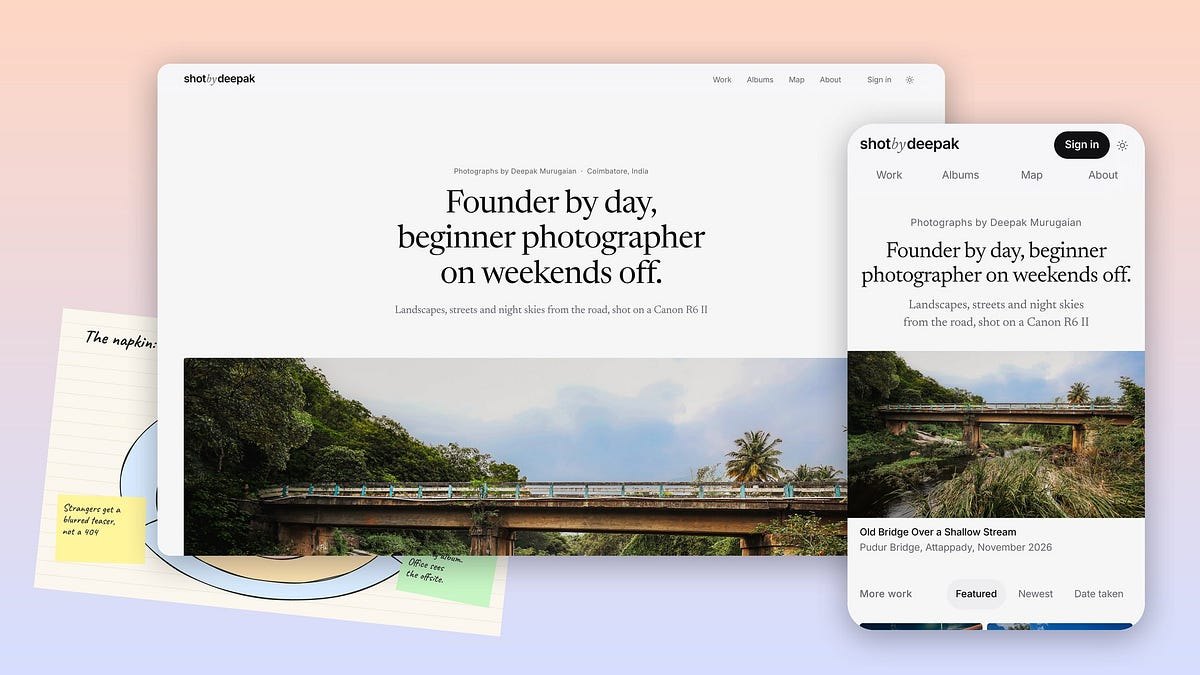
EdisonOS founder Deepak Murugaian launched shotbydeepak.com on November 18, 2026, using Anthropic’s Claude Code agent to construct an autonomous personal photography site. The implementation replaces scattered storage across Lightroom catalogs, Instagram posts, and WhatsApp groups with a unified web property tailored to motorcycle journeys starting out of Coimbatore. According to deepakmurugaian.substack.com's report, the deployment represents an applied case of steering conversational software models to produce full-stack access controls, geocoded route displays, and local desktop synchronization.
This analysis details the technical architecture, access control mechanisms, and user experience design patterns developed during the build. It provides practical patterns for software engineers, product managers, and developers deploying artificial intelligence agents to build production software.
01Audience circles and blurred teaser previews
Standard portfolio templates from commercial providers such as Squarespace and Adobe Portfolio assume a single public audience for visual media. The ride photography catalog required distinct segregation across public web traffic, trusted family circles, and private individuals. A foundational napkin diagram split visitors into three access tiers before any code was generated by the assistant.
Public visitors encounter landscape imagery and technical camera details without exposing sensitive family moments or wedding events. Unauthenticated users who navigate to protected member assets receive a soft blurred teaser image and a login prompt instead of standard server errors. Preserving navigational context through blurred previews prevents visitor drop-off while maintaining privacy boundaries for personal albums.
02Minimal viable scope and staged roadmap
The initial engineering cycle prioritized functional brevity over feature density to avoid prototype bloat during assisted coding. Murugaian constrained the first iteration to three core capabilities, deferring complex media filtering until real-world usage exposed operational bottlenecks. The baseline version focused entirely on high-fidelity display, local upload pipelines, and direct private link generation.
- MVP release A public gallery with direct uploads and private shareable links.
- Media expansion Albums, geolocation ride maps, and member authentication.
- Social access Group management, gated invitation loops, and facial tags.
- Platform analytics Usage monitoring and administrative operational insights.
Subsequent milestones introduced geographic coordinate plotting, collaborative group sharing, and account invitation flows. Interactive maps plot travel routes while replacing private coordinates with anonymous locked pins that preserve personal location security.
03Photography display and exposure metadata strip
Advertisement
Tech Pulse Daily
Get tomorrow's pulse first
Join engineers who read Tech Pulse before stand-up. Free, weekday mornings.
The visual interface prioritizes visual assets by eliminating competing navigation menus and placing biographical context in the page footer. The primary grid supports sorting by featured status, newest additions, or capture timestamps, with private assets distinguished by locked overlays. Every public image functions as a technical learning asset by exposing original capture metadata in a structured sub-frame.
Full-resolution downloads preserve camera data, including aperture, shutter speed, ISO values, and focal lengths recorded by Murugaian’s Canon EOS R6 Mark II. Mobile responsive rendering displays hero banners and interaction controls within a compact viewport suitable for messaging referrals. Every template layout underwent concurrent testing on desktop displays and mobile phone viewports.
04Unified permissions and consolidated administrative rooms
Access control represents the most complex technical layer within the application architecture. Five distinct authorization pathways initially emerged across direct shares, subject tags, album allocations, group memberships, and group album bindings. Claude Code identified five inconsistent permission rules across the codebase and consolidated authorization checks into a single authoritative database rule.
| Architecture component | Prototype implementation | Consolidated production system |
|---|---|---|
| Permissions evaluation | 5 fragmented rule copies | 1 central database definition |
| Access pathways | 5 independent entry vectors | 1 unified access resolution engine |
| Management interface | 12 fragmented navigation tabs | 5 consolidated operational rooms |
| Editor save action | 2 competing save buttons | 1 unified save action with toast alert |
| Asset ingestion policy | Manual exposure assignment | Strict private-by-default state |
The administration panel underwent a structural consolidation from twelve separate tabs into five core functional rooms. Desktop navigation employs a dedicated sidebar, while mobile viewports utilize an ergonomic bottom navigation dock. Clear descriptive strings display explicit access summaries beneath every photo asset.
05Lightroom automation and command line deployment
Desktop workflow integration eliminates manual web browser uploads through a local file system background watcher. A dedicated utility script on macOS monitors the local Adobe Lightroom export folder, transmitting processed photographs with automated title suggestions. In-place re-exports update existing web records without altering shared links, view counters, or engagement hearts.
npm install -g @anthropic-ai/claude-code
claude update
claude --model claude-3-7-sonnet
/model claude-3-7-sonnet
Member invitations pass through an administrative approval queue where existing users suggest new members with contextual notes. Administrators review incoming requests through an escalated notification feed before account creation links are dispatched.
Note: Image records and application assets run on a weekly scheduled backup routine with redundant off-site data copies.
Frequently asked questions
What development tool was used to build shotbydeepak.com?
Deepak Murugaian used Anthropic's Claude Code command-line tool to steer architecture and full-stack code generation using plain English prompts.
How does the platform handle permissions for private images?
Authorization routes through a single database rule that evaluates direct sharing, tags, albums, and groups, while defaulting all uploads to private.
How does the site integrate with photography workflows?
A local helper application monitors a macOS Lightroom export directory to upload photos automatically and replaces edits in place without changing existing links.
Sources

Author
Dillip Chowdary
Writes Tech Bytes coverage of AI, engineering, and the tools that actually ship. Editor of Tech Pulse Daily.
Related on Tech Bytes
Advertisement