Building AI that can work across the enterprise
SAP and Infosys revealed that 86 percent of enterprises remain trapped in AI pilot stages as companies adopt unified autonomous platform frameworks.
By Dillip Chowdary • Nov 16, 2026 • Source: MIT Technology Review
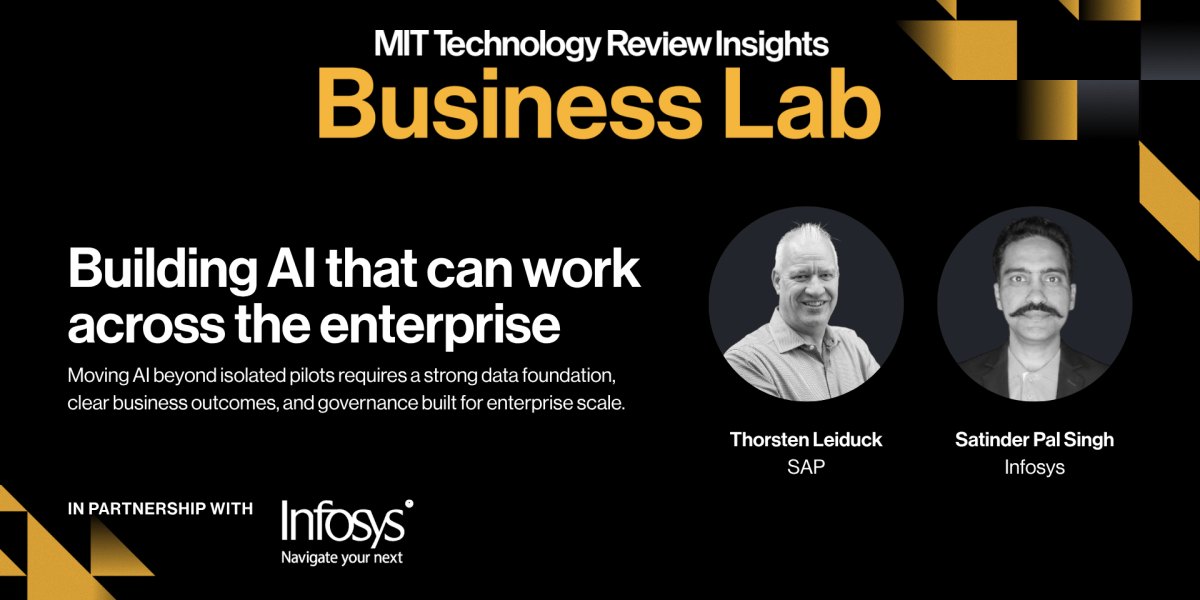
At a glance
- Product
- SAP autonomous enterprise framework
- Publisher
- MIT Technology Review Business Lab
- Lead partner
- Infosys
- Scaled rate
- 14% of Global 2000 firms
- Pilot stall
- 74% stuck in pilot mode
- Data access
- 42% cite quality barriers
Enterprise leaders are overhauling disconnected artificial intelligence initiatives as business operations transition from experimental prototypes to autonomous, agentic workflows. As detailed in MIT Technology Review's report, SAP and Infosys outlined the structural requirements for scaling digital coworkers across corporate operating models. To bridge the divide between experimentation and sustained execution, SAP introduced the SAP autonomous enterprise framework to embed governed agentic systems directly into core business processes.
This report examines how global enterprises are confronting data fragmentation, high pilot failure rates, and governance gaps when operationalizing machine intelligence. The analysis is designed for executive leadership, enterprise architects, and technology strategists managing the migration from departmental productivity tools to cross-functional autonomous systems.
01Enterprise platform shift and data foundations
Senior leadership conversations across major industries have elevated artificial intelligence to a mandatory strategic priority, yet operational deployment remains difficult. Thorsten Leiduck, senior vice president and global head of SAP Business AI Platform Ecosystem, explained that early corporate programs began as isolated proofs of concept across fragmented technical environments. This disconnected approach creates pervasive duplication, erratic system reliability, and an absence of viable pathways for organizational scaling.
Achieving production readiness requires treating intelligent systems as an integrated platform rather than a constellation of standalone tools. Leiduck emphasized that artificial intelligence is completely dependent on establishing a unified data foundation enriched with specific business process semantics. Without a coherent architectural layer connecting operational data to core applications, autonomous software cannot navigate corporate workflows with sufficient contextual understanding.
Operational precision demands vary sharply depending on the underlying business function. While an accuracy threshold of eighty percent might satisfy everyday productivity assistance, Leiduck pointed out that the same rate represents a very terrible result in mission-critical environments. In high-stakes domains such as global supply chain routing and financial close reconciliations, autonomous systems require absolute data integrity and verified reliability.
02Pilot traps and enterprise failure metrics
Extensive enterprise research highlights a wide divergence between organizational ambition and operational scaling. A Boston Consulting Group study found that 74 percent of surveyed organizations remain stuck in pilot mode without any defined plan to achieve enterprise scale. Additionally, survey data from Anthropic indicated that 42 percent of enterprises struggle directly with data accessibility and underlying data quality when attempting to expand intelligent systems.
Satinder Pal Singh, associate vice president for North America for SAP BAIP and SAP AI Strategy at Infosys, noted that an Infosys and HFS Research survey of more than 500 Global 2000 enterprises revealed only 14 percent have successfully scaled AI. The remaining 86 percent sit trapped in early exploration, proof of concept development, or fragmented pilots. Singh identified this failure mode as the departmental trap, wherein isolated technical teams construct pilots disconnected from authentic business requirements.
| Enterprise operational tier | AI revenue contribution | System deployment characteristics |
|---|---|---|
| AI native enterprises | 4x higher revenue impact | Unified architecture, calibrated knowledge graphs, and embedded workflows |
| Traditional pilot laggards | 1x baseline impact | Fragmented departmental experiments, isolated teams, and data silos |
03Three evaluation lenses for digital coworkers
Advertisement
Tech Pulse Daily
Get tomorrow's pulse first
Join engineers who read Tech Pulse before stand-up. Free, weekday mornings.
Moving past the departmental trap requires an operating model transformation where technical and business teams jointly configure autonomous workflows. Singh positions autonomous agents as digital coworkers that execute complex tasks across enterprise software environments. To prevent deploying technical solutions in search of problems, leadership teams evaluate prospective agent deployments through three specific operational criteria:
- Impact assessment Identify specific functional workflows where an autonomous agent moves meaningful, measurable business performance metrics.
- Feasibility review Verify whether enterprise data assets, integration points, and organizational technical talent can sustain the target deployment.
- Scalability validation Establish whether successful workflow implementations can be systematically replicated and expanded across broader organizational divisions.
Singh noted that any pilot unable to achieve operational scale represents nothing more than an isolated experiment. To build early enterprise familiarity, initial implementations frequently target widespread productivity improvements, including automated travel assistance, corporate meeting summaries generated through Microsoft Copilot, and baseline task automation.
04Governance policies and risk backlog mitigation
Transitioning autonomous software into sensitive business processes places system observability and control at the center of enterprise architecture. Corporate executives frequently report urgent concerns regarding security, system predictability, reliability, and ethical compliance when autonomous agents operate independently. Without formal control frameworks, organizations cannot guarantee that autonomous digital coworkers consistently comply with organizational policies.
Comprehensive governance structures require enforceable data policies, role-based access boundaries, continuous runtime monitoring, and explicit administrative oversight. Singh warned that bypassing administrative guardrails never accelerates real organizational adoption. Instead, omitting foundational oversight creates a massive operational risk backlog that eventually forces executive leadership into disruptive operational shutdowns, forensic audits, and costly architectural re-engineering.
Note: Implementing autonomous digital coworkers across financial accounting and supply chain management requires verified administrative controls before production deployment, as post-launch remediation incurs severe workflow disruptions.
05Compounding advantages and autonomous decision partners
Enterprise adoption patterns reveal a growing divide between industry front-runners and lagging organizations. According to the Infosys Knowledge Institute AI Maturity Index, only eight percent of global enterprises qualify as AI native today. Despite their small numbers, these advanced organizations capture four times the revenue contribution from their intelligent software investments compared to competing market laggards.
This performance divergence expands rapidly because pioneer enterprises establish compounding structural operational advantages. Organizations actively running autonomous workflows accumulate eighteen months of production agent behavior data, highly calibrated proprietary knowledge graphs, and an adapted corporate workforce. Because late-adopting competitors cannot close this technical capabilities gap merely by procuring identical enterprise platforms in the future, early operationalization becomes critical.
The ultimate architectural evolution transforms artificial intelligence from a task-level productivity accelerator into an autonomous decision-making partner. Both Leiduck and Singh envision agentic architectures that coordinate complex workflows across diverse enterprise applications while leveraging governed knowledge graphs. As digital coworkers assume operational responsibilities, these systems assist corporate leadership in understanding operational shifts, projecting upcoming conditions, and orchestrating rapid organizational responses.
Frequently asked questions
What is the primary cause of enterprise failure when scaling artificial intelligence?
Research from Infosys and HFS Research shows 86 percent of enterprises remain trapped in fragmented pilots because organizations isolate AI initiatives within disconnected technical departments rather than embedding them into cross-functional business operating models.
What evaluation framework do SAP and Infosys recommend for AI agent use cases?
Organizations should evaluate prospective agent deployments through three specific lenses: impact on measurable business metrics, operational feasibility regarding data and talent, and systemic scalability across organizational units.
Why do early adopters of enterprise AI hold a compounding competitive advantage?
AI native companies generate four times the revenue contribution of laggards by accumulating 18 months of proprietary agent behavior data, calibrated enterprise knowledge graphs, and organizational operational experience that cannot be matched by later software purchases alone.
Sources

Author
Dillip Chowdary
Writes Tech Bytes coverage of AI, engineering, and the tools that actually ship. Editor of Tech Pulse Daily.
Related on Tech Bytes
Advertisement