Cerebras Deploys Trillion-Parameter AI Models
Cerebras detailed a 59-wafer WSE-3T pipeline that runs the 3-trillion parameter Kimi K3 model at up to 2,000 tokens per second using stationary on-chip SRAM.
By Dillip Chowdary • Oct 25, 2026 • Source: cerebras.ai
Cerebras Systems detailed how it deploys multi-trillion parameter frontier artificial intelligence models across clusters of wafer-scale chips to deliver generation speeds between 1,000 and 2,000 or more tokens per second. The technical breakdown, authored by Sarah Chieng and published in cerebras.ai's report, centers on the company's WSE-3T wafer architecture. While a single WSE-3T chip integrates 44 GB of on-chip static random-access memory, frontier models demand terabytes of storage for their parameter weights alone. Using the open source model Kimi K3 as an illustrative production workload, the semiconductor firm demonstrated how pipelined model parallelism enables entire multi-trillion parameter networks to run directly inside on-chip memory without weight movement during inference execution.
This technical report covers the system architecture, mathematical memory budgeting, pipeline orchestration, and networking protocols required to serve frontier models at wafer scale. Machine learning engineers, infrastructure architects, and enterprise technology leaders can examine the operational trade-offs between linear-attention layers and dense attention layers, alongside the hardware scaling mechanics behind micro-batch pipelining. By outlining the hardware requirements for models with approximately 3 trillion parameters, the disclosure illustrates how wafer clusters sustain high request concurrency across 256,000-token context windows while keeping end-to-end token latency within strict interactive bounds.
Cerebras Deploys Trillion-Parameter AI Models: what actually changed
Cerebras resolved the physical memory bottleneck of wafer-scale inference by establishing a multi-wafer pipeline layout mapped to specific architectural layer types. In the case study of Kimi K3, a model spanning approximately 3 trillion parameters across 69 linear-attention layers and 24 dense layers, the system formats weights using 4-bit quantization, mirroring the Hugging Face implementation. Dividing the resulting raw 4-bit parameter payload across the model's 93 total layers yields an average layer weight footprint of roughly 16 GB. Because each individual WSE-3T wafer holds 44 GB of SRAM, a single layer fits directly onto a wafer without requiring layer slicing or off-chip weight transfers.
The physical wafer layout splits hardware allocation based on whether a layer requires an expanding key-value cache. Dense full-attention layers store keys and values for every token across active requests, requiring substantial memory overhead. Cerebras allocates one dense layer per 44 GB wafer, dedicating the remaining 28 GB of SRAM entirely to the key-value cache. Conversely, linear-attention layers maintain a small, fixed-size state per request regardless of sequence length, eliminating dynamic token-by-token cache expansion. The architecture packs two 16 GB linear layers onto a single wafer, consuming 32 GB of weight space. Servicing the complete Kimi K3 architecture therefore requires 35 wafers for linear attention and 24 wafers for dense attention, totaling 59 WSE-3T wafers.
Cerebras Deploys Trillion-Parameter AI Models: how it works
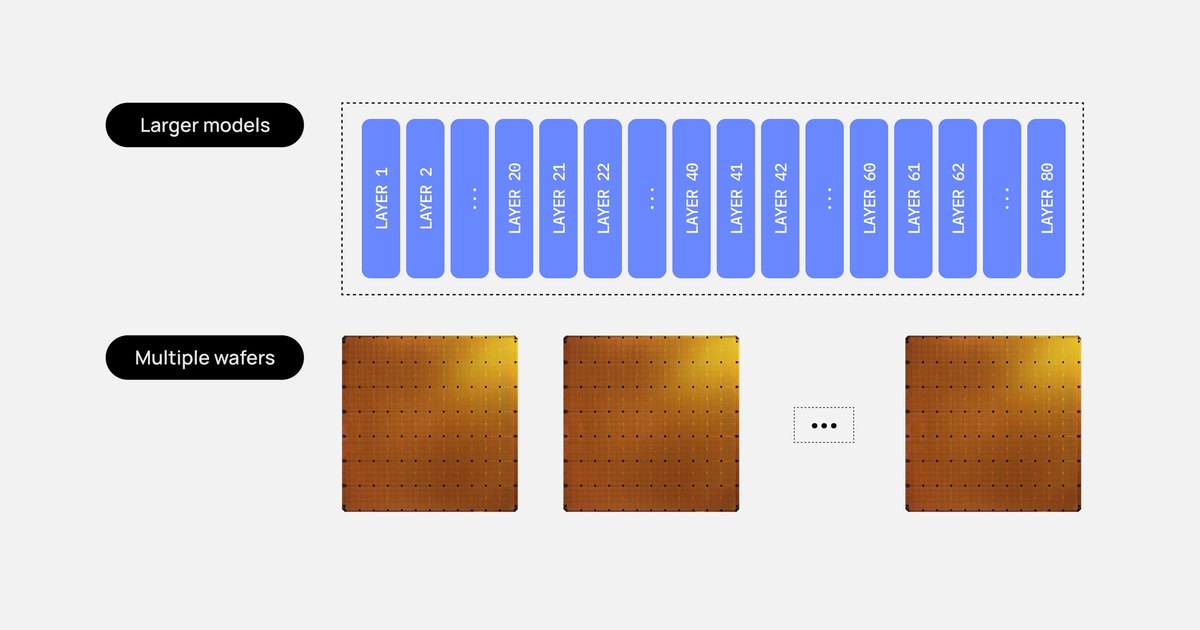
Execution flows across the cluster using an assembly-line pipeline managed by the Cerebras compiler and runtime. Once model layers are mapped across wafer regions, tokens advance sequentially from one wafer stage to the next. Because the weights for each stage remain permanently pinned in on-chip SRAM, weights never travel across the network. Only intermediate activation vectors move between chips. Inter-wafer communication runs over RDMA over Ethernet, clocking approximately 2 microseconds per physical network hop. For example, the first wafer executes layers one and two, transmitting activations to the second wafer for layers three and four, continuing through the pipeline until the final wafer outputs the generated token.
To prevent hardware underutilization and avoid idling stages, the runtime continuously interleaves multiple active requests throughout the pipeline instead of operating at a batch size of one. While a downstream wafer stage computes activations for an initial request, upstream stages simultaneously compute activations for subsequent requests. Each pipeline stage can also process a micro-batch of requests simultaneously, meaning the total count of requests in flight equals the number of stages multiplied by the micro-batch size. Smaller micro-batches reduce individual generation latency, whereas larger micro-batches maximize aggregate token throughput across the cluster. Unlike conventional graphics processor batching where requests pause to synchronize, requests stream independently through the wafers.
Advertisement
Tech Pulse Daily
Get tomorrow's pulse first
Join engineers who read Tech Pulse before stand-up. Free, weekday mornings.
Cerebras Deploys Trillion-Parameter AI Models: why it matters now
Frontier-scale open source architectures have reached parity with proprietary foundation models, demanding infrastructure capable of high-throughput deployment. Kimi K3 achieves a score of 88.3 percent on Terminal-Bench 2.1, closely trailing GPT-5.6 Sol's score of 88.8 percent, while reaching 91.2 percent on BrowseComp to surpass GPT-5.6 Sol's 90.4 percent mark. These evaluation metrics demonstrate advanced agentic autonomy and software engineering proficiency in open weights. However, enterprise utilization of such architectures depends directly on serving speeds across long prompt contexts, making high-throughput execution a critical operational requirement rather than a purely theoretical capability.
The hardware deployment model demonstrates that multi-trillion parameter networks can operate beyond the boundaries of traditional GPU clusters by eliminating high-bandwidth memory bandwidth bottlenecks. Conventional inference clusters frequently encounter communication overhead when distributing large layer parameters across discrete accelerator nodes. By keeping weights stationary inside 44 GB of SRAM per wafer and restricting network traffic to 2-microsecond activation hops, the WSE-3T deployment maintains generation speeds exceeding 1,000 tokens per second. Cerebras emphasized that evaluating system efficiency requires measuring total token throughput per unit of power, such as tokens per second per megawatt at target generation speeds, rather than isolated batch capacity figures.
Cerebras Deploys Trillion-Parameter AI Models: who is affected
Engineering teams building interactive agent workflows, enterprise developer tools, and high-concurrency reasoning applications are directly impacted by these deployment economics. Kimi K3's benchmark performance across coding and browsing benchmarks targets production environments where agents run multi-step tool interactions requiring continuous, fast feedback loops. High generation speeds of 1,000 to 2,000 tokens per second enable complex agent loops to finish in seconds rather than minutes. Organizations serving workloads with an assumed average request size of 256,000 tokens can project exact memory trade-offs when budgeting on-chip static memory allocations across large active user bases.
Infrastructure operators and cloud architects evaluating large-scale model hosting must recalculate operational limits around key-value caching and request concurrency. Because each dense layer wafer reserves 28 GB of SRAM for key-value caches with 8-bit quantization, the on-chip memory directly establishes the ceiling for concurrent requests moving through the system. Teams deploying through the Cerebras inference cloud or private hardware installations must align model architectures with these memory allocation rules. Model developers designing hybrid architectures that mix dense and linear-attention layers can leverage these structural guidelines to optimize deployment costs across physical wafer counts.
Cerebras Deploys Trillion-Parameter AI Models: what to watch
The primary technical boundary to monitor is how cluster configurations scale past 3 trillion parameters into larger frontier designs. Cerebras noted that the same mathematical formulation applies to larger model topologies: developers calculate aggregate parameter weights alongside dynamic request state, allocate layers across additional wafers, and connect them into extended pipelines. Because each supplementary WSE-3T wafer contributes compute capacity alongside an additional 44 GB of SRAM, the architecture expands modularly to host larger models without altering the underlying communication framework or forcing individual layers to split across disparate processors.
Industry adoption will depend on how production workloads balance micro-batch sizes against latency targets in real-world deployments. Observers should track availability across the Cerebras cloud API, developer uptake of 4-bit quantized Kimi K3 weights, and enterprise power efficiency benchmarks measuring tokens per second per megawatt. As open source research groups release models with heterogeneous attention mechanisms and extended sequence lengths, wafer-scale pipelining provides an architectural alternative to conventional accelerator fabrics, shifting the deployment focus toward on-chip SRAM capacity, low-latency RDMA fabrics, and micro-batched continuous execution streams.
Developer Action Items
- ☐ Verify the claim on the official Windows page (or Hacker News Best), not from this recap alone.
- ☐ Name the surface that moved — API, policy, model, hardware, or commercial terms — before you Slack the thread.
- ☐ Assign one owner a day to read the primary material and decide: this-sprint, this-quarter, or noise.
- ☐ Do not change production on day-one coverage. Watch the vendor changelog and one independent write-up first.
Cerebras Deploys Trillion-Parameter AI Models FAQ
How many Cerebras wafers are required to run the Kimi K3 model?
Running Kimi K3 requires 59 Cerebras WSE-3T wafers, consisting of 35 wafers to host 69 linear-attention layers and 24 wafers to host 24 dense layers.
How fast does Cerebras run trillion-parameter frontier models?
The multi-wafer pipeline architecture runs multi-trillion parameter models at generation speeds ranging from 1,000 to over 2,000 tokens per second.
Why do model weights remain stationary during inference on Cerebras hardware?
Each 4-bit quantized model layer requires about 16 GB, fitting entirely inside the 44 GB on-chip SRAM of a WSE-3T wafer so only activations move across wafers via RDMA over Ethernet.
How does attention layer design affect wafer capacity?
Dense layers require substantial on-chip memory for dynamic key-value caches, limiting allocation to one layer per wafer, while linear-attention layers maintain fixed-size states, allowing two layers per wafer.
Sources

Author
Dillip Chowdary
Writes Tech Bytes coverage of AI, engineering, and the tools that actually ship. Editor of Tech Pulse Daily.
Related on Tech Bytes
Advertisement