Claude Builds an Internal Customer Service App
E-commerce operator Alex Willen built Relay using Claude Code to automate customer support across Shopify, Amazon, and Meta for his Lone Trail brand.
By Dillip Chowdary • Oct 17, 2026 • Source: theautomatedoperator.substack.com

Former product manager Alex Willen built Relay, an internal progressive web application powered by Anthropic's Claude to automate customer support for outdoor brand Lone Trail. As reported in theautomatedoperator.substack.com's report, Willen assembled the tool using Claude Code to centralize customer tickets across email and social channels, coordinate Shopify and Amazon fulfillment, and issue return labels via Shippo.
This report examines Relay's architecture, iterative development loop, platform API limitations, and operational safeguards. Designed for e-commerce operators, solo business founders, and technical managers assessing AI agents, this case study shows how language models can handle multi-platform commerce operations while maintaining human supervision.
Claude Builds an Internal Customer Service App: what actually changed
Alex Willen acquired Lone Trail with an included Shopify storefront, exposing him directly to inbound shopper inquiries that never occurred under his Amazon-only brands. To reclaim his morning hours, Willen created Relay to centralize inbound customer communication into a single interface accessible on desktop browsers and mobile devices as a Progressive Web App. A background ingestion job polls connected accounts every ten minutes, pulling new customer emails, Facebook messages, Instagram direct messages, and social comments into a support queue where tickets receive unique identifiers for tracking.
Beyond generating draft replies, Relay executes operational tasks across Shopify and Amazon backends. When customers request an order cancellation, Claude verifies shipment status with Amazon before executing refunds and sending confirmation emails. Shipping address changes trigger cancellation attempts and initiate replacement shipments under updated Amazon identifiers. The software also moderates community interactions by liking positive Facebook comments, deleting offensive posts such as an abusive comment from user greyypilgrimm, and requesting permission from shoppers to feature user-submitted product photos directly on the Lone Trail website homepage and product pages.
Claude Builds an Internal Customer Service App: how it works
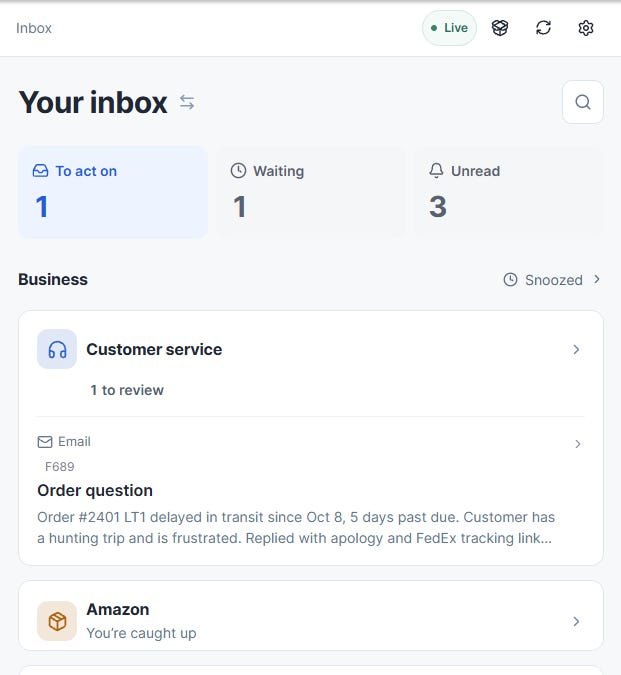
Relay operates as a browser-based Progressive Web App suggested by ChatGPT to allow seamless access from desktop computers and an iPhone home screen without loading Safari. Connected accounts include a dedicated brand Gmail alongside Facebook and Instagram pages. Every ten minutes, a scheduled task checks for new customer inquiries and generates tickets with specific identification numbers. Claude parses message bodies to extract customer intent and order identifiers, querying Shopify and Amazon to retrieve expected delivery dates or tracking links before drafting answers. Visual badges display the channel source for each ticket.
Willen iterated on Relay using Claude Code without formal planning or upfront specifications. When automated updates caused Claude to internalize outlier responses as universal rules, Willen added a custom feedback text box and a knowledge base update checkbox on every ticket. Direct hyperlinks to Shopify and Amazon objects were added to verify details quickly. For returns, Relay displays item weights and dimensions before using Shippo APIs to generate United States Postal Service return labels automatically. A camera button at the top of Relay lets Willen photograph returned parcels to inspect contents before initiating refunds.
Advertisement
Tech Pulse Daily
Get tomorrow's pulse first
Join engineers who read Tech Pulse before stand-up. Free, weekday mornings.
Claude Builds an Internal Customer Service App: why it matters now
The project underscores how generative coding tools transform software development economics for solo founders and small business acquirers. As a former product manager accustomed to managing human engineers, Willen observed that building with AI removes traditional engineering resource constraints. Operators no longer need to exhaustively document use cases or design specifications before writing code. When administrative bottlenecks emerged during live ticket processing, such as needing ticket identifiers, platform badges, or direct database links, Willen prompted Claude Code to implement adjustments immediately, achieving rapid software evolution that human engineering cycles rarely accommodate.
At the same time, Relay exposes persistent platform friction in modern commercial web ecosystems. While natural language reasoning proved straightforward to assemble, connecting to third-party services revealed erratic API permissions across Meta platforms. Claude can send direct messages on Instagram but lacks programmatic access for Facebook Messenger, requiring manual copying on mobile devices. Similarly, automated systems can like Facebook comments but cannot like Instagram comments. Browser use bridges certain gaps, but Instagram restricts story re-sharing exclusively to native mobile applications, showing that external API limits constrain fully autonomous deployments.
Claude Builds an Internal Customer Service App: who is affected
Independent e-commerce merchants and solo portfolio acquirers handling hybrid storefronts stand to gain immediate operational efficiency from custom AI apps. Businesses utilizing Amazon Multi-Channel Fulfillment to ship orders originating on Shopify often suffer from fragmented administrative workflows. Relay proves that a single operator can consolidate disparate communication channels, verify inventory movements, and automate USPS return label creation via Shippo without purchasing expensive help desk software licenses. By automating routine order tracking, address revisions, and basic cancellations, business owners can redirect their daily schedules toward growth tasks rather than inbox maintenance.
Customer service outsourcing agencies and conventional support software vendors also face long-term shifts as bespoke AI tools mature. When customized applications can be built and maintained conversationally for minimal expenditure, reliance on standard third-party support tiers diminishes. However, human managers remain critical supervisory anchors. As Willen noted regarding edge cases and outlier responses, unsupervised models risk hallucinating policies or distributing unapproved refunds. Until confidence mechanisms guarantee that autonomous agents cannot be manipulated into giving away free merchandise, human operators must continue reviewing outbound messages, confirming package receipts, and executing sensitive account actions.
Claude Builds an Internal Customer Service App: what to watch
The core development to watch is whether Relay achieves fully autonomous execution across low-risk customer service categories. Currently, Willen verifies generated responses, reviews cancellation statuses, and inspects physical return packages using Relay's camera button before issuing customer refunds. Observers should track whether structured guardrails enable Claude to handle routine delivery questions and verified Amazon shipment cancellations autonomously. Developing high-confidence verification methods that prevent conversational exploitation while safely automating payment refunds will serve as a crucial benchmark for solo e-commerce operators seeking complete administrative detachment.
Another key development involves third-party platform API policies and mobile operating constraints. Inconsistent developer access across Meta properties currently forces operators into hybrid workflows, such as manually pasting responses into Facebook Messenger or relying on mobile applications for Instagram story re-shares. As agentic tooling advances, platform holders may either normalize automated messaging APIs or implement stricter automated access controls. Tracking how e-commerce brands navigate these social media API bottlenecks and whether multi-modal features like image recognition improve return verification will define the next phase of agentic business software.
Developer Action Items
- ☐ Verify the claim on the official Anthropic / Claude / ChatGPT page (or HN Claude/Codex/Fable), not from this recap alone.
- ☐ Name the surface that moved — API, policy, model, hardware, or commercial terms — before you Slack the thread.
- ☐ Assign one owner a day to read the primary material and decide: this-sprint, this-quarter, or noise.
- ☐ Do not change production on day-one coverage. Watch the vendor changelog and one independent write-up first.
Claude Builds an Internal Customer Service App FAQ
What is Relay and how was it developed?
Relay is an internal progressive web application created by e-commerce brand owner Alex Willen using Anthropic's Claude to automate customer service for Lone Trail. The application was built iteratively via Claude Code without upfront engineering specifications.
Which platforms does Relay connect to for customer support?
The application pulls customer inquiries across Gmail, Facebook comments, Facebook Messenger, Instagram comments, and Instagram direct messages. Backend order and fulfillment details are retrieved directly from Shopify and Amazon seller portals.
How does Relay handle customer returns?
Relay displays item dimensions and weights, uses Shippo APIs to generate USPS return labels, and attaches them to customer emails. It also features a camera tool enabling the operator to photograph returned items to verify contents before issuing refunds.
What API limitations did the developer encounter with Meta?
Meta's APIs permit Claude to send direct messages on Instagram but not Facebook Messenger, and allow liking comments on Facebook posts but not Instagram posts. In addition, re-sharing tagged Instagram stories requires native mobile app access rather than web applications.
Sources

Author
Dillip Chowdary
Writes Tech Bytes coverage of AI, engineering, and the tools that actually ship. Editor of Tech Pulse Daily.
Related on Tech Bytes
Advertisement