Claude Cohen-Tannoudji (Physics Nobel Prize 1997) has died
Nobel laureate Claude Cohen-Tannoudji, who pioneered laser cooling and atomic trapping at Laboratoire Kastler Brossel, has died after decades of research.
By Dillip Chowdary • Oct 24, 2026 • Source: lkb.fr
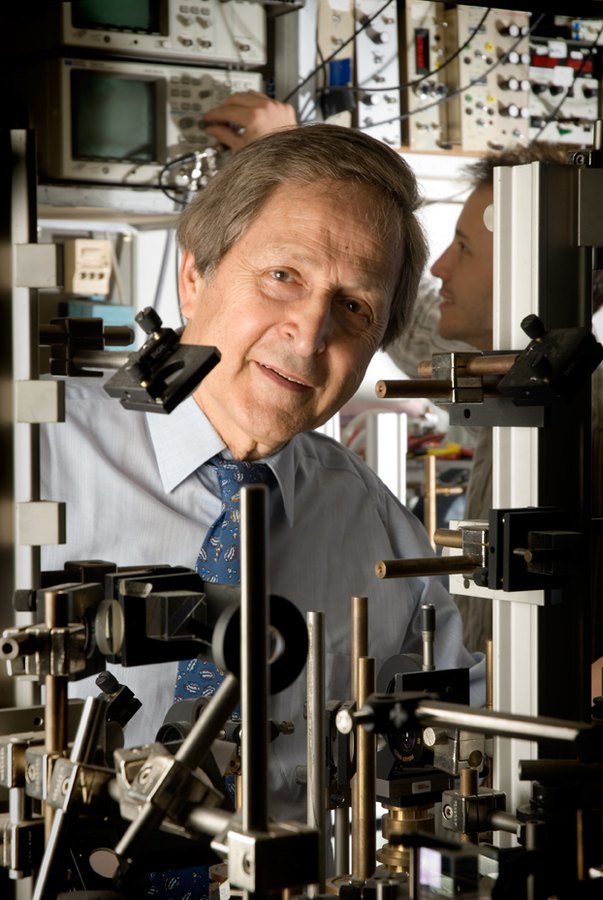
The Laboratoire Kastler Brossel in Paris confirmed the death of French physicist Claude Cohen-Tannoudji, who shared the 1997 Nobel Prize in Physics for developing techniques to cool and trap atoms with laser light. According to lkb.fr's report, Cohen-Tannoudji spent his entire research career at the École normale supérieure physics laboratory, joining in 1955 after studying mathematics and attending lectures by Alfred Kastler.
This report examines Cohen-Tannoudji's scientific discoveries, landmark quantum textbooks, and cold-atom manipulation milestones for physicists, researchers, and students. Over a six-decade career combining theoretical modeling with experimental verification, he established atomic cooling principles that remain foundational across modern quantum optics and precision metrology.
Claude Cohen-Tannoudji (Physics Nobel Prize: what actually changed
Cohen-Tannoudji transformed atomic physics by transitioning the field from passive observation of atomic vapours into active manipulation of neutral atoms using light. Defending his doctoral thesis in 1962, titled Quantum Theory of the Optical Pumping Cycle: Experimental Verification of Newly Predicted Effects, he demonstrated that light can shift atomic energy levels. This phenomenon proved vital following the advent of lasers, proving optical radiation directly alters atomic states. Working with his student Serge Haroche, Cohen-Tannoudji developed the concept of the dressed atom, demonstrating that an atom and its surrounding photon field form an inseparable whole whose physical properties are revealed by its energy-level diagram.
In 1984, Cohen-Tannoudji established a research group combining experimental and theoretical investigations on the physics of cold atoms at the Laboratoire Kastler Brossel, working alongside Alain Aspect, Jean Dalibard, and Christophe Salomon. The team was joined a few years later by Yvan Castin, followed by Michèle Leduc. This collaboration produced several world firsts in atomic manipulation, including the Sisyphus effect combining optical pumping and light shifts, cooling below the single-photon recoil limit, periodic lattices created by standing light waves, and experimental demonstrations of the optics and interference of matter waves in laboratory chambers.
Claude Cohen-Tannoudji (Physics Nobel Prize: how it works
The cooling process relies on the physical coupling between atomic ground states and spatial variations in standing laser waves. In the Sisyphus effect, counter-propagating laser beams create a standing wave with periodic polarization changes, modulating the energy levels of an atom across space through light shifts. When an atom traverses this optical potential landscape, it travels up a potential hill, converting kinetic energy into potential energy and slowing down. Near the peak of the hill, optical pumping transfers the atom into an adjacent lower energy sublevel, forcing the particle to repeatedly climb potential barriers.
This continuous dissipation reduces the kinetic energy of the atomic ensemble well past standard Doppler cooling thresholds. Using the dressed-atom concept, Cohen-Tannoudji and his team analyzed how atoms interact with photon fields, engineering cooling mechanisms that push particle temperatures below the single-photon recoil limit. Furthermore, standing light waves generated by laser interference create periodic optical lattices that trap neutral atoms at precise spatial intervals. Trapped in these standing waves, cold particles exhibit matter-wave properties, allowing experimentalists to control wave-packet trajectories and observe quantum interference patterns under stable vacuum conditions.
Advertisement
Tech Pulse Daily
Get tomorrow's pulse first
Join engineers who read Tech Pulse before stand-up. Free, weekday mornings.
Claude Cohen-Tannoudji (Physics Nobel Prize: why it matters now
Cohen-Tannoudji's experimental breakthroughs culminated in the 1997 Nobel Prize in Physics, awarded jointly to him, Steven Chu, and William D. Phillips for development of methods to cool and trap atoms with laser light. Concluding his Nobel lecture, Cohen-Tannoudji quoted Edmond Rostand: “C’est la nuit qu’il est beau de croire à la lumière” – “It is at night that it is beautiful to believe in the light.” His career distinctions also included election to the French Academy of Sciences in 1981 and the CNRS Gold Medal in 1996, establishing his standing across European physics institutions.
The methods developed by Cohen-Tannoudji continue to direct ongoing research programs at the Laboratoire Kastler Brossel in 2026. Recent achievements from the laboratory include Kyrylo Gerashchenko receiving 1er Accessit at the 2026 Dylan Cattiaux Thesis Prize for work on optomechanics and quantum measurements on 21/10/2026. Additionally, a 02/10/2026 scientific publication co-authored by Paul Indelicato demonstrated improved nuclear material monitoring using ultra-precise quantum sensors. These contemporary advances in exotic ions and simple-system metrology rely on precision laser manipulation, light-shift controls, and matter-wave confinement techniques originally established by Cohen-Tannoudji and his research group.
Claude Cohen-Tannoudji (Physics Nobel Prize: who is affected
University physics programs and generations of students remain directly influenced by Cohen-Tannoudji's dedication to teaching and disseminating knowledge. At the age of 34, he became a professor at the Faculty of Sciences in Paris, where he partnered with Bernard Diu and Franck Laloë to introduce a renewed approach to quantum physics education, publishing the landmark textbook known universally as the Cohen. In 1973, he was appointed to the Collège de France, where he taught for 31 years, using impeccably organized blackboards and handwritten notes to educate the French quantum optics and atomic physics community.
His academic influence expanded through further authoritative textbooks on quantum electrodynamics and light-matter interaction, co-written with Jacques Dupont-Roc, Gilbert Grynberg, and David Guéry-Odelin. Beyond lecture halls, Cohen-Tannoudji actively supported fellow researchers, using his 1981 election to the French Academy of Sciences to defend persecuted scientists internationally. His pedagogical and experimental leadership directly trained notable figures in modern physics, including his doctoral student Serge Haroche and laboratory collaborators Alain Aspect, Jean Dalibard, and Christophe Salomon, sustaining a culture of open knowledge sharing across global academic and research institutions.
Claude Cohen-Tannoudji (Physics Nobel Prize: what to watch
Research teams in quantum optics and metrology will continue tracking simple-system measurements and antimatter studies derived from Cohen-Tannoudji's laser-trapping frameworks. Recent work at the Laboratoire Kastler Brossel, including 17/09/2026 science outreach on antimatter co-authored by Nancy Paul, highlights ongoing tests of fundamental symmetries using precision spectroscopy. Observers are tracking how optical lattices, periodic standing waves, and matter-wave optics are deployed in next-generation atomic sensors, evaluating gravitational variations, atomic transition frequencies, and nuclear materials with measurement precision made possible by suppressing thermal velocity spreads through light-induced atomic cooling.
Academic archives and educational institutions will preserve Cohen-Tannoudji's teaching legacy through his published textbooks and Collège de France lecture materials. The Laboratoire Kastler Brossel in the École normale supérieure Department of Physics continues to maintain the combined theoretical and experimental culture he fostered across his career. As universities train future quantum physicists using the Cohen textbook, research facilities worldwide will apply his dressed-atom models and Sisyphus cooling mechanisms to develop portable quantum sensors, optical atomic clocks, and advanced matter-wave interferometers across industrial, laboratory, and national metrology environments.
Developer Action Items
- ☐ Verify the claim on the official Claude page (or HN Claude/Codex/Fable), not from this recap alone.
- ☐ Name the surface that moved — API, policy, model, hardware, or commercial terms — before you Slack the thread.
- ☐ Assign one owner a day to read the primary material and decide: this-sprint, this-quarter, or noise.
- ☐ Do not change production on day-one coverage. Watch the vendor changelog and one independent write-up first.
Claude Cohen-Tannoudji (Physics Nobel Prize FAQ
What did Claude Cohen-Tannoudji win the Nobel Prize in Physics for?
Claude Cohen-Tannoudji was jointly awarded the 1997 Nobel Prize in Physics with Steven Chu and William D. Phillips for developing methods to cool and trap atoms with laser light.
What is the Sisyphus effect discovered by Claude Cohen-Tannoudji's team?
The Sisyphus effect combines optical pumping and light shifts in a standing light wave to repeatedly force moving atoms up optical potential hills, dissipating kinetic energy and cooling them below standard Doppler limits.
What is the dressed atom concept developed by Claude Cohen-Tannoudji?
Developed with Serge Haroche, the dressed atom concept treats an atom and surrounding photons as an inseparable whole whose physical properties are revealed through its coupled energy-level diagram.
Which textbooks did Claude Cohen-Tannoudji publish?
He co-authored the landmark quantum mechanics textbook known as the Cohen with Bernard Diu and Franck Laloë, alongside works on quantum electrodynamics and light-matter interactions with Jacques Dupont-Roc, Gilbert Grynberg, and David Guéry-Odelin.
Sources

Author
Dillip Chowdary
Writes Tech Bytes coverage of AI, engineering, and the tools that actually ship. Editor of Tech Pulse Daily.
Related on Tech Bytes
Advertisement