Cloud Pathways, a distributed ML runtime for massive accelerator fleets
Google Cloud launched Cloud Pathways as a GA runtime on GKE, logging 130M TPU chip-hours across v5e, v5p, Trillium v6e, and Ironwood 7x accelerator clusters.
By Dillip Chowdary • Nov 09, 2026 • Source: Google Cloud Blog
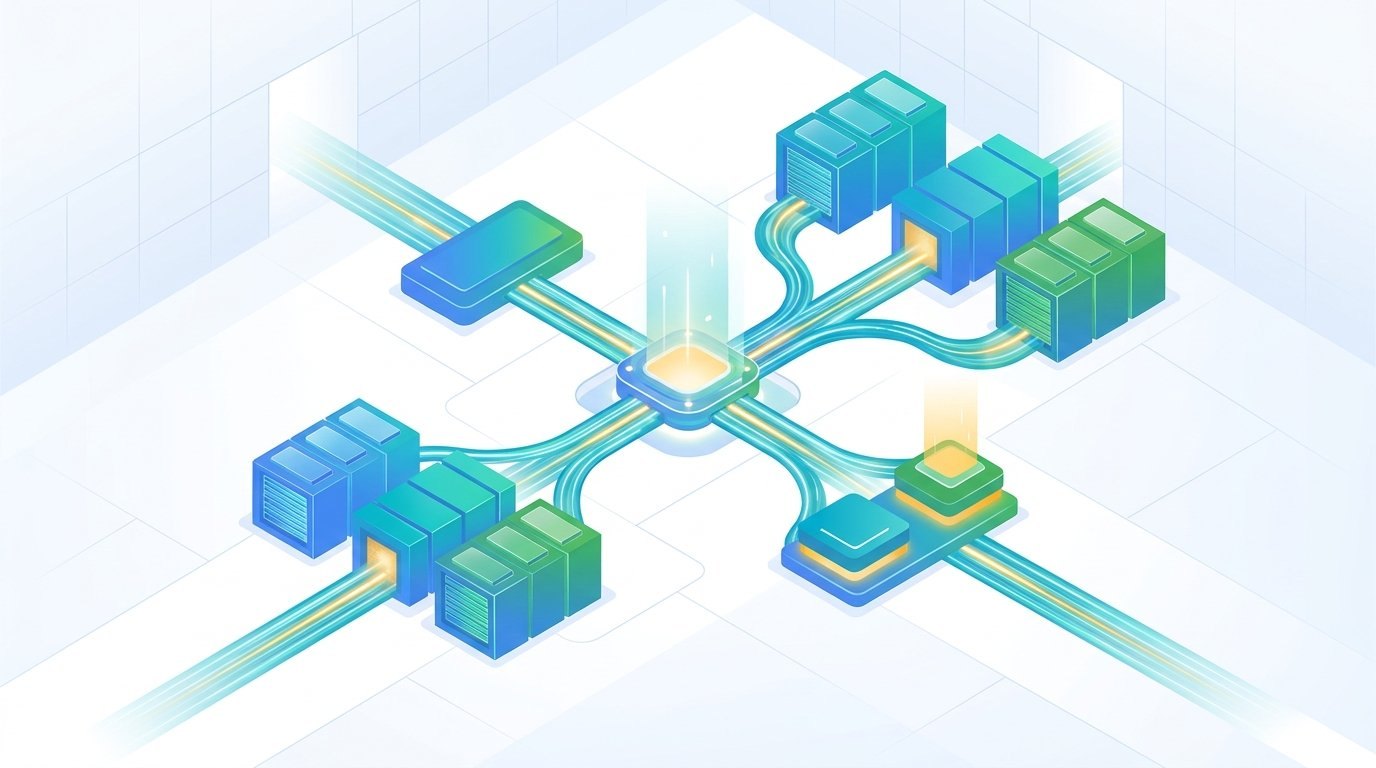
Google Cloud announced the general availability of Cloud Pathways on Google Kubernetes Engine, establishing the distributed machine learning runtime as a foundational component of the Google Cloud AI Hypercomputer stack. Originally created by Google DeepMind to train and serve frontier systems including Gemini, the system manages massive fleets of heterogeneous accelerators across multi-slice topologies. According to Google Cloud Blog's report, enterprise customers and research institutions logged more than 130 million Cloud TPU chip-hours on the platform over the past 90 days alone.
This report breaks down the architectural shift from traditional multi-controller frameworks to single-client orchestration, examining the operational implications for machine learning infrastructure teams and research engineers scaling multi-slice training. Readers will find details on supported accelerator families, resilience mechanisms that handle hardware interruptions, container deployment requirements, and the technical integrations enabling elastic reinforcement learning workflows. The analysis also reviews the platform's preview support for high-performance computing schedulers and outlines the exact requirements for upgrading existing JAX environments to production-ready Cloud Pathways clusters.
What Cloud Pathways shipped
Google delivered Cloud Pathways as a fully supported production runtime across Google Kubernetes Engine, opening DeepMind's distributed execution engine to all cloud customers. The core platform introduces a single-controller management model built on top of the open-source Interim Framework Runtime, allowing one client process to direct thousands of accelerator chips. In addition to GKE availability, the rollout includes a Preview release for Cluster Director that connects Pathways to Slurm environments, enabling researchers to run unified multi-slice JAX execution alongside interactive notebooks and elastic training runs.
The release packages client-side colocated Python sidecars equipped with shared-memory capabilities, which let engineering teams execute distributed data pipelines and checkpointing tasks directly on accelerator host nodes. For interactive experimentation and multi-tenant resource optimization, Google deployed the Shared Pathways Service alongside an interactive terminal mode. This service maintains a persistent pool of Cloud TPU slices that multiple engineers can access on demand for inspection and iterative testing, replacing rigid static reservations with dynamic multi-user scheduling across large accelerator topologies.
What changed for builders in Cloud Pathways
Standard distributed JAX setups require multi-controller execution where every individual TPU host runs an independent Python interpreter with only localized device visibility. This setup forces every node into lockstep SPMD operations, turning multi-program reinforcement learning loops and cross-slice resource distribution into brittle pipelines. Cloud Pathways resolves this bottleneck by routing operations through a centralized coordinator via proxy bindings. A single client manages overall graph evaluation, delegates persistent compilation caching to Cloud Storage, and triggers asynchronous XLA HLO dispatch across multiple TPU slices without coordinating separate interpreters.
| Capability | Standard Multi-Controller JAX | Cloud Pathways on GKE |
|---|---|---|
| Control Plane | Localized Python interpreter per host | Single centralized client via IFRT proxy |
| Execution Model | Strict SPMD lockstep across hosts | Asynchronous XLA HLO dispatch across slices |
| Compilation Cache | Host-local compilation overhead | Persistent Cloud Storage compilation caching |
| Fault Handling | Hardware fault crashes entire client | Elastic resharding down to N-1 slices |
| Quarterly Scale | Constrained by manual host recovery | Over 100M chip-hours per quarter logged |
Fault handling undergoes a significant shift through pathwaysutils elastic training primitives that decouple job execution from node-level hardware interruptions. Using host-memory snapshots, the runtime dynamically detects hardware faults and meshes the remaining topology down to N-1 slices without dropping client state. Large-scale enterprise benchmarks highlight this resilience: one global consumer platform maintains production batch and reinforcement learning inference across tens of thousands of TPU v5p, Trillium v6e, and Ironwood TPU 7x chips, recording over 100 million chip-hours quarterly while co-designing elastic pre-training primitives.
Advertisement
Tech Pulse Daily
Get tomorrow's pulse first
Join engineers who read Tech Pulse before stand-up. Free, weekday mornings.
How to install or upgrade Cloud Pathways
Adopting Cloud Pathways requires migrating existing training jobs to JAX version 0.10.1 or newer and targeting Google's versioned container images. Builders configure their client runtime environment to route through the proxy interface, enabling pathwaysutils to coordinate multi-slice execution. Google distributes official container images through the Artifact Registry, packaging the complete runtime dependencies needed for GKE nodes and colocated Python sidecar containers. Organizations using Cluster Toolkit can declare cluster topologies through standard specification files, while Slurm administrators initiate deployment using the Cluster Director integration workflow.
export JAX_PLATFORMS=proxy
docker pull us-docker.pkg.dev/cloud-tpu-v2-images/cloud-pathways:latest
gcluster deploy pathways-cluster --config=gke-tpu.yaml
To activate single-controller orchestration within existing pipelines, ML engineers import pathwaysutils inside their training script and set the proxy execution platform before initializing device meshes. When configuring Kubernetes workloads, manifests must mount shared-memory volumes for the colocated Python sidecar containers to support high-throughput data loading. Upgrading teams must also point their compilation cache targets to dedicated Google Cloud Storage buckets, ensuring that XLA compilation artifacts persist across cluster resizes, scheduled maintenance events, and dynamic elasticity adjustments.
Gotchas and compatibility in Cloud Pathways
Infrastructure engineers must note specific hardware and version boundaries before planning migrations. Cloud Pathways is generally available exclusively in Google Cloud regions that provide Cloud TPU v5e, TPU v5p, Trillium TPU v6e, and Ironwood TPU 7x accelerators. Workloads running on older TPU generations or unsupported geographic zones cannot access the single-controller runtime. Furthermore, codebases depending on legacy JAX releases prior to version 0.10.1 require framework upgrades, which may expose deprecated API usages or incompatible custom XLA primitives that must be resolved before deployment.
Operational considerations also apply to cluster orchestrators and fault handling configurations. While GKE support is fully production-ready, Slurm cluster integration through Cluster Director remains in Preview and requires testing before deployment to mission-critical research pipelines. Additionally, elastic resharding to N-1 slices depends on host-memory snapshotting configured through pathwaysutils. Workloads that do not implement snapshotting or rely on rigid tensor shapes cannot adapt dynamically to chip drops, causing interrupted jobs to require standard checkpoint recovery rather than seamless live resharding.
What to watch after Cloud Pathways
Real-world validation from early foundation model developers demonstrates how the runtime alters long-running research operations. Scientific foundation model startup ZenteiQ deployed Cloud Pathways on GKE with Cluster Toolkit, pairing MaxText pre-training and MaxText with Tunix reinforcement learning across multi-slice Trillium clusters. According to ZenteiQ founder Professor Sashikumaar Ganesan, the controller continuously monitors TPU topology and automatically re-meshes the cluster whenever hardware faults occur. This automated elasticity sharply reduces idle stall times and eliminates the need for manual restarts during multi-day pre-training campaigns.
Google's broader roadmap signals deeper integration across accelerator hardware and orchestration tooling. Recent infrastructure announcements highlighted new TPU architectures, including 8tx and 8i Max silicon built for agentic workloads, alongside TPU Sync protocols designed for rapid key-value cache and weight transfer during reinforcement learning. Engineering teams should track the graduation of Slurm support in Cluster Director toward general availability, as well as ongoing updates to the open-source Interim Framework Runtime that could bring broader multi-program machine learning paradigms to heterogeneous cloud fleets.
Developer Action Items
- ☐ Diff the official changelog for Gemini / Google / Framework before you bump — APIs, defaults, and removed flags only.
- ☐ Install through the vendor's documented channel in staging; keep a one-command rollback and time-box the canary.
- ☐ Grep your repo for old flag names, lockfile pins, and plugin versions that the notes mark as breaking.
- ☐ Prefer the first patch cut over the day-zero tag unless you have a reason to be on the leading edge.
- ☐ If Google Cloud Blog did not name a region, plan, or SKU, screenshot the official availability line before you promise it to users.
Cloud Pathways FAQ
What is Cloud Pathways on Google Cloud?
Cloud Pathways is a distributed machine learning runtime on Google Kubernetes Engine that provides a unified single-controller architecture for orchestrating massive accelerator fleets.
Which accelerator hardware supports Cloud Pathways?
Cloud Pathways is available on Google Kubernetes Engine in regions supporting Cloud TPU v5e, TPU v5p, Trillium TPU v6e, and Ironwood TPU 7x chips.
What minimum software versions are required?
The runtime requires JAX version 0.10.1 or higher and uses official container images hosted on Google Cloud Artifact Registry configured with the proxy platform.
How does Cloud Pathways handle accelerator hardware failures?
The runtime uses pathwaysutils and host-memory snapshots to dynamically reshard training down to N-1 slices during hardware faults without crashing the central client process.
Sources

Author
Dillip Chowdary
Writes Tech Bytes coverage of AI, engineering, and the tools that actually ship. Editor of Tech Pulse Daily.
Related on Tech Bytes
Advertisement