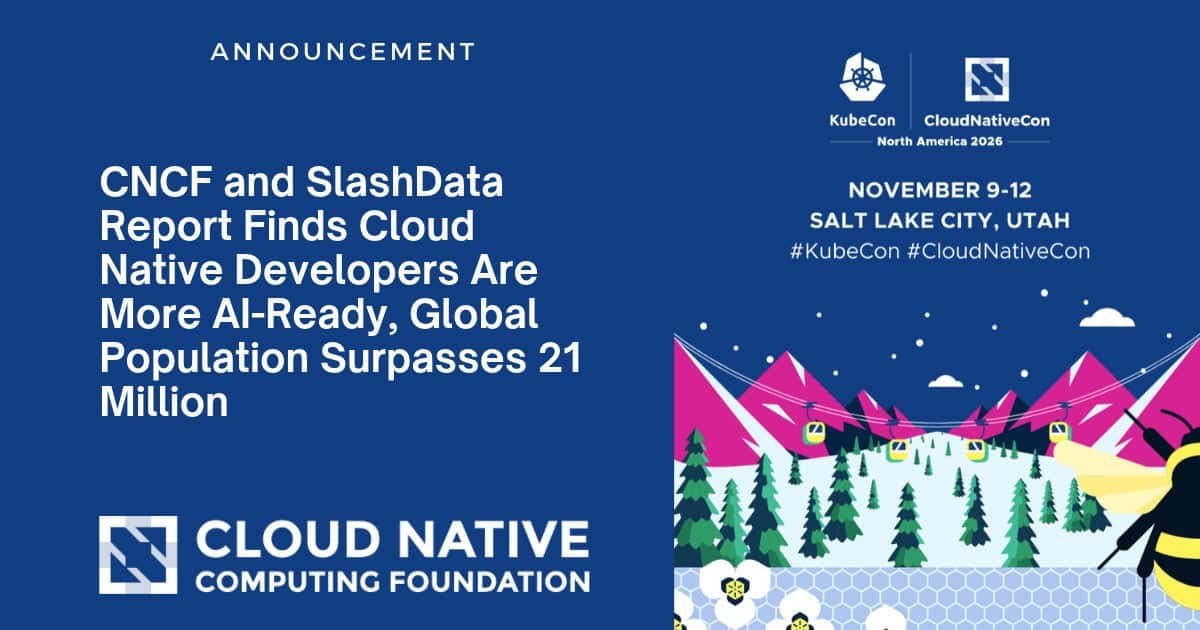
CNCF and SlashData Report Finds Cloud Native Developers Are More AI-Ready
CNCF and SlashData report the global cloud native developer population reached 21.2 million, with 75% adopting AI coding tools across production environments.
By Dillip Chowdary • Nov 11, 2026 • Source: CNCF Blog
The Cloud Native Computing Foundation and SlashData released their State of Cloud Native Development Q3 2026 report at KubeCon and CloudNativeCon North America in Salt Lake City on Nov. 10, 2026. According to CNCF Blog's report, the global cloud native developer population reached an estimated 21.2 million engineers, representing approximately 41% of all developers worldwide. Research shows that 75% of cloud native developers now use AI coding tools, outpacing their non-cloud native peers significantly across engineering disciplines.
This analysis details the demographic growth, AI integration trends, platform standardization metrics, and architectural tooling distributions established across global engineering teams. The findings serve platform engineers, backend developers, infrastructure architects, and engineering managers evaluating how cloud native maturity correlates with AI tool adoption and production agentic system deployment.
01Global developer community reaches 21.2 million
The worldwide cloud native developer population expanded from 15.6 million in Q3 2025 to 19.9 million in Q1 2026, officially climbing to 21.2 million in Q3 2026. This census marks the first instance where the measured population crossed the 20 million milestone. North America accounts for approximately 4 million of these engineers, reinforcing its foundational role in hosting cloud native workloads.
Cloud native practitioners now constitute 41% of the total developer workforce worldwide. Participation is particularly concentrated among backend specialists, where more than 80% of professional backend services and web backend developers employ cloud native practices. In addition, approximately 7.5 million dedicated AI developers work within cloud native environments.
Although population growth moderated over the past six months, the expansion reflects cloud native methods spreading beyond core backend infrastructure. Industry analysts note that increased reliance on managed offerings and internal developer platforms often abstracts underlying software, meaning developers utilize cloud native foundations without necessarily managing raw infrastructure components.
02AI coding adoption and agentic systems
Cloud native developers demonstrate substantially higher AI adoption rates than non-cloud native peers across active development tracks. While 75% of cloud native engineers rely on AI coding assistants, only 55% of non-cloud native developers use comparable tooling. A similar split appears in service integration, where 67% of cloud native builders embed AI into applications compared to 38% of non-cloud native teams.
| Metric | Non-Cloud Native | Cloud Native |
|---|---|---|
| AI Coding Tool Adoption | 55% | 75% |
| AI Integration in Services | 38% | 67% |
| Share of Agentic Builders | 45% | 55% |
| Q3 2025 Standardized Platform Adoption | 77% | 77% |
| Q3 2026 Standardized Platform Adoption | 93% | 93% |
Among all developers who embed AI capabilities into services, 49% report operating agentic systems in production across internal or customer-facing workloads. Within the segment building agentic software, 55% are cloud native developers, while the remaining 45% construct agentic workflows without directly managing cloud native layers.
Advertisement
Tech Pulse Daily
Get tomorrow's pulse first
Join engineers who read Tech Pulse before stand-up. Free, weekday mornings.
03Human oversight and regional coding habits
The research highlights that engineering maturity dictates how developers apply AI capabilities to their pipelines rather than eliminating oversight. Rather than deploying purely automated systems, teams continue using established governance around code quality, operational verification, and operational control.
In North America, deliberate human oversight remains the dominant development standard. Approximately 21% of cloud native engineers in the region use AI systems to draft initial code before conducting manual reviews and edits. Only 12% of North American developers deploy fully autonomous coding agents for their day-to-day software development tasks.
SlashData and CNCF analysts observed that while cloud native developers adopt AI tools at higher volumes, workflows remain consistent once tooling is active. As organizations scale AI workloads, open source technologies like Kubernetes and OpenTelemetry provide the operational reliability, compute scheduling, and observability needed to maintain distributed agentic deployments.
04Internal developer platforms and infrastructure tools
Platform engineering and organizational DevOps standardization surged over the past year, rising from 77% of developer organizations in Q3 2025 to 93% in Q3 2026. Organizations increasingly deploy internal developer platforms to centralize workflows, accelerate release velocity, and standardize routine deployment steps.
API gateways represent the most widely used backend infrastructure component, utilized by 40% of surveyed backend engineers. Microservices architectures follow at 30% adoption, while observability platforms account for 21% of active deployments across complex cloud topologies.
Direct Kubernetes use is reported by 19% of backend developers, though researchers point out that platform abstraction layers frequently hide raw orchestration clusters from day-to-day users. Advanced reliability techniques see targeted deployment, with immutable infrastructure adopted by 8% of respondents and chaos engineering practices registered at 7%.
05Adoption barriers and distributed scaling demands
Non-adopters identify compute costs, data privacy, and security risks as their primary obstacles when considering AI integration into core services. These concerns require development teams to implement rigid governance frameworks before deploying complex inference pipelines into live operating environments.
As agentic software moves into production, new challenges emerge around compute scheduling, operational resource efficiency, and distributed cluster observability. These operational constraints closely align with the core capabilities established by cloud native frameworks and platform engineering disciplines.
The findings demonstrate that cloud native platforms remain the baseline execution environment for modern software delivery. Whether developers manage Kubernetes clusters directly or consume managed AI APIs, cloud native foundations support the infrastructure scale necessary for production AI workloads.
CNCF and SlashData Report Finds Cloud Native FAQ
What share of cloud native developers use AI coding tools according to the report?
The report found that 75% of cloud native developers use AI coding tools, compared to 55% of non-cloud native developers.
How large is the global cloud native developer population in Q3 2026?
The worldwide cloud native developer population reached an estimated 21.2 million engineers, representing approximately 41% of all developers globally.
How many developers currently have agentic AI systems running in production?
Among developers who integrate AI capabilities into their services, 49% report having agentic systems running in internal or external production environments.
What percentage of organizations use DevOps standardization or internal developer platforms?
The report states that 93% of developers now work at organizations using DevOps standardization or internal developer platforms, up from 77% in Q3 2025.
Sources

Author
Dillip Chowdary
Writes Tech Bytes coverage of AI, engineering, and the tools that actually ship. Editor of Tech Pulse Daily.
Related on Tech Bytes
Advertisement