Commodore PET – The Worlds First Personal Computer
Commodore unveiled the PET 2001 with a 1 MHz MOS 6502 processor and an integrated 9-inch monitor, establishing the first all-in-one personal computer in 1977.
By Dillip Chowdary • Nov 08, 2026 • Source: commodore.ca
Commodore Business Machines launched the Commodore PET in January 1977 at the Consumer Electronics Show in Chicago, introducing the world's first personal computer months before the Apple II or Radio Shack TRS-80. According to commodore.ca's report, the machine arrived ready out of the box with a 1 MHz MOS 6502 processor, an integrated nine-inch blue-and-white monitor, a built-in cassette drive, and a keyboard with a dedicated numeric pad.
This report covers the engineering history of the PET 2001 under Chuck Peddle, its manufacturing in Palo Alto, Jack Tramiel's pricing and distribution decisions, the landmark Microsoft operating system license, and the dual-processor SuperPET workstation. The analysis is intended for computer historians, software developers, and systems architects examining how early consumer hardware established microcomputing standards.
Commodore PET – The Worlds First Personal: what actually changed
Before the PET debuted, microcomputers like the Altair 8800, the IMSAI 8048, the Southwest Technical 6800, and the Processor Technology SOL existed primarily as circuit-board kits aimed at hobbyists inside the Homebrew Computer Club. Commodore changed that paradigm by supplying a complete, operational consumer machine out of the shipping carton. The original PET 2001 eliminated external wiring by enclosing the power supply, a 9-inch monitor, an internal cassette drive, and a 47-pound stamped metal chassis into a single, unified desktop unit.
Moving from hobbyist kits to factory hardware required practical manufacturing trade-offs. Although designer Ira Velinsky conceived rounded contours for the initial prototype, Commodore selected square sheet-metal casework borrowed from its existing office filing cabinet lines to keep production expenses low. Inside this enclosure, Commodore fitted a calculator-derived chiclet keyboard with a separate numeric pad, expansion sockets for extra memory or auxiliary processor boards, an RS-232 serial interface, and built-in support for upper and lower case text alongside custom hardware graphic characters.
Commodore PET – The Worlds First Personal: how it works
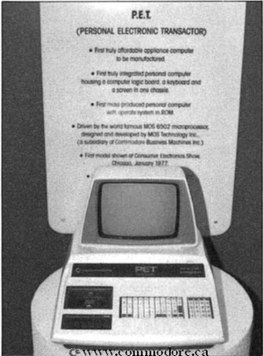
The system ran on a 1 MHz MOS 6502 microprocessor, an affordable chip engineered in spring 1976 by Chuck Peddle and former Motorola staff who previously created the KIM-1 trainer. The PET paired this chip with 4 kilobytes of memory, providing 4,096 addressable bytes, alongside expansion sockets for additional memory hardware. Instead of forcing owners to load system software manually from cassette tape during power-on, the machine stored its operating system directly on read-only memory chips, allowing it to boot instantly upon activation.
Software operations ran through Commodore BASIC, authored by Bill Gates and Paul Allen at Micro-Soft Corporation. Commodore acquired an unlimited software license for the language in 1976 and 1977, allowing the firm to distribute the code across millions of future computers without paying subsequent royalties. User data and programs saved directly to magnetic tape via the built-in cassette drive, while internal display circuits transferred character matrices to the integrated nine-inch blue-and-white screen without requiring external television adapter boxes or modulators.
Advertisement
Tech Pulse Daily
Get tomorrow's pulse first
Join engineers who read Tech Pulse before stand-up. Free, weekday mornings.
Commodore PET – The Worlds First Personal: why it matters
The PET established Commodore in microcomputing after founder Jack Tramiel secured a three-million-dollar loan guarantee from Canadian investor Irving Gould in summer 1977 to acquire Pennsylvania-based MOS Technology. That acquisition transferred ownership of semiconductor production facilities, staff, key patents, and Chuck Peddle's computer concept directly to Commodore. Instead of depending on external component suppliers, Commodore secured vertical integration, assembling the 47-pound desktop systems at its original United States manufacturing plant situated in Palo Alto, California, where early output first began to ramp.
Widespread visibility quickly transformed customer expectations for consumer hardware. After appearing on the cover of Popular Science in October 1977 and gaining featured reviews in Playboy and Electronics Today in February 1978, public inquiries surged beyond production volumes. During the initial months, the Palo Alto facility assembled only about 30 units per day, completing just 500 total machines in its first operational year. Despite those constraints, the PET proved that fully integrated personal computers possessed genuine commercial demand across retail consumer markets.
Commodore PET – The Worlds First Personal: who is affected
Independent retail businesses faced rigid operational hurdles to secure distribution rights, even as Commodore received up to 50 dealership inquiries daily. Jack Tramiel required all prospective merchants to possess a solid business history, an active storefront, an in-store repair technician, an inventory of replacement parts, and full advance cash deposits before orders shipped. Retail consumers faced three- to six-week delivery delays, while mail-order prices climbed quickly from 495 dollars to 595 dollars once initial demand surged for the 4K entry model.
Commodore subsequently steered buyers toward the 795-dollar 8K model by advertising earlier delivery schedules over backordered 4K systems. European customers absorbed higher price increases when exports began in 1978 under the Commodore PET 3008, 3016, and 3032 badges. Tramiel doubled retail prices across European markets while changing only the power supply to a 220-watt unit. The rebranded 3000 series succeeded commercially despite the inflated markup, demonstrating that overseas professional and educational buyers were willing to pay premium prices for self-contained desktop computing hardware.
Commodore PET – The Worlds First Personal: what to watch
Persistent customer criticism regarding the compact chiclet keyboard prompted Commodore to introduce a full-sized typewriter keyboard within a year of launch, removing the integrated cassette drive to accommodate the larger layout. The manufacturer also replaced the heavy sheet-metal chassis with lighter plastic cases and released a 12-inch green-and-white display model dubbed the Fat 40 in 1980. Expanded peripheral support followed, including external single 170K floppy disk drives like the model 2031, alongside updated business-oriented desktop variants such as the PET 4016 and 8032 computers.
Technical development reached a high point with the SuperPET, engineered alongside Ontario's University of Waterloo and produced by BMB CompuScience in Milton, Ontario. Built upon the PET 8032, the system added an expansion board with a Motorola 6809 processor and 64 kilobytes of RAM, with two toggle switches on the chassis to alternate CPU modes. Priced at 2,795 dollars or available as a 795-dollar upgrade kit, the dual-processor workstation ran Waterloo MicroAPL, MicroFORTRAN, MicroBASIC, MicroPASCAL, and MicroCOBOL, enabling students to program offline before transmitting data to expensive institutional mainframes.
Developer Action Items
- ☐ Verify the claim on the official Apple / Microsoft page (or Hacker News Front Page), not from this recap alone.
- ☐ Name the surface that moved — API, policy, model, hardware, or commercial terms — before you Slack the thread.
- ☐ Assign one owner a day to read the primary material and decide: this-sprint, this-quarter, or noise.
- ☐ Do not change production on day-one coverage. Watch the vendor changelog and one independent write-up first.
Commodore PET – The Worlds First Personal FAQ
When was the Commodore PET first demonstrated to the public?
The Commodore PET was first demonstrated in January 1977 at the Consumer Electronics Show in Chicago. It was revealed months before competing consumer systems like the Apple II and Radio Shack TRS-80.
What processor and base memory specifications did the original PET 2001 include?
The original PET 2001 ran on a 1 MHz MOS 6502 microprocessor. It shipped with 4 kilobytes of memory, providing 4,096 addressable bytes, alongside an integrated cassette storage drive.
How did Commodore obtain the operating system and BASIC interpreter for the PET?
Commodore licensed Commodore BASIC from Bill Gates and Paul Allen at Micro-Soft Corporation in 1976 and 1977. The contract was a perpetual, flat-fee license granting unlimited usage across all future machines without recurring per-unit royalties.
What was the Commodore SuperPET co-processor system?
Developed with the University of Waterloo, the SuperPET combined a PET 8032 with a secondary Motorola 6809 processor and 64 kilobytes of extra memory. Physical toggle switches on the chassis allowed users to switch CPU modes and run Waterloo programming languages offline from mainframes.
Sources

Author
Dillip Chowdary
Writes Tech Bytes coverage of AI, engineering, and the tools that actually ship. Editor of Tech Pulse Daily.
Related on Tech Bytes
Advertisement