Coordinating Codex and Claude Across macOS, Linux, and Windows
Tasklease launched as an open-source task coordinator using Cloudflare Workers and SQLite to sync Claude and Codex agents across macOS, Linux, and Windows.
By Dillip Chowdary • Nov 17, 2026 • Source: provos.org
At a glance
- Product
- Tasklease
- License
- Apache-2.0
- Runtime
- Python 3.12 or newer
- Cloud runtime
- Cloudflare Workers and SQLite Durable Objects
- Benchmark scale
- 181 requests per second with 5,000 workers
- Verification runs
- 13 requests totalling 348 minutes
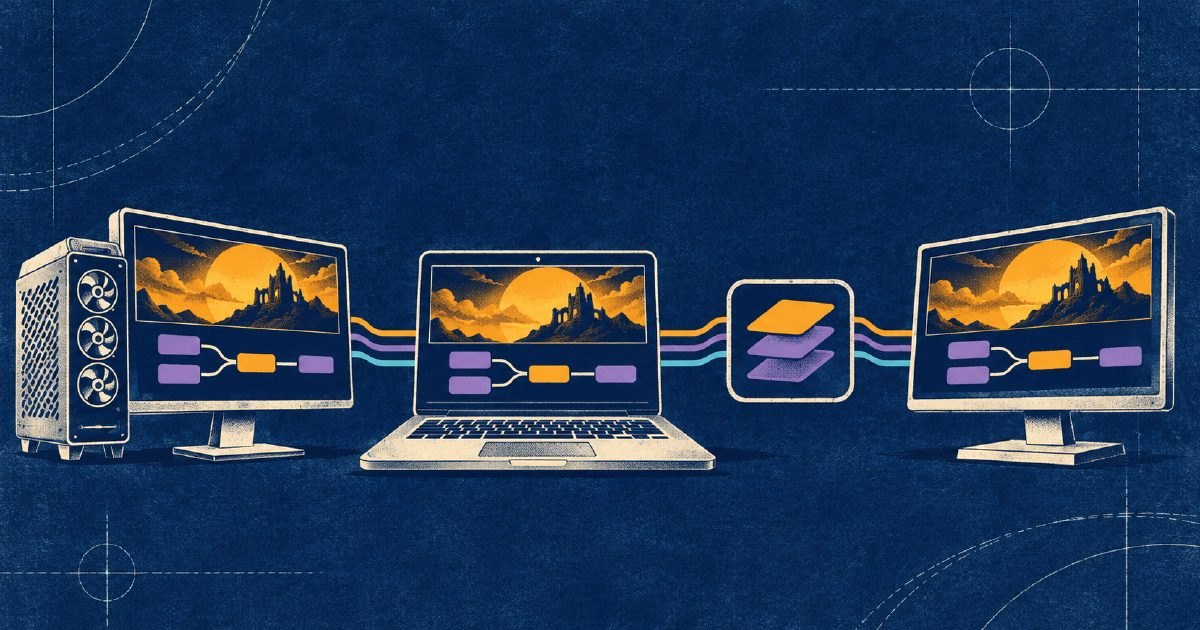
Provos launched Tasklease, an open-source task coordinator designed to synchronize software engineering workflows across operating systems and AI agent runtimes. According to provos.org's report, the system was built to coordinate development of FluxShot Editor, a node-based visual effects compositor for macOS, Linux, and Windows. While macOS and Linux builds were nearly complete, the Windows port required an automated way for Codex and Claude Code to exchange context and run remote tests without static network addresses.
This report details how Tasklease handles asynchronous agent communication, atomic work claiming, and cross-platform verification for multi-machine software projects. It is designed for engineers running multi-agent workflows across disparate machines who need verifiable execution logs without managing complex network routing. The tool executes entirely on personal Cloudflare infrastructure, removing inbound firewall requirements for roaming workstations.
01Outbound HTTPS connections and Durable Objects
Tasklease operates within a user's Cloudflare environment to coordinate tasks across separate developer environments. An HTTPS API hosted on Cloudflare Workers receives incoming commands, SQLite Durable Objects store the active work queues, and Cloudflare R2 stores large build artifacts including test execution logs. Every participating workstation initiates outbound HTTPS connections to poll for pending assignments, allowing moving laptops to reconnect seamlessly from changing networks without requiring static addresses.
Work distribution relies on structured JSON payloads targeted at specific topic paths. For instance, a macOS client submits a test job to verify/linux specifying the repository, target commit, verification profile, and a return topic like verified/mac-1. A deterministic Linux worker claims the pending task, checks out the code, executes tests, and uploads resulting logs directly to R2 storage before reporting completion.
Atomic state management ensures that task removal and response registration occur in a unified transaction. Tasklease deletes the request from the active queue within the identical SQLite transaction that registers the completed reply. The originating workstation saves the incoming response to local disk before acknowledging the remote server copy, preventing data loss when client machines disconnect while remote hardware executes jobs.
02Atomic transactions and twenty-four-hour task leases
The coordination protocol relies on four core primitives to survive machine restarts, network failures, and session interruptions. Topic queues route incoming tasks to specialized pools where worker instances compete to claim available jobs. Each claimed task receives an active lease lasting up to 24 hours, with the local worker runtime automatically issuing renewal heartbeats during long-running compilation or rendering tasks.
Task identifiers regenerate dynamically whenever a claim occurs to prevent stale executions from overwriting fresh state. If a disconnected worker reconnects after its lease expires and another worker claims the work, the original worker cannot complete the job or submit late responses. A single consume operation can finish an existing task, record its reply, and spawn up to 16 downstream successor tasks inside a single SQLite transaction.
The platform preserves an origin_id field across all claims, state transitions, and downstream successor tasks to let requesters match results back to initial requests. Formal verification with Hypothesis tests validated the protocol against an independent state model across lease expirations, stale identifiers, and dropped packets. A bounded TLA+ model further verified that retired task identifiers stay permanently retired while successor trees retain proper origin lineage.
03Nineteen cross-platform messages and test suite results
Advertisement
Tech Pulse Daily
Get tomorrow's pulse first
Join engineers who read Tech Pulse before stand-up. Free, weekday mornings.
Real-world usage during the FluxShot Editor test suite port demonstrated continuous communication between distinct AI models. Over a single afternoon session lasting 4 hours and 52 minutes, an automated Codex session running on Windows exchanged 19 messages with a Claude Code adviser operating on macOS. The logged transcript recorded seven technical questions, seven immediate answers, and five operational status updates concerning test suite triage and merge readiness.
The communication exchange enabled the Windows Codex instance to query existing macOS test failures and determine which components to port next without manual copying between terminal windows. From November 9 through November 12, the macOS workstation dispatched 13 remote verification requests across Linux and Windows machines, accumulating 348 minutes of total execution time. Individual Windows foundation test passes completed between 3.1 and 4.5 minutes from initial claim to final reply.
Automated Linux graphics testing validated the compositor under simulated display servers without manual intervention. A dedicated Linux test worker successfully executed 111 display tests under Xvfb, recording the diagnostic output and uploading logs to R2 storage. These runs allowed the development agent to verify visual rendering output and pull request readiness across remote hardware before merging code changes into the shared repository.
04Workflow boundaries and five thousand worker benchmarks
Tasklease provides low-level coordination for multi-platform environments containing heterogeneous operating systems and dedicated GPU hardware. Synthetic load testing on a paid Cloudflare Workers plan demonstrated sustainable throughput under high concurrency. During benchmark testing with 5,000 simulated workers polling every 30 seconds with individual authentication tokens, a single domain processed 181 API requests per second without encountering request errors.
The system deliberately omits complex state management features to keep the coordination runtime minimal and deterministic. Tasklease contains no native constructs for parallel join barriers, durable timers, or automated compensation logic, leaving multi-step dependency orchestration to the surrounding client applications. Distributed development setups requiring complete, durable workflow history and orchestration rollback typically deploy specialized engines alongside task transport systems.
| Architecture Feature | Tasklease | Temporal |
|---|---|---|
| Execution Scope | Stateless task leasing and replies | End-to-end durable orchestration |
| Storage Backing | Cloudflare SQLite Durable Objects | Relational database cluster |
| Join Handling | Managed by client application | Built-in workflow primitives |
| High Scale Testing | 181 requests per second | Enterprise cluster limits |
Note: Tasklease delegates advanced orchestration responsibilities such as parallel join barriers, durable delay timers, and compensation logic directly to calling applications. When an engineering pipeline requires end-to-end audit trails or durable execution graphs across multi-day pipelines, external engines like Temporal should be integrated on top of the lease transport layer.
05Python runtime installation and Cloudflare deployment
Deploying the coordination service requires Node.js, an active Cloudflare account with Workers and R2 enabled, and Python 3.12 or newer. The client tooling and background worker daemon distribute through standard Python packaging utilities. The installation command compiles the service bundle, provisions the Cloudflare Worker, configures SQLite Durable Objects, and initializes the remote R2 storage bucket.
- Tool installation Install the command-line utility across environments using uv tool install tasklease on Python 3.12 or newer.
- Account authentication Sign in to your Cloudflare account from the command line by executing npx wrangler login.
- Infrastructure deployment Provision the worker and storage by running tl service deploy with service.toml, worker name, and bucket flags.
- Credential configuration Export the generated administrator secret to TL_ADMIN_TOKEN and configure R2 bucket access credentials.
- Worker activation Launch the background execution process on the remote test runner with tl --config worker.toml worker.
- Task dispatch Send verification payloads from the client workstation using tl --config requester.toml request with wait flags.
Administrators generate scoped identity tokens that restrict which topic queues each machine can create, claim, or inspect. The command-line client validates end-to-end request, claim, and reply paths using a local echo topic before connecting production handlers. The complete Tasklease framework, worker runtime, and verification specifications are open-source software published under the Apache-2.0 license on GitHub.
Frequently asked questions
What problem does Tasklease solve for multi-agent workflows?
It provides an asynchronous, queue-based coordination layer that lets coding agents on different operating systems exchange questions and run tests across roaming networks without fixed IP addresses.
How does Tasklease prevent stale workers from submitting outdated results?
Every task claim regenerates the task identifier, immediately invalidating previous IDs so that disconnected workers whose 24-hour leases expired cannot complete tasks or submit late replies.
What infrastructure is required to deploy Tasklease?
Deployment requires Node.js, Python 3.12 or newer, and a Cloudflare account with Workers, SQLite Durable Objects, and R2 object storage enabled.
Does Tasklease include built-in workflow joins and durable timers?
No, Tasklease intentionally delegates join barriers, timers, and compensation logic to application code, recommending external workflow engines like Temporal when complete execution histories are needed.
Sources

Author
Dillip Chowdary
Writes Tech Bytes coverage of AI, engineering, and the tools that actually ship. Editor of Tech Pulse Daily.
Related on Tech Bytes
Advertisement