Data farmers: Ag-tech startup Aigen grows AI-generated weeds to train its
Aigen developed the Alchemy synthetic data platform to train solar weeding robots in one week, selling out 2027 fleets as diesel hits $6.30 a gallon.
By Dillip Chowdary • Oct 24, 2026 • Source: GeekWire Startups
Redmond, Washington agricultural robotics startup Aigen has developed a synthetic data pipeline called Alchemy that generates digital weeds and plants in simulation to train its autonomous, solar-powered field robots. The synthetic generation approach reduces the training cycle for adding new crops from three to four years of manual photography down to roughly one week, according to GeekWire Startups's report. By eliminating the multi-year cycle required to collect and manually annotate real-world agricultural imagery, the startup has expanded its weed-pulling operations beyond staple fields into crops including asparagus, hops, flowers, and lettuce.
This operational update details how Aigen pairs synthetic visual training with entirely solar-driven hardware to eliminate field herbicides and avoid rising fuel costs. The analysis covers the mechanical specifications of Aigen's Element robots, fleet sales pricing structures, the commercial licensing of synthetic agricultural datasets, and how the company positions itself against other Pacific Northwest agricultural technology startups. For specialty crop growers, organic farming operations, and agricultural engineers, the company's shift toward simulated datasets signals a rapid shortening of robotics deployment schedules across diverse farming environments.
Data farmers: what actually changed
Aigen transitioned its core machine learning pipeline from physical field data collection to Alchemy, an internal platform that algorithmically generates diverse 3D weeds and crops. Previously, teaching a field robot to recognize a new plant variety required three to four years of capturing real-world photography in varying weather conditions and paying annotators to draw boundaries by hand. The new synthetic pipeline generates pre-labeled variations of weeds and crops in digital environments within about a week, enabling the company to accept customer orders for crops that were previously unsupported.
Following demonstrations at the FIRA USA agricultural robotics expo at State Fair Park in Yakima, Washington, Aigen closed several new customer orders across specialty crop categories. The company confirmed that its production volume of Element weeding robots is nearly sold out for the upcoming 2027 farming season. In parallel with manufacturing its own robotic weeders, the startup has turned the underlying Alchemy synthetic dataset into a standalone enterprise data product, licensing simulated training libraries directly to large agricultural corporations seeking to train computer vision models.
Data farmers: how it works
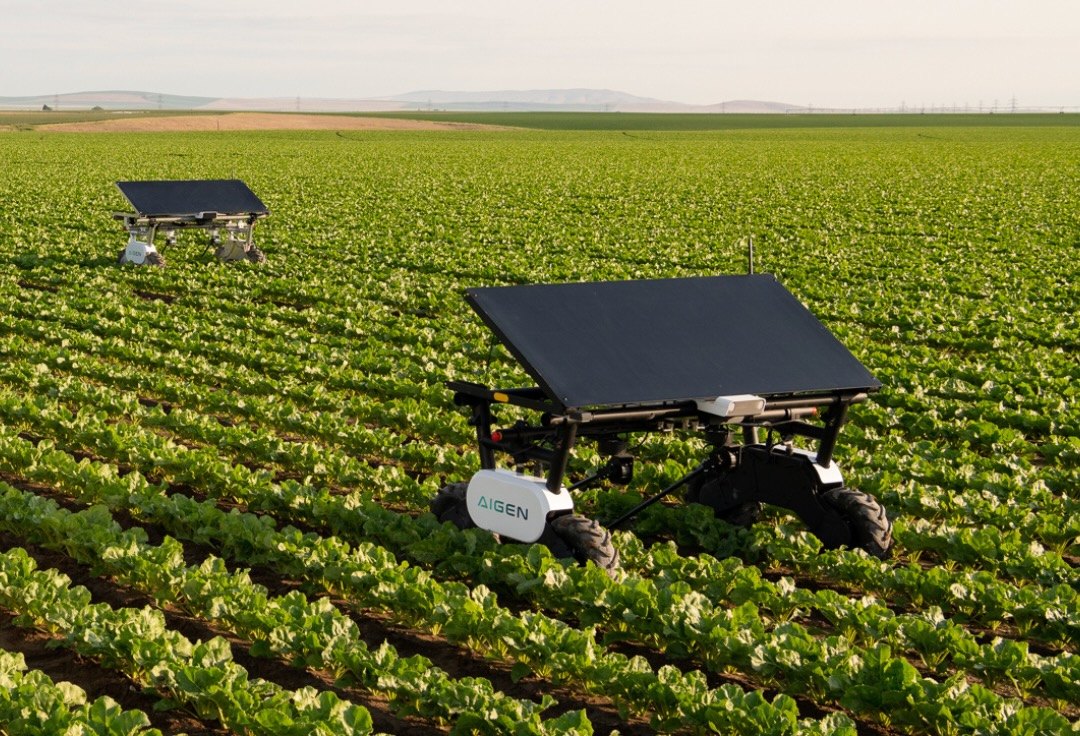
Aigen's physical platform consists of the Element robot, a six-foot-wide autonomous rover topped with a roughly 400-watt solar panel. Unlike conventional agricultural implements pulled behind diesel tractors or machines that require heavy internal combustion engines, Element runs entirely on captured solar energy supported by an onboard battery backup system. The rover navigates between crop rows using onboard cameras and local neural networks to distinguish unwanted weeds from cash crops without using artificial lighting rigs, deploying mechanical arms that grip and physically pull each weed out at its root structure.
The computer vision model running on each robot receives its classification capabilities from the Alchemy simulation engine rather than hand-labeled field photos. Because digital plants are rendered within software, every pixel belonging to a crop leaf or weed stem comes inherently pre-labeled with zero annotation errors. This precision allows the model to differentiate overlapping foliage under changing natural daylight and harsh sun angles without manual intervention. Aigen has assembled more than 100 Element units at its Redmond facility, recording over 15,000 operational field hours across farming sites in California, Minnesota, and North Dakota.
Advertisement
Tech Pulse Daily
Get tomorrow's pulse first
Join engineers who read Tech Pulse before stand-up. Free, weekday mornings.
Data farmers: why it matters now
Sharp increases in agricultural operational overhead have increased commercial interest in fully solar field equipment. United States diesel prices have climbed approximately 70 percent compared to last year based on Energy Information Administration records, averaging nearly $6.30 per gallon nationwide this month according to AAA tracking. With competing automated weeding platforms relying on heavy tractors that burn diesel continuously, Aigen co-founder and chief technology officer Richard Wurden noted that running an entirely solar-powered weeding system without chemicals matches the economic pressures facing commercial growers trying to cut fuel expenses.
The technological shift also lowers entry barriers for agricultural automation startups that lack massive data-labeling budgets. Wurden explained that Aigen originally developed Alchemy because the 15-person company lacked the financial resources to hire human annotation teams for years of field image processing. The mission is directly shaped by personal health challenges faced by its leadership: co-founder and chief executive officer Kenny Lee previously dealt with non-Hodgkin’s lymphoma, while Wurden manages type 1 diabetes, conditions both founders note have medical links to synthetic pesticide and herbicide exposure.
Data farmers: who is affected
The rollout directly impacts specialty crop growers who have struggled to source mechanical weeding tools tailored to non-commodity plants. Current deployments include organic soybean producers in North Dakota and commercial tomato growers across California, alongside an ongoing commercial pilot expansion with an unnamed Fortune 500 agricultural firm. Aigen sells Element units in five-robot bundles, with individual units priced between $50,000 and $70,000 depending on mechanical options and crop configurations, providing a pesticide-free alternative for certified organic growers and conventional farms reducing spray volumes.
The availability of Alchemy data also affects commercial pesticide technology companies. Aigen enforces selective licensing rules on its synthetic datasets, supplying imagery libraries to precision-spraying equipment makers seeking to target individual weeds with micro-doses, while refusing to license data to chemical operations that broadcast-spray non-selective herbicides over entire acreage. Meanwhile, regional agricultural tech companies Issaquah-based TerraClear, which maps weed locations for tractor-mounted sprayers, and Seattle-based Carbon Robotics, which uses lasers guided by 150 million real-world plant images, face an alternative vision development approach that bypasses multi-year image harvesting.
Data farmers: what to watch
Field deployments will expand early next year as Aigen ships Element units to farms across Washington state for local commercial field duties. The engineering team is developing a specialized orchard variant fitted with extended articulating arms designed to weed underneath tree canopies and between orchard rows. A next-generation robot platform is also in development at the Redmond workshop to succeed the existing Element rover, supported by the company's $26 million in total funding from backers including ReGen Ventures and NEA.
Broader adoption will depend on whether purely synthetic training data maintains high weed-detection accuracy across unpredictable weather patterns and muddy soil variations without manual human oversight. Observers will also track whether large agribusiness clients expand their purchases of simulated plant models over real-world photography databases as autonomous farming equipment scales. If Aigen continues to sell out annual production allocations, specialty growers will look to see how quickly the company can expand manufacturing capacity beyond its current 100-robot manufacturing milestone.
Developer Action Items
- ☐ Verify the claim on the official Pixel page (or GeekWire Startups), not from this recap alone.
- ☐ Name the surface that moved — API, policy, model, hardware, or commercial terms — before you Slack the thread.
- ☐ Assign one owner a day to read the primary material and decide: this-sprint, this-quarter, or noise.
- ☐ Do not change production on day-one coverage. Watch the vendor changelog and one independent write-up first.
Data farmers FAQ
What is Aigen Alchemy?
Alchemy is Aigen's synthetic data pipeline that generates digital, pre-labeled weeds and crops in simulation to train computer vision models in about a week.
How much do Aigen Element robots cost?
Element robots cost between $50,000 and $70,000 each depending on configuration, and Aigen typically sells them in packs of five.
How is the Element robot powered?
The robot runs entirely on solar power using a roughly 400-watt solar panel paired with an onboard battery backup, without using diesel fuel or artificial lights.
How does Element destroy weeds without chemicals?
Onboard cameras and artificial intelligence identify weeds among crop plants, and mechanical arms physically pull the weeds out at the root.
Sources

Author
Dillip Chowdary
Writes Tech Bytes coverage of AI, engineering, and the tools that actually ship. Editor of Tech Pulse Daily.
Related on Tech Bytes
Advertisement