Design Once, Deploy at Scale: Building a Template-Driven ML Ecosystem
Meta introduced Standard Model Templates for its ads ranking fleet, reducing per-model engineering time by 92% across 5,000 technique-model deployments.
By Dillip Chowdary • Nov 18, 2026 • Source: Meta Engineering
At a glance
- System name
- Standard Model Templates
- Engineering impact
- 92% engineering time reduction per model
- Scale shipped
- 5,000+ technique-model combinations
- Quality gain
- 0.86% online lift on 70% of models
- Paper release
- November 18, 2026
- Validated techniques
- 80 new ML techniques over two years
Meta deployed a template-driven machine learning framework that standardizes production model development across its ads ranking infrastructure, according to Meta Engineering's report. Authored by Anirudh Agrawal, Djordje Gligorijevic, Yao Xuan, Peggy Yao, Jiang Liu, John Martabano Landy, and Rahul Suresh, the system replaces bespoke model configurations with reusable structural components. The architecture cut per-model engineering time by 92 percent while propagating more than 5,000 technique-model combinations across production fleets.
This report details the architectural mechanisms behind Meta's Standard Model Templates, the multi-model validation workflows governing technique propagation, and the system's integration with automated modeling pipelines. It is written for machine learning engineers, systems architects, and infrastructure leads managing large-scale recommendation or ranking systems. Readers will learn how centralized template iteration eliminates configuration drift and scales model enhancements across hundreds of production variants without increasing headcount.
01Linear engineering bottlenecks in ads ranking
Meta's advertising delivery systems process billions of daily recommendation requests across diverse product surfaces and competing business objectives. Because individual product teams historically customized architectures, training configurations, and serving logic for specific tasks, the fleet fragmented into hundreds of isolated configurations. This fragmentation transformed routine algorithmic propagation into an unsustainable linear bottleneck where shipping a verified enhancement required bespoke re-engineering for each downstream target.
Engineering complexity compounded as architectural divergence broke downstream platform migrations across long-tail setups and obscured the ecosystem-wide impact of tuning adjustments. When every production model maintained unique feature bindings and hardware-specific serving constraints, validation workflows could not guarantee uniform outcomes. Consequently, promising algorithmic discoveries often remained confined to single models for years instead of lifting the wider ranking ecosystem.
Systemic variance also crippled automated optimization suites and AutoML frameworks that rely on predictable parameter spaces to execute searches efficiently. Rather than constructing additional automated layers over this fragmented foundation, engineering teams chose to resolve underlying structural divergence directly. Meta addressed the bottleneck by consolidating arbitrary model configurations into standardized, highly structured operational blueprints.
02Architecture of standard model templates
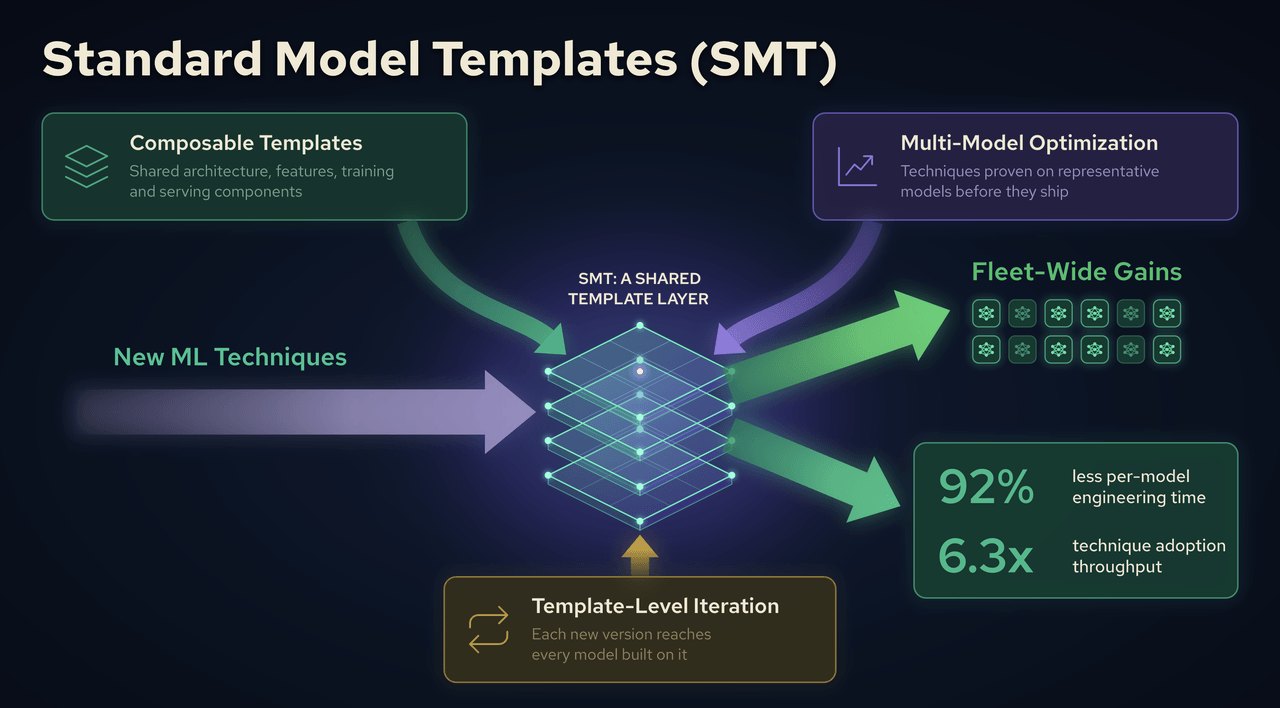
Standard Model Templates, designated as SMT, organize model development around opinionated, modular configurations composed of standardized, reusable building blocks. Each template bundles feature selection routines, interaction layers, model parallelism strategies, training settings, and hardware-aware serving parameters into unified packages. Instead of designing independent model architectures from scratch, engineering teams map related production workloads directly to curated templates that support necessary variations.
This modular abstraction shifts engineering effort from isolated per-model maintenance to centralized template-level iteration. Updating a shared template allows a single validated upgrade to distribute automatically across every production workload mapped to that family. The consolidation creates robust validation boundaries, making training instabilities and serving regressions far simpler to diagnose within bounded structural frameworks.
| Workflow attribute | Manual per-model tuning | Standard model templates |
|---|---|---|
| Optimization scope | Isolated per-model tuning | Shared representative models |
| Complexity growth | Exponential combinations | Centralized template updates |
| Fleet propagation | Individual bespoke migrations | Automated template adoption |
03Technique transfer across production fleets
Advertisement
Tech Pulse Daily
Get tomorrow's pulse first
Join engineers who read Tech Pulse before stand-up. Free, weekday mornings.
Standardizing structural boundaries enabled Meta to treat its diverse machine learning fleet as a unified innovation surface. Rather than migrating individual algorithmic tweaks in isolation, engineers transfer complete, holistic designs established on high-performing source models directly into target families. This approach leverages critical interactions among feature architectures, scaling parameters, and distributed training schedules that isolated component migrations routinely fail to replicate.
Deploying template-driven transfers across production systems delivered substantial operational and algorithmic gains over a two-year evaluation window. The methodology reduced per-model engineering labor by 92 percent while distributing more than 5,000 technique-model combinations across live production fleets. Concurrently, offline model accuracy improved by an average of 0.63 percent at neutral hardware serving capacity.
The unified ecosystem generated a 0.86 percent cumulative online lift spanning 70 percent of production models measured by fleet count. Establishing uniform structural baselines also enabled predictable resource allocation through reusable scaling-law workflows. Teams uncovered global compute and capacity trade-offs within template parameters rather than benchmarking resource curves independently for every individual production task.
04Multi-model evaluation and regression filtering
Meta established a multi-model optimization framework to evaluate algorithmic proposals across representative model cohorts before incorporating them into core templates. This evaluation protocol measures both aggregate quality improvements and localized regression frequencies across diverse objectives. Systems reject candidate configurations that generate substantial average gains if those gains trigger intolerable regression spikes on critical production workloads.
- Cohort benchmarking Evaluate candidate enhancements across designated representative models to assess aggregate performance metrics.
- Regression auditing Filter out algorithmic adjustments that trigger unacceptable degradation rates within individual production pipelines.
- Held-out validation Test surviving configurations on independent holdout models to confirm cross-fleet generalizability.
- Template integration Package verified adjustments into the subsequent standard template release for fleet-wide deployment.
Over a two-year operational period, this systematic screening workflow successfully integrated 80 new machine learning techniques into production templates. Downstream systems adopting a refreshed template automatically inherit a cumulative history of generalized architectural gains without conducting individual experimental cycles. The compounding design ensures production teams benefit from centralized research advancements immediately upon upgrading their base configurations.
Note: Candidate techniques demonstrating strong average gains are disqualified if their localized regression rates exceed strict production thresholds across monitored models.
05Bounded search spaces for agentic modeling
Autonomous agentic model development systems frequently encounter performance hurdles when navigating unconstrained architectural search spaces. Without rigid structural boundaries, autonomous agents waste substantial compute resources investigating unproductive model topologies, troubleshooting trivial pipeline crashes, or generating idiosyncratic code that human engineers cannot reliably maintain. Standardized templates resolve these operational failures by providing agentic workflows with validated, predictable starting structures.
Standard Model Templates define strict parameter search boundaries and embedded operational guardrails that restrict agent exploration to viable design spaces. Autonomous agents focus compute budgets on evaluating high-leverage architectural refinements and feature interaction schedules rather than rebuilding baseline pipelines. This template foundation bridges autonomous machine learning research and enterprise production requirements, ensuring agent-generated modifications integrate cleanly into existing serving infrastructure.
Frequently asked questions
What are Meta Standard Model Templates?
Standard Model Templates, or SMT, are opinionated model architectures built from modular components including feature logic, interaction layers, training settings, and serving configurations. They standardize model design across Meta's ads ranking infrastructure to turn per-model tuning into centralized systems engineering.
How much engineering time does SMT save?
Meta reported a 92 percent reduction in per-model engineering time over two years. The framework also delivered an average 0.63 percent offline quality gain at neutral serving capacity and a 0.86 percent cumulative online lift across 70 percent of models.
How does multi-model optimization prevent production regressions?
The workflow evaluates candidate techniques across representative models, assessing both aggregate improvements and regression rates. Techniques that pass aggregate and regression thresholds are verified on held-out models before being packaged into the next template version.
Why are model templates useful for agentic ML systems?
Unconstrained agentic systems often waste compute exploring unproductive topologies or writing code that fails in production. Templates establish bounded search spaces and pre-validated structural guardrails, allowing autonomous agents to focus on high-impact algorithmic improvements.
Sources

Author
Dillip Chowdary
Writes Tech Bytes coverage of AI, engineering, and the tools that actually ship. Editor of Tech Pulse Daily.
Related on Tech Bytes
Advertisement