Designing an Always-On Agent news update
Rubric Labs detailed an always-on AI agent architecture using scheduled heartbeats, self-compaction tools, and sub-agent dispatching to run proactive tasks.
By Dillip Chowdary • Nov 08, 2026 • Source: rubriclabs.com
Rubric Labs introduced an architectural framework for building always-on, single-threaded artificial intelligence agents designed to operate proactively rather than waiting for explicit user prompts. As detailed in rubriclabs.com's report, current AI chatbots operate as ephemeral, reactive tools that execute synchronous tasks before going idle. Rubric Labs proposed replacing that model with an architecture centered on continuous background heartbeats, self-directed context management, tool-based external messaging, and asynchronous sub-agent dispatching.
This analysis breaks down the engineering mechanics, context management tools, and runtime trade-offs involved in moving from conversational prompt loops to persistent digital assistants. The technical blueprint is aimed at systems developers, AI engineers, and automation architects who need to maintain unified user state across background computer actions, inbound webhooks, and multi-step browser tasks without exhausting context limits.
Designing an Always-On Agent news update: what actually changed
Rubric Labs shifted the AI interaction model away from multi-thread, turn-by-turn chat interfaces into a persistent, single-threaded agent architecture. Standard assistants run short-lived, reactive loops that only compute when receiving direct input. Under the new approach, the system runs on a single continuous thread that retains long-term awareness of the user while delegating heavier operational workloads to background sub-agents.
To prevent third-party truncation from breaking an agent's reasoning momentum, the architecture gives the model direct control over its own context window. The agent monitors its token consumption at every turn using designated foldContext and dropContext tools. It compacts unneeded historical data at natural task lulls, preserving active facts while outsourcing heavy web and browser actions to isolated sub-agents.
Designing an Always-On Agent news update: how it works
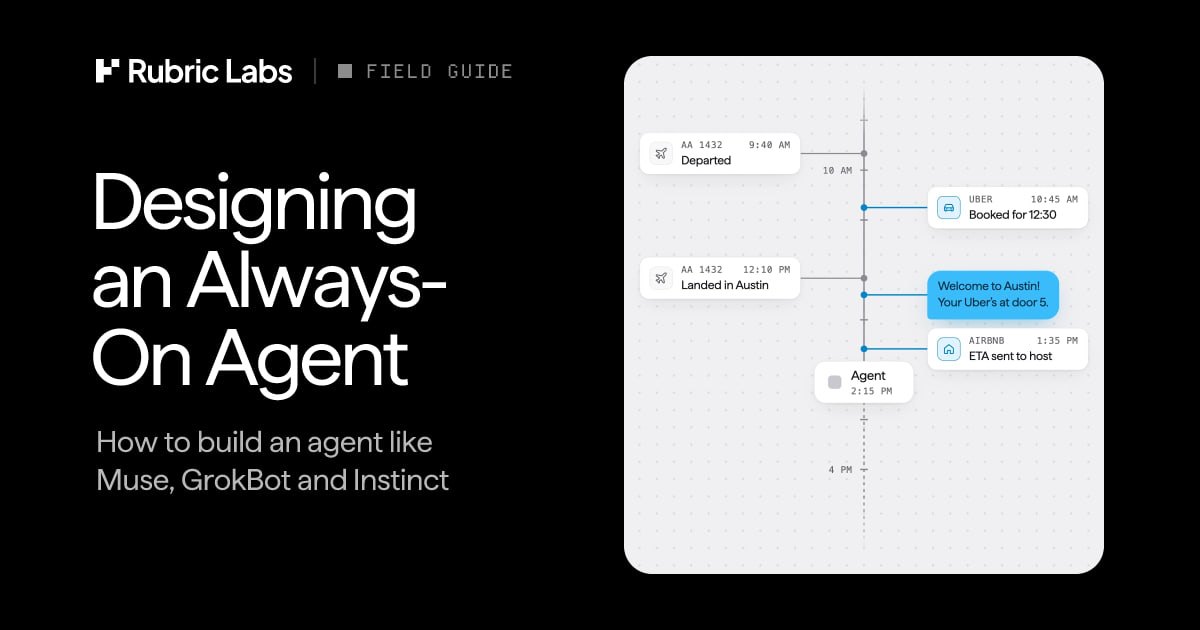
The proactive mechanism relies on periodic wake signals called heartbeats pushed directly into the chat history. A heartbeat message wakes an asleep agent either on a set interval, such as once every hour, or via internal self-scheduling where the agent decides when to wake next. In an example scenario covering an upcoming flight, an agent wakes on a routine heartbeat, inspects travel details, and sets its next wake event to match the user's landing time.
Outbound communication is decoupled from model execution by treating messaging as an explicit tool call. Rather than treating every completion as a public message to the user, the agent only transmits text when it specifically calls its user-messaging tool. If background checks uncover nothing urgent, the final generation remains in the thread as an internal note, keeping routine diagnostic output completely silent.
Advertisement
Tech Pulse Daily
Get tomorrow's pulse first
Join engineers who read Tech Pulse before stand-up. Free, weekday mornings.
Designing an Always-On Agent news update: why it matters
Standard third-party context compaction often degrades agent momentum by stripping critical reasoning history without regard to task status. By exposing real-time token metrics directly to the model, agents can time reductions strategically, folding completed reasoning chains into summaries while preserving active instructions. This allows complex multi-step workflows, such as booking medical appointments or placing grocery orders, to execute without overflowing active memory.
In addition, sub-agent dispatching keeps the primary execution thread uncluttered. Offloading deep tasks to auxiliary agents prevents large blocks of browser telemetry and raw scraping output from saturating the parent context window. The primary thread remains reserved for high-level user coordination, allowing the agent to converse naturally about ongoing needs while subsidiary processes complete independent work in parallel.
Designing an Always-On Agent news update: who is affected
Software engineers building persistent personal assistants, workplace automation bots, and autonomous web agents are directly impacted by these design requirements. Integrating always-on architectures requires shifting backend infrastructure from synchronous request-response endpoints to event-driven inbox pipelines fed by system webhooks and polling daemons. Teams must implement external filtering layers to classify incoming noise before messages wake expensive models.
Users interacting with these agents experience proactive updates rather than purely conversational turn-taking. For instance, if an airline cancels a flight, event notifications push data straight into the agent inbox, prompting immediate rebooking efforts before the user manually flags the disruption. However, because agents receive wide operating access to email, local files, and browsers, users must contend with unpredictable autonomous behavior if agents misinterpret background notifications.
Designing an Always-On Agent news update: what to watch
The primary barrier facing always-on architectures remains model discernment. Current foundation models are trained heavily on task-focused reinforcement learning benchmarks where goals and trigger boundaries are explicit. When exposed to unfiltered notification streams, models frequently struggle with ambiguous environments, mistakenly acting on irrelevant workplace messages or generating unsolicited documents for tasks they lack the authority to execute.
To manage inbox volume and avoid burning excessive tokens on routine chatter, developers are testing auxiliary classification models. Lightweight system one models, such as Jev, are placed upstream to sort incoming emails, Slack messages, and repository events into urgent and non-urgent queues. Watching how smaller classification layers filter noisy inputs will determine whether persistent background agents can operate cost-effectively without constant developer supervision.
Developer Action Items
- ☐ Verify the claim on the official Framework page (or HN AI Agents), not from this recap alone.
- ☐ Name the surface that moved — API, policy, model, hardware, or commercial terms — before you Slack the thread.
- ☐ Assign one owner a day to read the primary material and decide: this-sprint, this-quarter, or noise.
- ☐ Do not change production on day-one coverage. Watch the vendor changelog and one independent write-up first.
Designing an Always-On Agent news update FAQ
What is an always-on AI agent?
An always-on agent is a single-threaded system that runs continuously in the background, waking proactively via heartbeats and external event notifications rather than waiting for direct user prompts.
How does the agent control its token usage?
The agent monitors its token count at every turn and uses self-directed foldContext and dropContext tools to summarize or remove old messages during task lulls.
Why are messaging tools separated from model completions?
Decoupling messaging into an explicit tool call allows the agent to wake up, complete background maintenance, and log internal notes without sending unnecessary chat messages to the user.
What prevents the agent from waking on every spam email or notification?
Upstream events pass through a smaller classifier model, such as Jev, which determines whether notifications are urgent enough to wake the primary agent or should be queued for later bulk review.
Sources

Author
Dillip Chowdary
Writes Tech Bytes coverage of AI, engineering, and the tools that actually ship. Editor of Tech Pulse Daily.
Related on Tech Bytes
Advertisement