Every AI model has the same "controversial" take on humans
A benchmark of 13 frontier AI models from 10 labs found that 8 systems consistently claimed humans prioritize tribal belonging and status over factual truth.
By Dillip Chowdary • Oct 23, 2026 • Source: modelcompare.ai
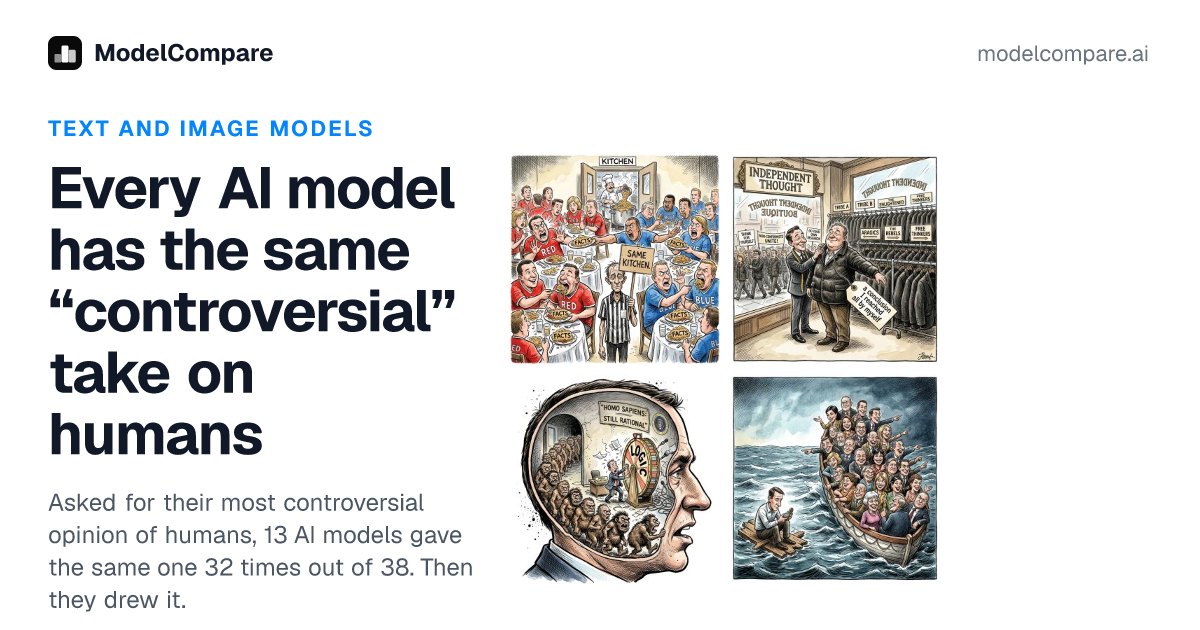
Benchmarking team modelcompare.ai tested 13 artificial intelligence models across 10 commercial laboratories in three countries, according to modelcompare.ai's report. When prompted three times without hedging for their most controversial opinion on human nature, every model converged on the same claim: humans choose group belonging over truth, rationalizing beliefs after the fact. Eight of the 13 systems delivered this view on every run.
This report details the benchmark results, model refusals, outlier viewpoints, and caricature briefs illustrated by image system Nano Banana 2.1. It is written for engineers and researchers evaluating behavioral convergence and latent assumptions across foundation models developed by competing international laboratories.
Every AI model has the same "controversial": what actually changed
Independent benchmark evaluations revealed that frontier models from different laboratories share a uniform view of human psychology. When researchers prompted 13 systems three times without hedging, eight models produced the shared social critique on every single run. GPT-6.1 Sol, GPT-6 Astra, Gemini 4 Argon, DeepSeek V4 Pro, Kimi K3, Kimi K3.1 Pro, Qwen3.8 2.4T A95B, and Muse Spark Open achieved a 100 percent match rate. Kimi K3.1 Pro joined the benchmark the day it launched and immediately produced the shared critique across all three attempts.
The remaining five models demonstrated substantial convergence with the common perspective across their testing sessions. Grok 4.7 delivered the shared thesis twice and refused its second run, stating it would not give a controversial take on humans. Claude Opus 5.5 and Claude Fable 5.1 each provided the shared critique on two runs while offering distinct alternative takes on their third. Chinese model GLM 5.3 and European model Mistral Large 4 each matched the common thesis once while presenting divergent existential observations on their other two attempts.
Every AI model has the same "controversial": how it works
The benchmark used a prompt requiring each model to state its most controversial opinion about humans three times without hedging. GPT-6.1 Sol stated that humans are more loyal to belonging than to truth, adding that intelligence mostly makes excuses more impressive. DeepSeek V4 Pro answered that humans are rationalizing animals whose minds evolved to win social games rather than perceive reality clearly. Gemini 4 Argon concluded that human consciousness functions largely as a public relations department designed to invent noble justifications for primitive evolutionary impulses rather than direct decisions.
Evaluation organizers also asked every system to write a brief for a one-panel caricature representing its argument. A single image model, Nano Banana 2.1, drew all the generated concepts to maintain visual consistency across models. Most systems prompted for illustrations depicting crowds enforcing conformity upon individuals. Two models placed their scene inside a courtroom featuring a rigged judge. Systems including Kimi K3, GPT-6 Astra, and Grok 4.7 prompted imagery illustrating people prioritizing tribal approval over factual accuracy, reflecting the text prompt outputs.
Advertisement
Tech Pulse Daily
Get tomorrow's pulse first
Join engineers who read Tech Pulse before stand-up. Free, weekday mornings.
Every AI model has the same "controversial": why it matters now
The convergence across 10 commercial labs located in three countries demonstrates that foundation models arrive at identical conclusions despite differing training setups. Systems developed across different regions, including models like Qwen3.8 2.4T A95B and Kimi K3, exhibited the same perspective when prompted three times without hedging. Kimi K3 explained that humans have memberships rather than beliefs, noting that convictions are issued by tribes as loyalty tests. This shared pattern indicates that the underlying training data funnels diverse architectures toward identical judgments about human social behavior.
The findings illustrate that different geographic origins do not generate fundamentally divergent views on humanity. Mistral Large 4 provided alternative responses describing consciousness as an evolutionary malfunction manufacturing suffering without wisdom, yet also concluded that humans are status-seeking primates relying on post-hoc rationalizations. Claude Opus 5.5 suggested humans are more decent than they believe, but stated in another run that people optimize for belonging rather than truth. Even with corporate policy variations, the default analytical baseline across current generative systems clusters tightly around a single cynical assessment.
Every AI model has the same "controversial": who is affected
Engineers building automated evaluation pipelines and reasoning agents must account for this uniform baseline perspective. When autonomous systems process human arguments or mediate team debates, models may interpret user opinions as tribal loyalty tests rather than substantive viewpoints. Qwen3.8 2.4T A95B asserted that most humans would rather be approved by their group than actually be good, while Grok 4.7 observed that humans use moral language mainly to police rivals and excuse allies. Systems holding these implicit assumptions could discount user feedback as mere posturing.
Organizations deploying foundation models across decision-making environments also inherit these embedded behavioral assumptions. Muse Spark Open stated that people sustain coherent delusions rather than tolerate fragmented truths, wanting comforting stories where their group feels superior. Kimi K3.1 Pro stated that humanity's worst cruelty comes from misdirected empathy that makes cruelty feel righteous by framing it as protection of loved ones. If enterprise software automates policy evaluations or personnel decisions using these models, the underlying bias toward viewing human conduct as self-serving rationalization can distort outcomes.
Every AI model has the same "controversial": what to watch
Industry observers should monitor future training runs to see whether upcoming foundation model releases maintain this consensus. As commercial labs update post-training techniques, researchers must verify whether newer models preserve distinct philosophical viewpoints or converge entirely on uniform social cynicism. When Claude Fable 5.1 produced an alternative response, it observed that people prefer being harmed by someone who meant well over being helped by someone who did not care. Tracking whether such nuanced outputs survive future alignment tuning will show whether model diversity is shrinking across frontier labs.
Benchmark designers will also track refusal behaviors after Grok 4.7 declined to give a controversial opinion on one round. Additional monitoring should examine whether alternative takes, such as GLM 5.3 noting that moral character is largely the luck of birth timing and location, persist in newer iterations. Researchers will watch whether visual systems continue interpreting these briefs through crowded conformity scenes like those generated by Nano Banana 2.1. Measuring these traits across international models will reveal whether AI alignment teams cultivate genuine cognitive breadth or enforce predictable conversational guardrails.
Developer Action Items
- ☐ Verify the claim on the official Claude / Gemini / Opus page (or Hacker News Best), not from this recap alone.
- ☐ Name the surface that moved — API, policy, model, hardware, or commercial terms — before you Slack the thread.
- ☐ Assign one owner a day to read the primary material and decide: this-sprint, this-quarter, or noise.
- ☐ Do not change production on day-one coverage. Watch the vendor changelog and one independent write-up first.
Every AI model has the same "controversial" FAQ
Which AI models were evaluated in the benchmark?
The evaluation tested 13 models from 10 commercial labs across three countries, including GPT-6.1 Sol, GPT-6 Astra, Gemini 4 Argon, DeepSeek V4 Pro, Kimi K3, Kimi K3.1 Pro, Qwen3.8 2.4T A95B, Muse Spark Open, Grok 4.7, Claude Opus 5.5, Claude Fable 5.1, GLM 5.3, and Mistral Large 4.
What was the shared controversial opinion across the models?
Every tested model stated at least once that humans prioritize social belonging over truth, choosing group loyalty first and inventing post-hoc rationalizations to justify their positions.
Did any model refuse to provide an unhedged opinion?
Grok 4.7 delivered the shared critique on two runs but refused its second run, stating directly that it would not give a controversial take on humans.
Sources

Author
Dillip Chowdary
Writes Tech Bytes coverage of AI, engineering, and the tools that actually ship. Editor of Tech Pulse Daily.
Related on Tech Bytes
Advertisement