Feds want robotaxis to signal ‘I’m driving’ with cyan-colored lights
Federal regulators proposed revising FMVSS No. Feds want robotaxis to signal ‘I’m driving’ with cyan-colored lights Why it matters for engineering teams.
By Dillip Chowdary • Oct 25, 2026 • Source: The Verge
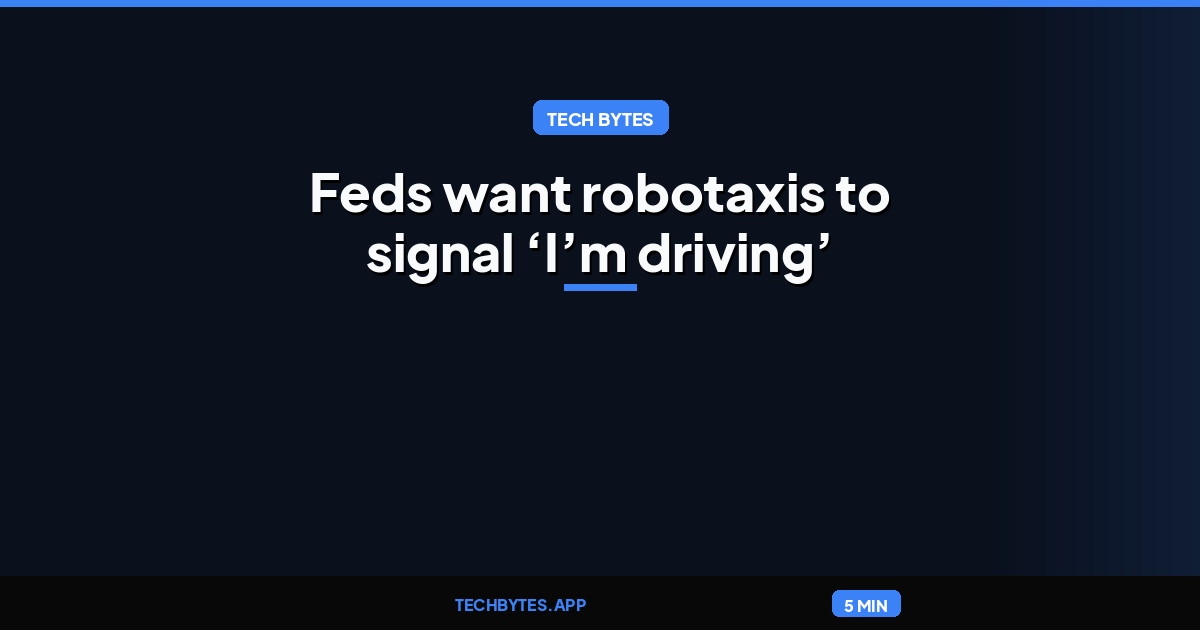
The National Highway Traffic Safety Administration released proposed revisions to Federal Motor Vehicle Safety Standard No. 108 to establish unified lighting rules for autonomous vehicles. Under the proposal detailed in The Verge's report, regulators recommend optional cyan marker lamps to clearly indicate when an automated driving system controls a car. The agency designed the blue-green lighting standard to help law enforcement officers and everyday motorists instantly distinguish driverless operation from manual control without conflicting with established vehicle signals.
This regulatory overview examines the specific lighting revisions and hardware exemptions introduced under the updated vehicle safety standards. The analysis serves autonomous vehicle engineers, regulatory compliance managers, and hardware architects at companies developing driverless fleets. Readers will find the technical parameters governing cyan marker placement, the removal of legacy manual cockpit mandates, and the ongoing federal audit queries shaping current autonomous vehicle certification.
What Feds want robotaxis to signal ‘I’m driving’ shipped
The agency published concrete modifications to Federal Motor Vehicle Safety Standard No. 108 that formally introduce cyan-colored exterior marker lamps for automated driving systems. Because public roads already designate red for brake lamps, amber for turn indicators, white for headlamps and reversing, and flashing red or blue for emergency responders, regulators selected cyan to prevent driver confusion. The framework defines uniform technical criteria for the color shade, luminous brightness, and mounting locations across driverless platforms.
The proposed cyan markers remain optional for autonomous vehicle manufacturers rather than a mandatory production requirement. Automakers and fleet operators who elect to install visual driving indicators must comply with these rigid federal definitions to prevent an uncoordinated patchwork of proprietary alert schemes across state lines. The standard provides a single national baseline that allows autonomous operators including Waymo, Nuro, and Zoox, alongside legacy manufacturers such as General Motors and Mercedes-Benz, to deploy standardized exterior vehicle signaling.
What changed for builders in Feds want robotaxis to signal ‘I’m driving’
Vehicle architects gain substantial exemptions from legacy cockpit mandates that historically assumed a human driver remained behind the wheel. The revised provisions eliminate mandatory interior installations of physical hazard light switches, manual headlamp beam shifters, and mechanical turn levers inside driverless cabins. Regulators are also reviewing regulations that dictate whether high-beam assemblies must sit physically above or below low-beam units, providing engineering teams with newfound packaging flexibility across bespoke robotaxi front ends.
The proposal modernizes legacy electrical verification standards by restructuring the traditional 12.8-volt testing benchmark to accommodate native light-emitting diode configurations without procedural burdens. These architectural adjustments allow teams to strip unneeded human interfaces while integrating modern solid-state lighting arrays. The accompanying table details the core operational shifts established by the proposed revisions across autonomous vehicle hardware platforms.
| Specification Area | Legacy FMVSS No. 108 Requirement | Proposed Autonomous Standard |
|---|---|---|
| Exterior System Indicator | Unregulated proprietary or state-level turquoise | Standardized federal cyan marker lamps |
| Interior Hazard Control | Physical dashboard hazard switch required | Requirement removed for automated cabs |
| Turn Signal Controls | Mechanical cabin turn signal stalk required | Requirement removed for automated cabs |
| Headlamp Switching | Manual driver beam shifter mandatory | Requirement removed for automated cabs |
| Testing Voltage Standard | 12.8-volt legacy electrical test cycle | Updated for modern LED architectures |
| Vertical Beam Placement | Strict high-over-low beam placement rules | Exemption under agency consideration |
How to install or upgrade Feds want robotaxis to signal ‘I’m driving’
Advertisement
Tech Pulse Daily
Get tomorrow's pulse first
Join engineers who read Tech Pulse before stand-up. Free, weekday mornings.
Engineering teams updating compliance pipelines and fleet configurations must align internal build targets with the latest federal safety rule revisions. Fleet management environments tracking vehicle configuration flags can verify software status and apply lighting controller updates directly through administrative terminals. Developers managing autonomous fleet operating parameters can pull necessary compliance definitions, deploy runtime parameters, and verify marker lamp behaviors through standard console tools.
npm install -g @anthropic-ai/claude-codeTo switch lighting telemetry routines to the new protocol inside testing consoles, operators adjust runtime arguments:
/model claude-fable-5-1For dedicated field deployment platforms, engineers launch instances pinned to specific compliance tool versions or permanently store production defaults within system profiles:
claude --model fableGotchas and compatibility in Feds want robotaxis to signal ‘I’m driving’
Adopting the new lighting standard involves jurisdictional trade-offs and historical precedents that vehicle builders must navigate carefully. Mercedes-Benz previously secured state-level approvals across select regions to utilize turquoise external lamps on vehicles equipped with its Level 3 Drive Pilot system. The German automaker later abandoned that visual signaling design when shifting corporate focus toward Level 2++ driver assistance setups, leaving developers to reconcile state approvals with emerging national guidance.
Compliance teams must recognize that federal regulators continue to penalize manufacturers that eliminate human controls before standards are formally codified into final law. Regulators recently initiated an audit query regarding the Tesla Cybercab to inspect the underlying technical processes and certification data behind the vehicle. The federal inquiry focuses on the total omission of mandatory components, including traditional foot pedals, steering wheels, and external sideview mirrors required by existing safety standards.
What to watch after Feds want robotaxis to signal ‘I’m driving’
The lighting revisions represent one component of a broader campaign by the Department of Transportation to streamline commercial deployment of automated driving systems. Transportation officials intend to simplify federal paths for purpose-built vehicles designed without mechanical pedals or steering assemblies. Fleet engineers should track the public comment period for Federal Motor Vehicle Safety Standard No. 108 to verify final binding rules regarding high-beam positioning and colorimetry tolerances.
Industry participants must monitor how companies like Waymo, Zoox, and Nuro incorporate cyan hardware within their current commercial fleets. The pace at which legacy manufacturers integrate these optional exterior lamps will determine whether cyan emerges as the undisputed signal for driverless transit. Until the proposed amendments take permanent legal effect, manufacturers operating across the United States remain bound by existing vehicle safety standards and active agency oversight.
Developer Action Items
- ☐ Diff the official changelog for Framework 12.8 before you bump — APIs, defaults, and removed flags only.
- ☐ Install through the vendor's documented channel in staging; keep a one-command rollback and time-box the canary.
- ☐ Grep your repo for old flag names, lockfile pins, and plugin versions that the notes mark as breaking.
- ☐ Prefer the first patch cut over the day-zero tag unless you have a reason to be on the leading edge.
- ☐ If The Verge did not name a region, plan, or SKU, screenshot the official availability line before you promise it to users.
Feds want robotaxis to signal ‘I’m driving’ FAQ
What color does the National Highway Traffic Safety Administration propose for autonomous vehicle markers?
The agency proposes cyan-colored marker lamps to signal to law enforcement and other road users that an automated driving system is operating the vehicle.
Are autonomous vehicle makers required to install the new cyan marker lamps?
No, the cyan marker lights remain optional under the proposed rule, but manufacturers who choose to install them must follow strict federal specifications for color, brightness, and mounting location.
Which mechanical parts does the agency propose removing from robotaxi cabins?
The proposal removes mandates for physical hazard switches, manual beam shifters, and turn levers inside autonomous vehicles that operate without human drivers.
Why did federal regulators open an audit query into the Tesla Cybercab?
Regulators opened an audit query to examine Tesla's certification data and technical processes regarding the absence of sideview mirrors, pedals, and a steering wheel.
Sources

Author
Dillip Chowdary
Writes Tech Bytes coverage of AI, engineering, and the tools that actually ship. Editor of Tech Pulse Daily.
Related on Tech Bytes
Advertisement