Fireface UCX on Linux: reverse engineered and built with Claude Code
Developer Johan Yngman reverse-engineered RME Fireface UCX audio drivers for Linux using Claude Code, achieving 3.5 ms round-trip latency at 48 kHz.
By Dillip Chowdary • Nov 15, 2026 • Source: johanyngman.com
Developer Johan Yngman published an open-source Linux kernel driver, terminal mixer, and configuration utility for the RME Fireface UCX audio interface, according to johanyngman.com's report. The software provides full access to onboard digital signal processing, routing matrices, and hardware effects previously locked inside Windows. Testing demonstrated low round-trip latency of 3.5 milliseconds at 48 kHz through PipeWire.
This report details the reverse-engineered kernel architecture, the terminal mixer interface, and the AI-assisted disassembler workflow used to inspect closed vendor binaries. The breakdown is designed for Linux audio engineers and developers managing pro-audio digital signal processors.
01What shipped in Fireface UCX on Linux
The release introduces snd-fireface-ucx, an out-of-tree Linux kernel driver delivering 18 audio channels at 32 kHz to 192 kHz sample rates. The driver supports physical MIDI ports, dynamic device hot-plugging, and clean system sleep and resume states. Every audio parameter maps to standard ALSA controls, ensuring compatibility with PipeWire, JACK, and Linux recording workstations.
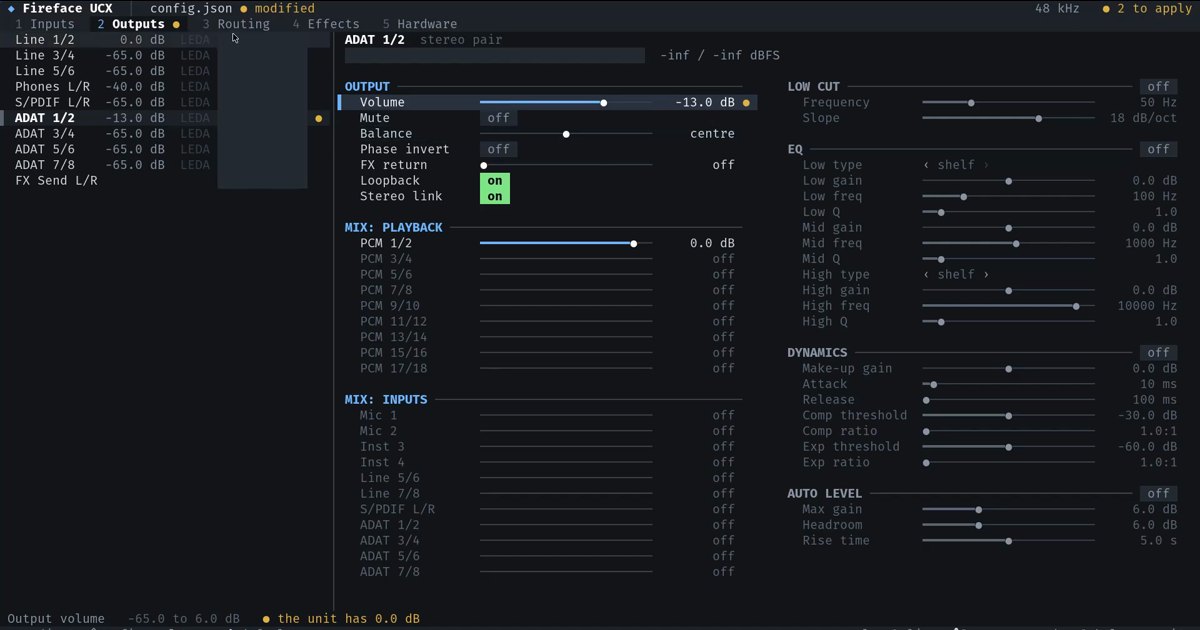
Accompanying the driver is ucxtui, a terminal mixer replicating RME TotalMix FX on the console with real-time metering, a routing grid, and hardware equalizer controls. System configuration is automated through ucxcfg, which reads a single declarative JSON specification to configure hardware registers whenever the interface connects.
02What improved in Fireface UCX on Linux
While the interface functioned on Linux previously in USB Class Compliant mode, internal digital signal processing remained frozen in the state last saved by Windows software. Adjusting routing matrices, dynamics, or reverbs required rebooting into Windows. The new stack establishes direct hardware control, eliminating operating system reboots during production sessions.
| Metric | Class Compliant Mode | snd-fireface-ucx Stack |
|---|---|---|
| Round-Trip Latency | High baseline latency | 3.5 ms at 48 kHz via PipeWire |
| Audio Channels | 18 channels input and output | 18 channels at 32–192 kHz |
| MIDI Interface | Limited driver routing | Both MIDI ports functional |
| DSP Routing | Locked to Windows profile | Full control via ucxtui and ALSA |
| Onboard Effects | Static uneditable values | Real-time EQ, dynamics, reverb |
| Configuration | Manual Windows TotalMix app | Declarative JSON via ucxcfg |
Operating in dedicated driver routines also resolves latency bottlenecks inherent to generic class-compliant audio communication. RME originally noted that proprietary drivers substantially outperform class-compliant streaming in real-time responsiveness. The reverse-engineered driver delivers 3.5 milliseconds round-trip latency at 48 kHz through PipeWire during live tracking.
03What you gain from Fireface UCX on Linux
Audio engineers obtain a reproducible operating environment where hardware state is managed through plain text rather than opaque vendor configuration files. Because all hardware parameters expose native ALSA controls, shell scripts and alsamixer can automate channel gains and monitor mutes on demand. Producers avoid maintaining secondary Windows installations merely to repatch audio buses.
Advertisement
Tech Pulse Daily
Get tomorrow's pulse first
Join engineers who read Tech Pulse before stand-up. Free, weekday mornings.
The project demonstrates how artificial intelligence and reverse-engineering toolkits accelerate legacy hardware driver development. By pairing Claude Code with REA, an MCP server interfacing with Ghidra and rizin, the author analyzed proprietary Windows drivers without manual disassembler navigation. The agent isolated USB requests, traced execution call trees, and identified shared command structures documented in Linux FireWire drivers.
04How to get Fireface UCX on Linux
The driver, terminal mixer, and NixOS package definitions are published under the MIT license in the realbogart/fireface-ucx-linux repository on GitHub. Installation instructions cover NixOS modules and source builds for standard distributions. Developers preparing similar hardware reverse-engineering workflows with Claude Code can install and update the command-line agent via official npm repositories:
npm install -g @anthropic-ai/claude-codeclaude updateDevelopers using Claude Code for driver analysis and code generation can switch active models interactively or lock terminal sessions to specific target releases. The agent accepts in-session commands to adjust reasoning depth during decompilation tasks, while launch flags pin the model version or establish durable global workspace defaults:
/model fableclaude --model fableclaude config set model fable05What to watch after Fireface UCX on Linux
The software stack has been verified on a single first-generation Fireface UCX unit. Community validation across diverse motherboard chipsets, USB controller revisions, and auxiliary interface variants remains necessary to confirm long-term stability. Users should track the GitHub repository as additional audio engineers report performance benchmarks across Linux kernel updates.
Because the underlying USB control protocol remains proprietary, future firmware updates from the manufacturer could modify packet headers and register allocations. Hardware functionality was validated using audio loopback testing, routing physical test tones to verify register changes on hardware meters. Ongoing documentation of these registers ensures the protocol remains accessible to the open-source audio ecosystem.
Fireface UCX on Linux FAQ
Can the RME Fireface UCX run on Linux without Windows?
Yes, the open-source driver stack enables full control over onboard DSP routing, EQ, and reverb on Linux. Users no longer need to boot into Windows to update TotalMix FX settings.
What round-trip latency does the Linux driver achieve?
The driver delivers 3.5 milliseconds of round-trip latency at 48 kHz through PipeWire. This provides professional real-time monitoring performance on Linux audio systems.
How did Claude Code contribute to building the driver?
Paired with the REA reverse-engineering MCP server, Claude Code analyzed the Windows driver using Ghidra and rizin. The AI traced USB calls, decoded fader movements, and generated the driver and mixer code.
How are audio mixer settings saved and restored?
Settings are stored in a single declarative JSON document applied automatically by ucxcfg on hardware connection. Parameters also appear as standard ALSA mixer controls accessible to system scripts.
Sources

Author
Dillip Chowdary
Writes Tech Bytes coverage of AI, engineering, and the tools that actually ship. Editor of Tech Pulse Daily.
Related on Tech Bytes
Advertisement