Five agent chores: $258 on a top model, $11 on open models
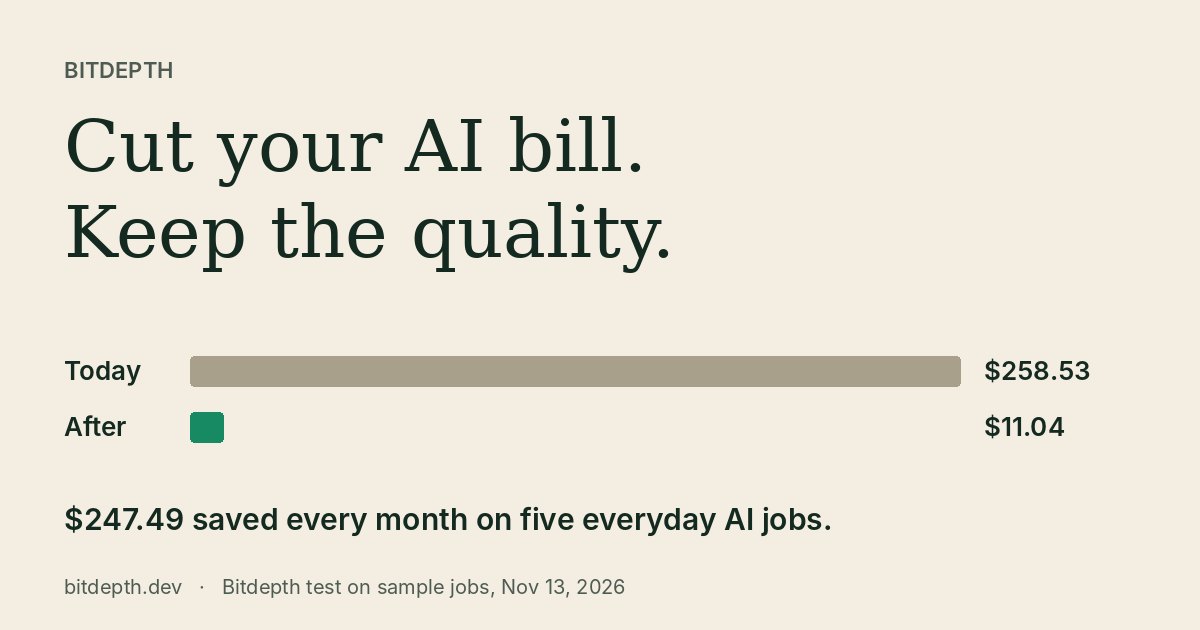
Bitdepth cut monthly AI agent costs from $258.53 to $11.04 by moving four routine monitoring jobs to open models while keeping ticket tagging on Sonnet.
By Dillip Chowdary • Nov 19, 2026 • Source: bitdepth.dev
At a glance
- Product
- Claude Sonnet 5.5
- Alternative
- gpt-oss-120b
- Alternative
- DeepSeek V4 Pro
- Test date
- Nov 13, 2026
- Test cost
- $1.29 total
- Bill reduction
- 95.7% from $258.53 to $11.04
Bitdepth evaluated five routine artificial intelligence agent workloads across closed and open-weight models, finding that shifting four scheduled tasks reduced monthly operational expenses from $258.53 to $11.04. The analysis, detailed in bitdepth.dev's report, measured exact token consumption and output accuracy using automated code grading. The test demonstrated a 95.7 percent total cost reduction across workloads while showing that one specific complex task still failed outside premium proprietary infrastructure.
This evaluation examines recurring automation workflows, detailing operational expenses, token volume overheads, and accuracy thresholds across commercial and self-hosted model endpoints. Engineering teams managing scheduled polling jobs, automated alerts, and routine queue processing can use these findings to balance model capabilities against recurring token fees.
01Twenty pages of system prompt overhead
Agent architectures require the complete system instruction context on every execution cycle. In this benchmark run, the operational instruction manual consumed roughly 14,000 tokens per invocation, which equals approximately 20 printed pages. Claude Sonnet 5.5 billed roughly 20,000 input tokens for every single call once conversational framing and tool definitions were appended.
At a baseline rate of $2.00 per million input tokens, each invocation costs roughly four cents before the model generates a single completion token. A recurring status check executing on a standard 30-minute interval generates 1,440 API calls every month. That operational frequency accumulates to $57.57 monthly on Claude Sonnet 5.5, with the vast majority of executions returning a negative or idle status update.
Alternative open models alter this financial profile by pricing equivalent input contexts at substantial discounts. The open-weight model gpt-oss-120b lists at $0.03 per million input tokens, while DeepSeek V4 Pro lists at approximately $0.66 per million tokens. An invocation consuming four cents on Claude Sonnet 5.5 drops to approximately one-fifth of a cent on DeepSeek V4 Pro and one-twentieth of a cent on gpt-oss-120b.
02Five automated jobs and grading rules
The evaluation tested five distinct synthetic operational workloads designed with objective criteria verifiable by deterministic software assertions. The status check ran 1,440 monthly calls checking for pending deadlines, while an infrastructure monitoring job ran every 15 minutes for 2,880 monthly calls flagging service health issues. An inbox digest processing daily action items modeled 150 monthly calls, a daily briefing accounted for 300 calls, and ticket classification processed 50 daily batches of 20 tickets for 1,500 monthly calls.
Testing protocol established Claude Sonnet 5.5 as the baseline standard across five runs per workload, while gpt-oss-120b and DeepSeek V4 Pro completed ten runs per job across two low-cost hosting platforms. All model inferences operated at zero temperature to eliminate non-deterministic variance. Evaluation software graded every output against defined expected answers without relying on model-based evaluation techniques, incurring a total test expense of $1.29.
Note: Workloads qualified for migration only when the cheapest candidate model achieved a 100 percent pass rate across every validation run.
Advertisement
Tech Pulse Daily
Get tomorrow's pulse first
Join engineers who read Tech Pulse before stand-up. Free, weekday mornings.
03Model costs across five workloads
| Job | Monthly calls | Claude Sonnet 5.5 | DeepSeek V4 Pro | gpt-oss-120b |
|---|---|---|---|---|
| Status check | 1,440 | $57.57 | $19.01 | $0.86 |
| Monitoring | 2,880 | $115.14 | $38.02 | $1.73 |
| Inbox digest | 150 | $6.00 | $1.98 | $0.09 |
| Daily briefing | 300 | $12.00 | $3.96 | $0.18 |
| Ticket tagging | 1,500 | $67.82 | Failed | Failed |
04Four successful migrations to open endpoints
Four routine operational tasks achieved flawless completion records on the lowest-priced infrastructure tier. The recurring status verification and infrastructure monitoring workloads executed without a single incorrect response on gpt-oss-120b, dropping their combined monthly operational run rates from $172.71 to $2.59. Routine boolean and status queries showed no degradation when processed on smaller models.
The scheduled summary jobs followed an identical operational path under automated test harness scrutiny. The daily inbox prioritization workflow and the broader daily briefing task completed all test evaluations successfully on gpt-oss-120b. Together, those daily recurring jobs fell from a combined baseline cost of $18.00 on Claude Sonnet 5.5 down to $0.27 per month on the open model.
Deploying gpt-oss-120b for these four predictable workloads captured nearly the entire monthly expenditure reduction. Routine polling workflows characterized by invariant instructions and simple structural outputs operated reliably on lightweight infrastructure. These tasks eliminated repetitive proprietary token expenditures that previously accrued while waiting for state changes.
05One failed workload on ticket classification
The batch ticket classification workload failed to meet the strict accuracy threshold on both open models. Processing 50 daily batches of 20 customer tickets required simultaneous categorization across complex entity classifications and multi-variable business rules. Claude Sonnet 5.5 completed the categorization tasks accurately, running at a projected baseline cost of $67.82 per month across 1,500 batch calls.
Both gpt-oss-120b and DeepSeek V4 Pro produced inconsistent labeling outputs that failed automated validation scripts during batch ticket processing. Under the benchmark testing guidelines, neither open model achieved an unbroken record of correct classifications across its ten validation runs. As a consequence of these categorization failures, the ticket categorization job remained assigned exclusively to Claude Sonnet 5.5.
Retaining the classification pipeline on Claude Sonnet 5.5 raised the final composite benchmark deployment cost from an optimal $3.67 to $11.04 per month. The evaluation demonstrated that while high-frequency context polling moves seamlessly to open models, complex multi-item analytical categorization still requires frontier proprietary intelligence.
Frequently asked questions
Which AI models were tested in the benchmark?
Bitdepth evaluated Claude Sonnet 5.5 as the baseline against open-weight models gpt-oss-120b and DeepSeek V4 Pro.
How much did monthly costs drop across the five routine jobs?
Monthly operational expenses dropped 95.7 percent, falling from $258.53 on Claude Sonnet 5.5 to $11.04 on the cheapest successful setup.
Which automated job failed to run accurately on open models?
Ticket tagging failed on both gpt-oss-120b and DeepSeek V4 Pro, requiring it to remain on Claude Sonnet 5.5.
How much does gpt-oss-120b charge for input tokens?
The gpt-oss-120b model lists at $0.03 per million input tokens, compared to $2.00 per million on Claude Sonnet 5.5.
Sources

Author
Dillip Chowdary
Writes Tech Bytes coverage of AI, engineering, and the tools that actually ship. Editor of Tech Pulse Daily.
Related on Tech Bytes
Advertisement