Gemini Robotics Embodied Reasoning 2 is now available on Google Cloud
Google Cloud opened Gemini Robotics Embodied Reasoning 2 in public preview on October 28, 2026, with 91.3% critical-frame accuracy and 4x execution speed.
By Dillip Chowdary • Oct 27, 2026 • Source: Google Cloud Blog
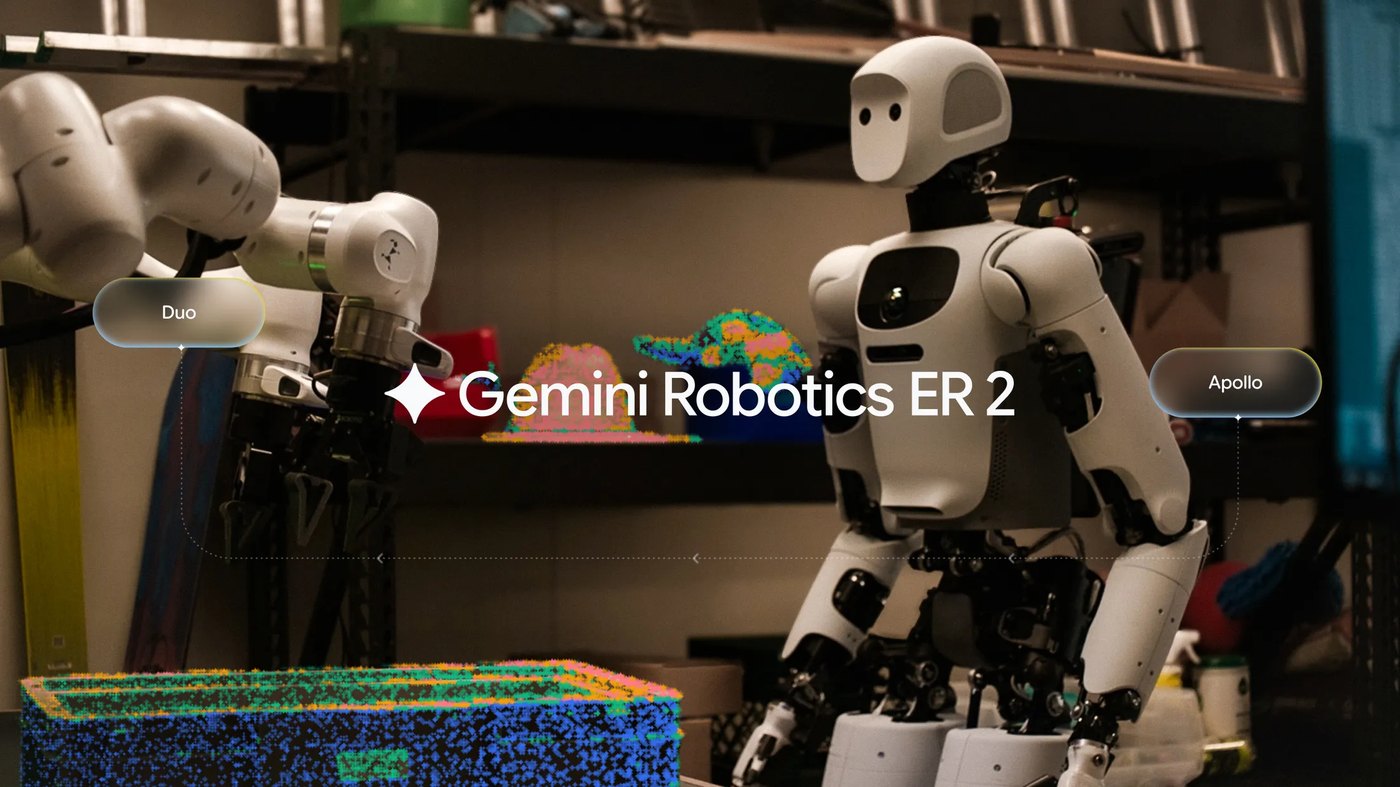
Google Cloud has placed Gemini Robotics Embodied Reasoning 2 (ER 2) in public preview on the Gemini platform. Carolina Parada, VP and Head of Deepmind Robotics, and Adrian Jones, Applied AI Blackbelt, published the October 28, 2026 details in Google Cloud Blog's report. ER 2 is the specialized Gemini model at the core of Gemini Robotics 2, the intelligence layer Google introduced earlier this year.
This is for developers and enterprise teams operating robots on Google Cloud. It covers ER 2 video checks, instrument reading, multi-robot handoffs, tool calls to Vision-Language-Action models, navigation APIs, and custom functions, plus simulation, training, and edge deployment on the Gemini platform.
What shipped in Gemini Robotics Embodied Reasoning 2 is now
Gemini Robotics 2 is Google's intelligence layer for robots that think, act, and adapt in the physical world. Gemini Robotics Embodied Reasoning 2 is the specialized Gemini model that serves as a robot's high-level brain across any embodiment, from stationary arms to full humanoids. It combines spatial and temporal video understanding, long-horizon planning, and built-in safety guardrails. A robot can converse naturally with humans, orchestrate low-level action models and hardware APIs, execute multi-minute tasks involving hundreds of decisions, and collaborate across multi-robot teams.
Google is bringing that model into enterprise production environments. ER 2 is available in public preview on the Gemini platform. Google says this is the first time organizations can pair Google DeepMind's latest embodied reasoning model for robotics with the enterprise-grade security, multi-agent orchestration, and end-to-end lifecycle management of Google Cloud to simulate, evaluate, and deploy safe, adaptive physical AI at scale. Developers declare Vision-Language-Action models or navigation APIs as tools and stream multimodal video, audio, or text directly into the model.
What improved in Gemini Robotics Embodied Reasoning 2 is now
A robot needs to know whether a step actually succeeded before the next one starts. ER 2 adapts to new and unfamiliar situations on the fly by reasoning over continuous video feeds. It classifies task progress into a binary status, discrete categories, or continuous scores. Google says that improves real-time situational awareness and allows real-time adjustment or iteration on failed steps without restarting an entire workflow. The model pinpoints the exact video frame where a critical event occurs, such as when to stop pouring a liquid.
Google reports 91.3% accuracy on that frame and a 0.96-second mean absolute frame distance, running at 4x the execution speed and a fraction of the compute cost of many larger model categories. Teams use moment finding and spatial pointing to label demonstration video. The release also advances core spatial reasoning, including visual question answering and instrument reading. From visual input alone, ER 2 reads values across 10+ instrument categories: circular dials, sight glasses, digital displays, linear scales, rulers, and liquid thermometers.
Advertisement
Tech Pulse Daily
Get tomorrow's pulse first
Join engineers who read Tech Pulse before stand-up. Free, weekday mornings.
| Benchmark | Figure | Comparison |
|---|---|---|
| Critical-frame accuracy | 91.3% | exact frame of a critical event, such as stopping a pour |
| Mean absolute frame distance | 0.96 seconds | same frame-finding task |
| Execution speed | 4x | many larger model categories |
| Compute cost | a fraction | many larger model categories |
| Instrument categories from visual input | 10+ | circular dials, sight glasses, digital displays, linear scales, rulers, liquid thermometers |
What you gain from Gemini Robotics Embodied Reasoning 2 is now
One ER 2 model orchestrates many body types, scaling from stationary arms and wheeled rovers to quadrupeds and complex forms. Google describes that span as one intelligence layer across embodiments. Different robots share a semantic understanding of their workspace, divide labor, and hand off tasks, completing workflows a single machine could not do alone. Deep spatio-temporal reasoning and long-horizon planning let the model orchestrate steps, self-correct, and generalize to novel situations. Google says this transforms a robot into a physical agent.
The model thinks about what comes next while simultaneously orchestrating actions. Developers declare Vision-Language-Action models, navigation APIs, or custom functions as tools for simulation, real-world robot control, or human tele-operation, and ER 2 calls low-level action models and hardware APIs through them. Natural-language commands drive navigation and manipulator movement APIs. The robot can explain its approach while performing an action, and operators can redirect it without using technical language. Workflows then run directly on physical robots at the edge, on Google Cloud's scalable infrastructure.
How to get Gemini Robotics Embodied Reasoning 2 is now
Developers and enterprise teams can now start building with Gemini Robotics ER 2 in public preview via Model Garden in the Gemini platform. Documentation and pricing are published for the preview. Sample code and bidirectional streaming guides are in the Gemini API Robotics documentation, and benchmarks plus the safety technical report are in the Google DeepMind Gemini Robotics ER 2 announcement. Google describes the infrastructure at cloud.google.com/solutions/physical-ai and cloud.google.com/ai. Deployed workflows use enterprise IAM, security controls, and built-in function calling.
Teams test behaviors before touching hardware in familiar environments such as MuJoCo-Warp and NVIDIA Isaac Sim, then generate synthetic scenarios with multimodal models and auto-label workcell imagery on the Gemini platform. They use ER 2's spatial pointing, moment finding, and progress classification to curate and label demonstration videos in Cloud Storage and BigQuery. Custom Vision-Language-Action models train through the Gemini platform, GKE, or Cluster Director. Latency-sensitive SLAM and path planning move to factory floors with Google Distributed Cloud, and fleet telemetry streams into BigQuery.
What to watch after Gemini Robotics Embodied Reasoning 2 is now
Marco da Silva, VP and General Manager of Spot at Boston Dynamics, said, "We've seen exponential growth in customers using AIVI-Learning every month, and Gemini Robotics ER 2 brings them even more value. Video changes what an inspection can be. Spot isn't just checking whether something looks right in a moment in time." Chris Liu, co-founder and CTO at DeepReach, said DeepReach AI is "the real-world skills engine for physical AI," capturing how skilled people work all over the world and turning that into a data flywheel for model training. ER 2, he said, gives "accurate task understanding of every recording, to help us find data that matters most — faster and at a far greater scale."
Barrie Mullins, Senior Director of Arm Total Design for Physical AI at Arm, said, "Google's Gemini Robotics ER 2 model represents an important step in this direction." Arm is working with Google on next-generation robotics compute platforms. Prof. Loh Xian Jun, executive director at ASTAR Institute of Materials Research and Engineering (ASTAR IMRE) and executive director of MARVEL-AI, said most lab automation relies on rigid scripts for single, isolated tasks. With ER 2, their robots read a touchscreen on a legacy microwave reactor that has no API, balance and load a centrifuge, and move samples safely through a busy lab, much closer to self-driving labs that can run full experimental campaigns from synthesis to separation.
Developer Action Items
- ☐ Diff the official changelog for Gemini / Google 91.3 before you bump — APIs, defaults, and removed flags only.
- ☐ Install through the vendor's documented channel in staging; keep a one-command rollback and time-box the canary.
- ☐ Grep your repo for old flag names, lockfile pins, and plugin versions that the notes mark as breaking.
- ☐ Prefer the first patch cut over the day-zero tag unless you have a reason to be on the leading edge.
- ☐ If Google Cloud Blog did not name a region, plan, or SKU, screenshot the official availability line before you promise it to users.
Gemini Robotics Embodied Reasoning 2 is now FAQ
When did Gemini Robotics Embodied Reasoning 2 become available on Google Cloud?
Google Cloud announced public preview on the Gemini platform on October 28, 2026. Developers start in Model Garden. Gemini Robotics 2, the intelligence layer ER 2 belongs to, was introduced earlier this year.
How accurate is ER 2 at finding a critical moment in video?
Google cites 91.3% accuracy and a 0.96-second mean absolute frame distance for pinpointing the frame where a critical event occurs, such as when to stop pouring a liquid. That run is 4x the execution speed of many larger model categories and a fraction of their compute cost.
Which robot body types can one ER 2 model orchestrate?
Stationary arms, wheeled rovers, quadrupeds, full humanoids, and other complex forms. Multi-robot teams can share a semantic understanding of a workspace, divide labor, and hand off tasks.
How do developers attach low-level robot control to ER 2?
They declare Vision-Language-Action models, navigation APIs, or custom functions as tools for simulation, real-world control, or human tele-operation, and they stream video, audio, or text into the model. Natural-language commands can call navigation and manipulator movement APIs.
Where do simulation, training, and factory deployment run?
Simulation uses MuJoCo-Warp and NVIDIA Isaac Sim on the Gemini platform. Training labels are curated in Cloud Storage and BigQuery, and custom VLA models train through the Gemini platform, GKE, or Cluster Director. Latency-sensitive SLAM and path planning can move to Google Distributed Cloud, with fleet telemetry streamed to BigQuery.
Sources

Author
Dillip Chowdary
Writes Tech Bytes coverage of AI, engineering, and the tools that actually ship. Editor of Tech Pulse Daily.
Related on Tech Bytes
Advertisement