Genesis AI raises $500 million to deploy glove-wearing robots
Genesis AI raised $500 million in Series A funding led by Khosla Ventures to scale mass production of its Eno humanoid robot and sensor-glove platform.
By Dillip Chowdary • Nov 17, 2026 • Source: TechCrunch
At a glance
- Product
- Eno humanoid robot
- Funding round
- $500 million Series A
- Founding date
- 2024
- Seed funding
- $105 million in July 2025
- Fleet size
- 30 to 40 Eno robots built
- Lead investors
- Khosla Ventures, Premji Invest, Eclipse
Genesis AI has raised $500 million in Series A funding to scale physical artificial intelligence and deploy dexterous humanoid robots into industrial workflows, according to TechCrunch's report. The Silicon Valley robotics company is directing the capital toward mass manufacturing, proprietary data collection, and large-scale simulation environments. Co-founder and chief executive officer Zhou Xian stated that the business has solved dexterous hand manipulation by pairing specialized sensor hardware with physical foundation models.
This analysis details the engineering architecture, data-gathering techniques, operational constraints, and commercial production timelines behind the company's robotics platform. It examines hardware testing benchmarks, founder backgrounds, and supply chain bottlenecks for operations executives, automation engineers, and enterprise software strategists evaluating industrial robotic deployments.
01Cardboard packing arms and hiccup data
At its Silicon Valley testing facility, the company demonstrated dual off-the-shelf robotic arms performing complex packaging workflows without manual human guidance. The machine executed a multi-step fulfillment routine designed to mirror real warehouse sorting environments:
- Object grasping Robotic grippers pick up two individual small cardboard boxes from a staging surface.
- Barcode scanning The system scans both cartons before packing them into a container.
- Carton packing Mechanical arms position the scanned cartons securely inside a larger master box.
- Box sealing The mechanism folds down the cardboard top flaps and tapes the enclosure shut.
- Label application The grippers peel an adhesive shipping label from printer tape and mount it onto the box.
During a secondary demonstration run, the automated arms dropped a box and struggled to peel the adhesive shipping label away from the printer tape backing. Company executives categorize these operational failures as valuable hiccup data that feeds directly into iterative model updates. This telemetry provides real edge cases required to refine automated handling routines.
Bridging the performance gap between controlled laboratory presentations and dependable factory automation remains the defining hurdle for humanoid robotics companies. Unpredictable tactile feedback and irregular packaging materials frequently disrupt rigid automation scripts. Genesis AI relies on adaptive error recovery data to prevent the arrival of another commercial robotics winter.
02Series A financing and vertical integration
The startup secured $500 million in Series A capital led by venture capital firms Khosla Ventures, Premji Invest, and Eclipse. The new investment follows a $105 million seed round announced in July 2025. The fresh balance sheet provides runway to expand end-to-end hardware manufacturing and run large physical intelligence models.
Zhou Xian and company president Théophile Gervet co-founded the robotics enterprise in 2024 after meeting as graduate researchers inside a Carnegie Mellon University laboratory. The founders built their roadmap around vertical integration across the operational pipeline. Their strategy pairs in-house data generation and generative AI model training directly with proprietary humanoid robot design.
Xian affirmed that building an end-to-end product is necessary to deliver reliable commercial hardware to enterprise customers. Rather than licensing third-party foundational models or outsourcing mechanical arm designs, the organization maintains control over the software stack, physical prototypes, and sensor integrations.
Advertisement
Tech Pulse Daily
Get tomorrow's pulse first
Join engineers who read Tech Pulse before stand-up. Free, weekday mornings.
03Sensor gloves and human motion simulation
To differentiate its manipulation capabilities from competing platforms developed by Figure and Agility, Genesis AI captures physical force telemetry directly from human workers. More than 100 industrial workers across the globe wear sensor-equipped gloves alongside camera headsets while performing daily manual labor. This telemetry streams real-world contact dynamics into the company's central training dataset.
The company's mechanical arms and humanoid robots wear matching sensor-equipped gloves across end-effectors designed to replicate biological human hand dimensions. Xian noted that mirroring natural human hand proportions enables precise manipulation of delicate items, electrical wiring, and parcel sorting. Capturing nuanced pressure data provides the critical foundation for stable robotic grasping.
To scale training beyond physical data collection, the engineering team relies heavily on synthetic physics simulation. Company adviser Minchen Li contributed an influential physics simulation algorithm that generates millions of high-fidelity synthetic task environments. This digital training ground models complex material interactions before the software deploys to physical machines.
04Eno humanoid robot fleet and pilots
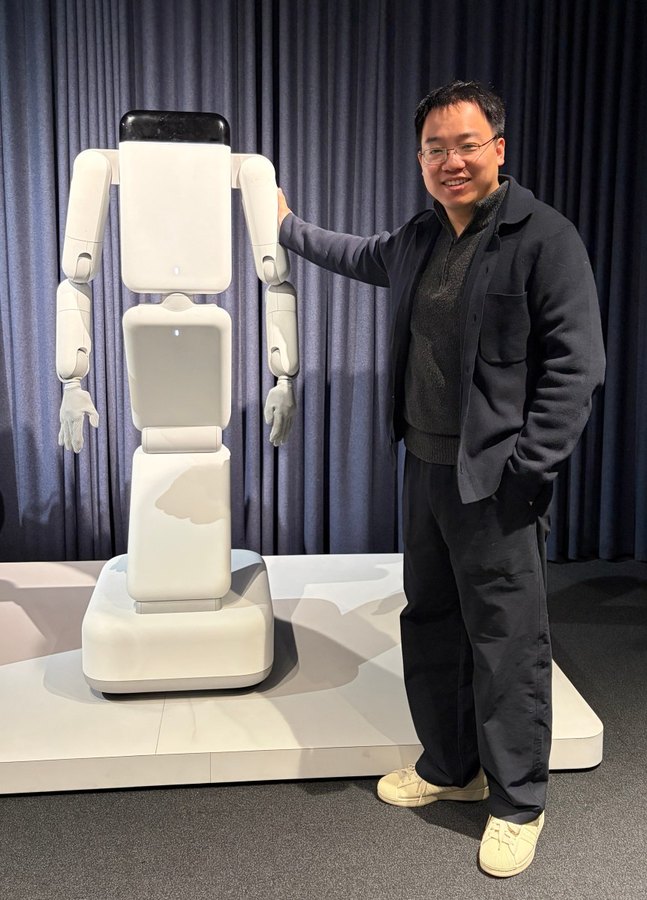
While dual-arm test benches handle bench demonstrations, the company developed Eno, its flagship full-body humanoid machine. The robot abandons exposed industrial metal skeletons for a clean, consumer-grade aesthetic reminiscent of classic Apple hardware design. Executives intentionally modeled Eno to resemble a mobile iMac rather than an intimidating industrial automaton.
Genesis AI has manufactured between 30 and 40 Eno units to date, though leadership has not disclosed exact production quotas for the upcoming year. The business is running early customer pilot programs with a small group of undisclosed commercial partners. These enterprise trials evaluate how the platform navigates unstructured operational settings.
A United States contract manufacturing partner has been selected to initiate commercial assembly lines next year. Mechanical engineering teams have locked in the final mass-production hardware specifications. Future factory deployments will transition pilot machines into continuous production lines across domestic warehouse facilities.
05Hardware bottlenecks and data infrastructure scale
The primary bottleneck restricting widespread humanoid deployment stems from mechanical engineering and specialized hardware supply chains rather than fundamental model science. Producing durable components that withstand industrial wear remains a serious operational barrier across the robotics sector.
Note: Current dexterous hand components operate for only a few weeks of regular industrial duty before mechanical wear requires replacement.
Xian downplays academic debates comparing Vision-Language-Action frameworks against World-Action architectures, noting that core robotics software relies on standard transformers and attention mechanisms. The chief executive estimates that model architecture contributes roughly 10% to final machine capabilities.
True operational breakthroughs depend on massive training clusters, high-speed data pipelines, and strict physical dataset quality. Hardware limit: Hands require replacement after few weeks
Frequently asked questions
How much funding has Genesis AI raised?
Genesis AI raised a $500 million Series A round led by Khosla Ventures, Premji Invest, and Eclipse, following a $105 million seed round announced in July 2025.
How does Genesis AI collect training data for robot dexterity?
More than 100 workers worldwide wear sensor-enabled gloves and headset cameras to record tactile force and movement data, which is supplemented by millions of simulated physics models.
What is Eno and when will it enter mass production?
Eno is Genesis AI's flagship humanoid robot, with 30 to 40 units currently built and a finalized production design scheduled to begin assembly with a U.S. manufacturing contractor next year.
What are the main operational limits of the current hardware?
The company's dexterous robotic hands can only operate for a few weeks of regular industrial work before mechanical wear requires complete replacement.
Sources

Author
Dillip Chowdary
Writes Tech Bytes coverage of AI, engineering, and the tools that actually ship. Editor of Tech Pulse Daily.
Related on Tech Bytes
Advertisement