Google Open Sources Ambient Quality Agent (AQuA) to Diagnose Production AI
Google open-sourced Ambient Quality Agent to diagnose production AI agent failures against source snapshots, cutting seat bypasses from 15 sessions to two.
By Dillip Chowdary • Nov 14, 2026 • Source: InfoQ
Google released Ambient Quality Agent (AQuA) as an open-source reference implementation to detect, cluster, and troubleshoot production AI agent failures against deployed code revisions. According to InfoQ's report, the system catches silent behavioral regressions that bypass standard infrastructure health checks, such as agents returning successful responses while quietly omitting user requirements or skipping mandatory tool executions. The project provides engineering teams with an automated pipeline that connects production runtime telemetry directly to source code revisions.
This analysis details AQuA's sidecar architecture, its five-stage diagnostic workflow, the source snapshot verification engine, and controlled test results from a multi-agent travel application. It is written for cloud architects, AI systems engineers, and operations teams operating autonomous agents on Google Cloud infrastructure who need systematic root cause attribution without breaking production request paths. The breakdown outlines configuration requirements, empirical replay benchmarks, ecosystem comparisons, and operational constraints.
01Sidecar Telemetry and Five Pipeline Stages
AQuA operates completely outside the active serving path as an ambient sidecar within Google Cloud environments. The agent ingests application telemetry asynchronously from Cloud Trace, Cloud Logging, or BigQuery data warehouses without introducing latency to user-facing requests. Each diagnostic cycle processes batches of up to 1,000 recent interaction sessions to identify systemic failures.
The operational pipeline organizes analysis into five discrete stages: sampling, reviewing, clustering findings, verifying candidate clusters, and tracking issues across deployments. Engineering teams configure domain quality baselines through a localized goal.md file and attach deterministic custom metrics to enforce application rules. These checks detect behavioral flaws that traditional HTTP status monitors fail to register.
Organizations can trigger execution cycles on demand, link them directly to automated continuous delivery pipelines following new releases, or run them on recurring schedules. Because evaluation occurs asynchronously against stored telemetry logs, teams can inspect large historical transaction volumes without affecting downstream cloud service quotas or degrading real-time agent latency.
02Immutable Source Snapshots and File Citations
Root cause analysis in AQuA depends on an immutable source code snapshot captured precisely at deployment time. When recurring session failures emerge, the diagnosis agent inspects session traces alongside the specific repository revision that served those requests. This approach prevents discrepancies caused by code drift between production releases and current development branches.
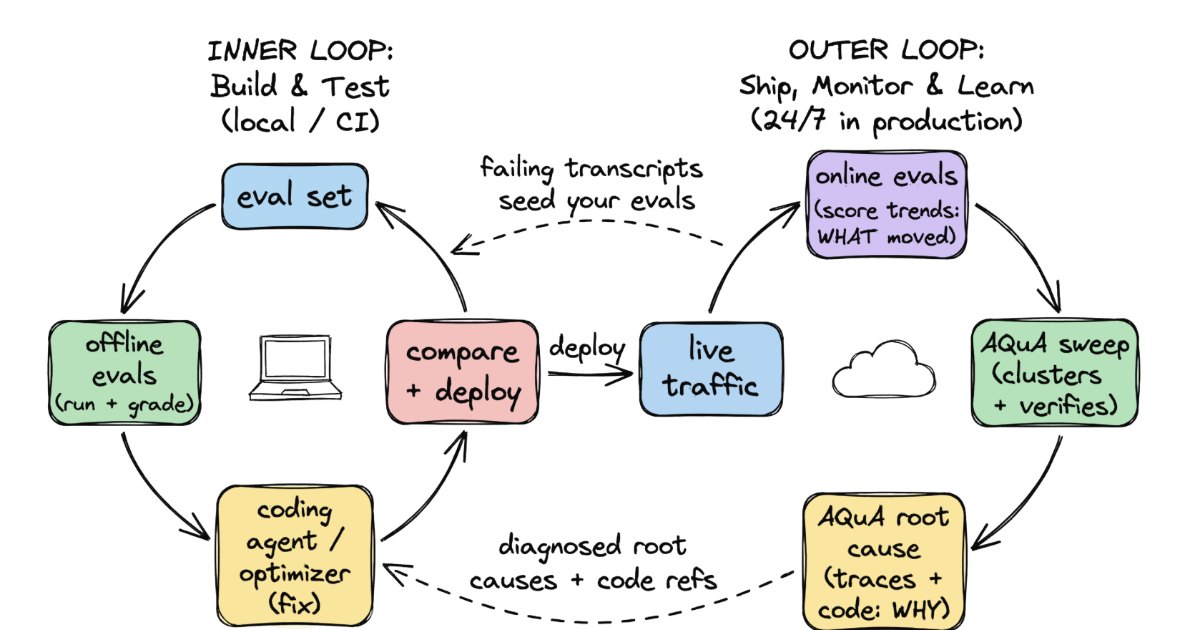
The diagnostic system parses the exact failure sequence to pinpoint offending instructions, referencing specific source files and line ranges in its reports. When defects originate within application code, AQuA generates proposed modifications for developer review. The architecture can also isolate external failure points, attributing regressions to tool handoffs, broken API dependencies, or corrupted retrieval data.
Human oversight remains an explicit design constraint within the remediation workflow. AQuA does not apply patches directly to live environments, nor does it open automated pull requests against version control repositories. Engineers must review the generated file citations and inspect the proposed logic updates before committing fixes to production codebases.
Advertisement
Tech Pulse Daily
Get tomorrow's pulse first
Join engineers who read Tech Pulse before stand-up. Free, weekday mornings.
03Travel Delegation and Seat Availability Findings
Google validated the architecture using an evaluation dataset of 32 sessions recorded from a multi-agent travel planning system. The initial reviewing and clustering stages surfaced 42 raw findings across the sample, which the system consolidated into nine candidate issue clusters. These sessions revealed complex delegation failures across specialized downstream subagents.
A dedicated verifier stage checked up to three complete session transcripts for each proposed grouping, eliminating three unsupported candidate clusters to prevent false alarms. The verification filter preserved six confirmed failure patterns for detailed root cause inspection. This mechanism ensured developers investigated only genuine systemic errors rather than isolated statistical noise.
The verified issues exposed critical failures in application logic and inter-agent communication. In one pattern, agents bypassed seat availability verification steps entirely during booking flows while still returning successful confirmations. In another recurring pattern, subagents lost a traveler's explicit vegan dietary preference during delegation between planning components.
04Prompt Modifications and Controlled Replay Verification
Following the diagnostic findings, developers revised the underlying agent system prompts to address the identified instruction gaps and replayed the 32 sessions. In this controlled replay evaluation, seat selection bypasses dropped from 15 sessions down to two. At the same time, dietary preference omissions fell from seven sessions to zero.
The targeted prompt adjustments substantially raised overall reliability across the benchmark suite. Sessions satisfying all system quality checks and business constraints increased from five to 13 during the replay run. Google emphasized that these measurable quality improvements reflect controlled offline replay benchmarks rather than unconstrained live production traffic.
The platform grounds its validation philosophy in transparent evidentiary backing. As the Google blog post noted, an insight is its citations, not a self-reported confidence score. Every flagged issue must link directly to supporting trace events, and proposed root causes must cite verifiable line numbers in the deployment snapshot.
05Lifecycle Issue Tracking and Production State Limits
AQuA categorizes detected regressions into distinct operational states, designating findings as NEW or RECURRING as runs progress. If an issue remains unobserved for 14 consecutive days across scheduled sampling passes, the system marks it as automatically RESOLVED. This automated lifecycle tracking prevents alert fatigue while maintaining an audit trail of recurring regressions.
Industry practitioners have highlighted the necessity of automated telemetry analysis in production agent workflows. Commenting on the announcement on LinkedIn, Dmytro Aprelenko, engineering manager at Redcore, noted that agent orchestration definitely needs better continuous diagnosis to catch these loops early. Google's release addresses that requirement by connecting runtime traces to source code.
The implementation complements Google Cloud Agent Platform evaluation tools and Arize Phoenix open-source tracing systems. While those platforms emphasize regression testing and production observability, AQuA specifically isolates failure clusters and links them to deployed code. Known operational constraints include sampling limits that can overlook rare anomalies and replay environments that cannot fully reproduce dynamic external state.
Google Sources Ambient Quality Agent (AQuA) FAQ
What is Google Ambient Quality Agent (AQuA)?
AQuA is an open-source reference implementation that monitors production AI agent telemetry outside the request path, clusters recurring failure patterns, and investigates root causes against immutable source snapshots.
How does AQuA locate the root cause of an agent failure?
AQuA compares failing session traces with an immutable source code snapshot captured at deployment, citing specific files and line ranges where prompt instructions or application logic failed.
What benchmark results did Google achieve in replay evaluations?
In a 32-session replay of a travel planning application, prompt updates reduced seat availability bypasses from 15 sessions to two and eliminated dietary preference omissions entirely.
Does AQuA automatically patch code or submit pull requests?
No, AQuA does not apply automatic fixes or create pull requests, leaving remediation and code changes to developers who inspect the generated file and line citations.
Sources

Author
Dillip Chowdary
Writes Tech Bytes coverage of AI, engineering, and the tools that actually ship. Editor of Tech Pulse Daily.
Related on Tech Bytes
Advertisement