Google’s latest AI weather model gives you no excuse to forget your
Scientists at Google Deepmind and Google Research released a new artificial intelligence model for weather forecasting today that sees our changing atmosphere.
By Dillip Chowdary • Sep 06, 2026 • Source: TechCrunch
What happened
Scientists at Google DeepMind and Google Research have released WeatherNext 3, a new artificial intelligence model for weather forecasting that the teams say sees the atmosphere more clearly and generates predictions more frequently than its predecessors. The release marks the latest development in a broader shift toward deep learning techniques that has been reshaping meteorology over the past several years.
This piece breaks down what WeatherNext 3 actually ships, how it differs from earlier approaches, what developers and researchers working with weather data need to know about adopting it, and where the project is likely to head next. If you build applications that depend on forecast APIs, work in climate research, or simply want to understand how machine learning is changing the field, this covers the ground you need.
Google DeepMind and Google Research jointly released WeatherNext 3, describing it as a model that perceives atmospheric conditions with greater clarity than prior versions and runs predictions at higher temporal frequency. The announcement frames it as part of an ongoing series rather than a one-off experiment, with the "WeatherNext" lineage representing Google's sustained investment in AI-driven meteorology. The model is designed to ingest atmospheric state data and produce forecasts, and Google has indicated it will begin feeding WeatherNext 3 outputs into downstream products and services, though the specific integration points were not fully detailed at launch time.
How it works
The release positions WeatherNext 3 within a wave of deep learning models that have entered the weather forecasting space over recent years, including systems from other research organizations. Google's framing emphasizes that the new model does not simply replicate numerical weather prediction pipelines with a neural layer on top, but instead approaches the atmosphere as a system the model learns to represent internally. That distinction matters because it affects what kinds of improvements are achievable as training data scales and architectures evolve.
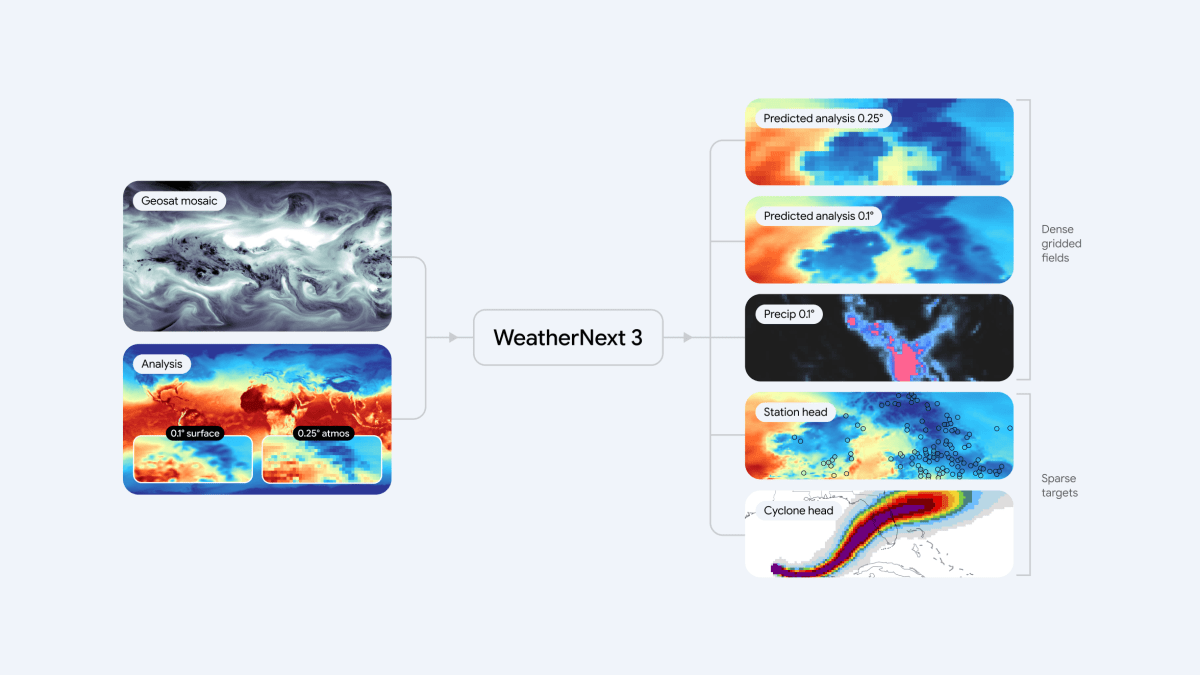
For developers who integrate weather forecast data into applications, the most relevant shift is the combination of improved atmospheric resolution and increased prediction frequency. A model that updates more often means applications can surface fresher data, which matters for anything from agricultural scheduling tools to logistics platforms that reroute shipments around incoming weather events. The change is not purely cosmetic: more frequent predictions reduce the window of time during which a forecast is operating on stale atmospheric state, particularly in fast-moving weather situations.
Why it matters
Advertisement
Tech Pulse Daily
Get tomorrow's pulse first
Join engineers who read Tech Pulse before stand-up. Free, weekday mornings.
Researchers working with weather model outputs will also want to examine how WeatherNext 3 handles the representation of atmospheric variables compared to earlier versions. The claim that it "sees the atmosphere more clearly" implies structural changes to how the model encodes spatial and temporal features, though the technical specifics of the architecture have not been fully disclosed in the announcement. Builders should watch for any associated research papers or model cards that detail input variables, output formats, pressure levels, and validation benchmarks, as those will determine how the model slots into existing data pipelines.
Google has stated that WeatherNext 3 outputs will begin flowing into Google products and services, which suggests the primary route to consuming the model for most developers will be through existing Google APIs rather than running the model locally. No direct model weights download or self-hosted deployment path was announced alongside the release. Developers currently using earlier WeatherNext outputs through Google services should monitor Google's developer documentation and any associated API changelogs for notices about when WeatherNext 3 data becomes the default source in their region or product tier.
Researchers seeking direct access to the model for academic or comparative evaluation should check Google DeepMind's and Google Research's publications channels, as these teams have previously released associated code and checkpoints alongside or shortly after major model announcements. If a paper accompanies this release, it will typically include details on reproducibility and data sources. Watching the official Google Research blog and the DeepMind publications page is the most reliable way to track that availability.
Who is affected
Because WeatherNext 3 is a deep learning model rather than a traditional numerical weather prediction system, its error characteristics differ from what many operational meteorologists and application developers are accustomed to. Neural weather models can perform well on aggregate metrics while producing physically inconsistent outputs in specific edge cases, such as extreme events or rapidly evolving convective systems. Builders relying on forecast data for safety-critical decisions should validate WeatherNext 3 outputs against ground-truth observations for their specific use cases before treating it as a drop-in replacement for established forecast sources.
The announcement does not specify backward compatibility with APIs or data schemas from previous WeatherNext versions. If your application parses forecast outputs at a specific format or field level, verify that the new model version does not alter variable names, units, grid resolution, or the structure of any JSON or binary outputs you are consuming. Silent format changes have caused integration failures in past forecast API transitions, and confirming schema stability before WeatherNext 3 becomes the default feed is worth the time.
What to watch next
Google's framing of WeatherNext 3 as part of a wave suggests additional iterations are in progress. The language around it being the "latest" in a series rather than a final form implies active research continues, and the integration into Google products means real-world feedback will flow back into future development cycles. Watching how WeatherNext 3 performs during high-impact weather events, and whether Google publishes skill scores comparing it against operational centers like the European Centre for Medium-Range Weather Forecasts, will clarify where genuine improvements land.
More broadly, WeatherNext 3 arrives at a moment when AI weather models from multiple organizations are converging on similar claims of higher resolution and faster inference. The meaningful differentiator going forward will likely be verified performance on tail-risk events, ensemble uncertainty quantification, and how cleanly these models integrate into operational forecasting workflows that mix AI outputs with physics-based systems. Track the peer-reviewed literature accompanying this release to assess those dimensions concretely.
Developer Action Items
- ☐ Diff the official changelog for Google before you bump — APIs, defaults, and removed flags only.
- ☐ Install through the vendor's documented channel in staging; keep a one-command rollback and time-box the canary.
- ☐ Grep your repo for old flag names, lockfile pins, and plugin versions that the notes mark as breaking.
- ☐ Prefer the first patch cut over the day-zero tag unless you have a reason to be on the leading edge.
- ☐ If TechCrunch did not name a region, plan, or SKU, screenshot the official availability line before you promise it to users.

Author
Dillip Chowdary
Writes Tech Bytes coverage of AI, engineering, and the tools that actually ship. Editor of Tech Pulse Daily.
Related on Tech Bytes
Search agent beats GPT-6 Astra on benchmarks, just days after release
Read →
Apple launches new Mac Studios with its ‘most powerful chip ever’ — the M5 Ultra
Read →
Claude Fable 5.1 is generally available in GitHub Copilot
Read →
Apple upgrading recent Mac mini orders to M6, M5 Pro models for free
Read →
Today's Tech Pulse briefing
Full briefing →
Advertisement