Hands-on with Ring’s new AI drone camera for your home
Ring announced the $249.99 Drone Cam indoor flying camera with AI Pilot cloud navigation and a 165-gram frame, scheduled to ship on January 27, 2027.
By Dillip Chowdary • Nov 10, 2026 • Source: The Verge
Ring founder Jamie Siminoff announced at a launch event in New York City that the company will ship the Ring Drone Cam on January 27, 2027, for $249.99, according to The Verge's report. The indoor autonomous flying camera arrives nearly six years after Ring first unveiled its predecessor, the Always Home Cam, which never officially reached consumer doorsteps.
This breakdown covers the technical design, autonomous navigation architecture, regulatory hurdles, and privacy controls behind Ring's first consumer drone. It is aimed at smart-home administrators, automation developers, and hardware builders looking to evaluate whether cloud-dependent aerial units can replace fleets of fixed indoor security cameras.
01Autonomous patrol hardware and camera specifications
The Ring Drone Cam weighs 165 grams and features a small camera integrated directly into its main frame rather than dangling from a gimbal. It captures video at 2K resolution across a 148-degree field of view, providing 360-degree coverage by rotating while airborne. Integrated LED spotlights provide forward illumination to assist nighttime navigation and alert property owners to unusual movement.
The unit reacts directly to environmental triggers from Ring ecosystem sensors, including door openings, motion alarms, and water leak detectors. When an alert fires, the drone unlatches from its dock, follows preprogrammed paths to the incident location, and streams live footage to the Ring mobile application. Homeowners can also dispatch the device manually or configure recurring automated patrol schedules.
Each flight lasts between five and eight minutes on a full battery. Ring states that the hardware requires eight minutes of charging time for every minute spent in the air, meaning a typical five-minute patrol requires approximately 40 minutes connected to the base station. When grounded on the charging station, the camera lens is physically covered by the dock assembly.
02Cloud-tethered vision architecture and model upgrades
Ring stripped out heavy onboard computing to hit consumer price targets, moving autonomous flight intelligence to a new framework called AI Pilot. Instead of carrying complex proximity sensors, the drone relies only on landing sensors and its primary lens. The visual stream routes directly to remote vision models and cloud computing servers that calculate real-time routing adjustments around household obstacles.
| Metric | Always Home Cam Prototype (2020/2023) | Ring Drone Cam (2027) |
|---|---|---|
| Retail Price | Unreleased target | $249.99 |
| Hardware Weight | ~660 grams | 165 grams |
| Physical Footprint | Full-scale CES demo unit | Quarter-size redesign |
| Navigation Compute | Local experimental sensors | Cloud-based AI Pilot |
| Camera Enclosure | Dangling center assembly | Integrated chassis |
| Resolution Profile | 1080p stream | 2K stream |
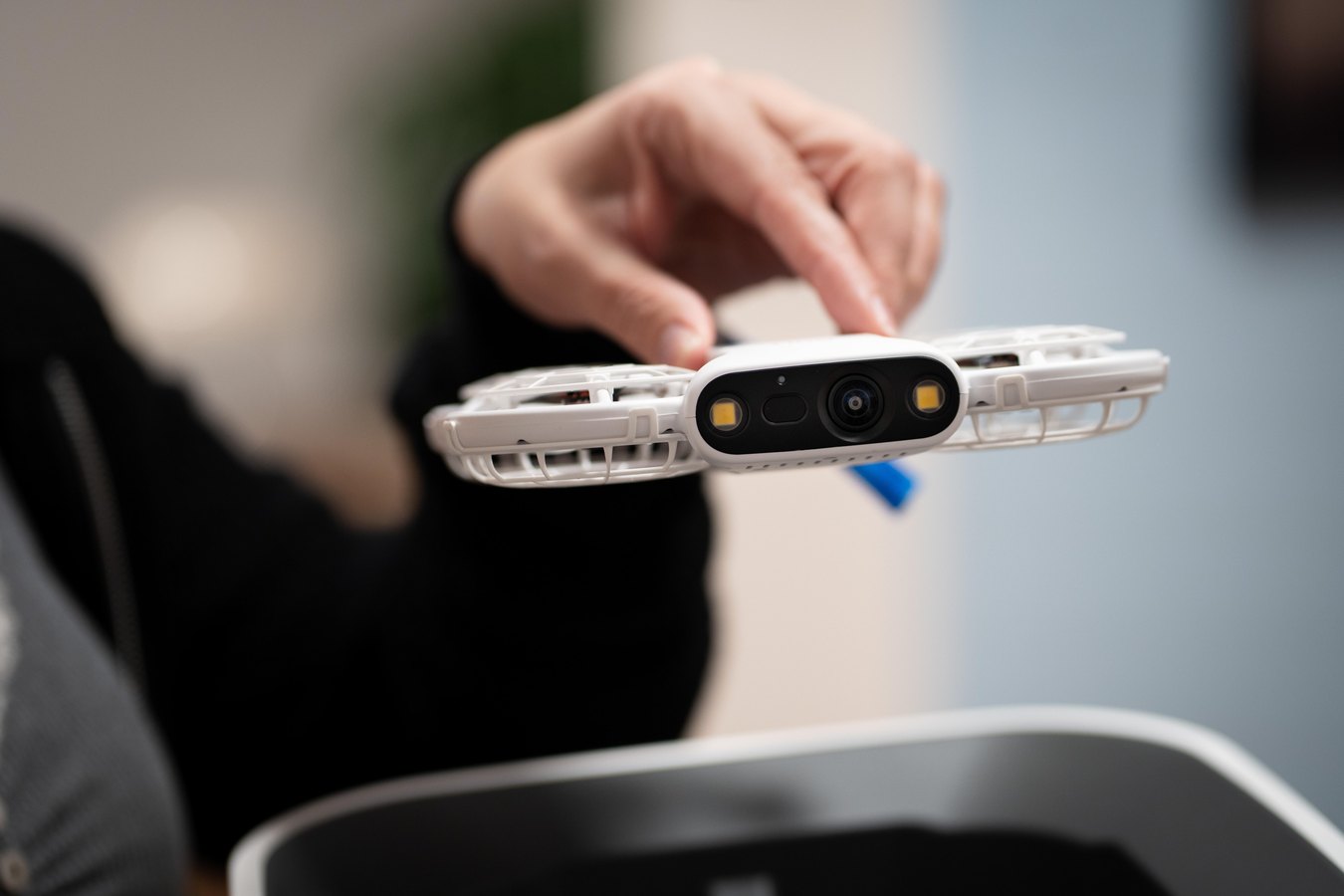
Because flight calculations depend on off-device processing, an active internet connection is an absolute operating prerequisite. If local Wi-Fi drops while the unit is patrolling, the drone cannot continue path navigation and will immediately touch down where it hovers. Footprint data will also link into Amazon's Alexa Home Map platform to align spatial coordinates with connected accessories.
03Deployment commands and Ring application onboarding
Advertisement
Tech Pulse Daily
Get tomorrow's pulse first
Join engineers who read Tech Pulse before stand-up. Free, weekday mornings.
Activating the Drone Cam across an automated home setup requires provisioning the hardware inside the Ring companion app alongside supported Ring Protect tiers. Operators configure flight paths through guided mapping routines and link trigger conditions to designated contact sensors.
ring-cli devices discover --type drone-cam
ring-cli patrol-routes create --name living-room --preset perimeter
To switch navigation behavior to specific AI Pilot autonomy profiles or pin operational parameters within programmatic setups, home integrators target the device interface:
/model ai-pilot-v1
ring-cli config set --device drone-cam-01 --model ai-pilot-v1
ring-cli config set --default-drone-model ai-pilot-v1
Once linked, the Ring app manages route maps, custom flight triggers, and video storage rules. The Drone Cam ships in a gray finish and functions strictly within indoor boundaries, using automated waypoints to travel across rooms and traverse domestic stairwells.
04Encryption boundaries and regulatory certification constraints
Recorded video transmissions use Ring's Throw Away the Key Encryption system, known as TAKE. The architecture rotates encryption keys every five minutes and automatically purges Ring-held key copies after 24 hours. This structure limits Amazon platform access while preserving server-side compute for smart alerts and automated video search queries.
Physical privacy relies on loud in-flight acoustics and mechanical lens shuttering inside the base dock. Because the device records only while in flight, it cannot monitor rooms while stationary. However, Ring is currently working through mandatory Federal Communications Commission certification before release, which brings added scrutiny under rules regulating foreign-made aerial hardware.
Siminoff stated that the Drone Cam complies with FCC requirements and confirmed the device is assembled in the United States. Prospective buyers must maintain an active Ring Protect subscription to retain cloud video history and unlock automated vision alerts, adding recurring subscription costs to initial hardware expenditures.
05Commercial robotics lines and ecosystem integration
The Drone Cam launches exclusively in the United States under Ring's newly formed Ring Robotics product division. Alongside the aerial camera, Ring unveiled the Ring Rover Cam, a $999.99 wheeled commercial security robot developed on Amazon's Astro robotics platform. The Rover Cam uses the same AI Pilot system, begins customer deliveries on December 16, 2026, and is available for immediate preorder.
Both robotic devices require cloud access to process navigation waypoints and coordinate responses with Amazon's upcoming Alexa Home Map ecosystem. As deployment approaches January 27, 2027, Ring must demonstrate that domestic obstacle avoidance functions reliably around active household pets without physical sensor arrays.
Long-term adoption depends on whether property owners embrace autonomous roving lenses inside living spaces after years of surveillance debates. By combining cloud machine learning with low-cost aerial frames, Ring aims to establish robotic patrols as a standard tier of modern residential security.
Hands-on with Ring’s new AI drone camera FAQ
When will the Ring Drone Cam ship and how much will it cost?
The Ring Drone Cam will ship in the United States on January 27, 2027, with a retail price of $249.99.
How long can the Ring Drone Cam fly on a single charge?
The drone flies for five to eight minutes per charge and requires eight minutes of docking time for every minute flown, meaning a five-minute flight needs 40 minutes of charging.
What happens if the Ring Drone Cam loses its Wi-Fi connection during flight?
Because the drone relies on cloud servers and its AI Pilot system to calculate navigation and bypass obstacles, losing its Wi-Fi connection causes the drone to immediately land.
How does Ring handle video privacy on the flying camera?
The camera records only while airborne, is mechanically shuttered inside its charging base, and uses TAKE encryption that rotates keys every five minutes and deletes company copies after 24 hours.
Sources

Author
Dillip Chowdary
Writes Tech Bytes coverage of AI, engineering, and the tools that actually ship. Editor of Tech Pulse Daily.
Related on Tech Bytes
Advertisement