HomeKit Weekly: Meross’s new presence sensor splits a room into three
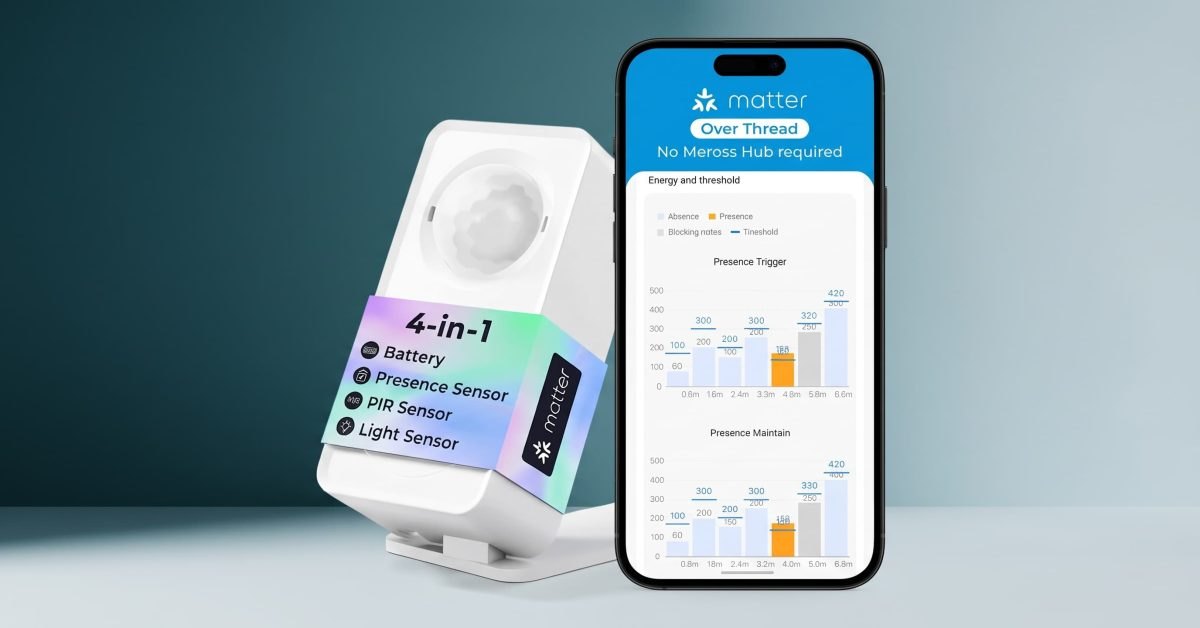
The Meross MS605 presence sensor connects via Matter to split a room into three distance zones, exposing each zone as a separate Apple Home sensor.
By Dillip Chowdary • Nov 29, 2026 • Source: 9to5Mac
At a glance
- Product
- Meross MS605 presence sensor
- Connectivity
- Matter over Bluetooth
- Detection range
- 20 feet motion and 13 feet presence
- Operating temperature
- -4 to 140 degrees Fahrenheit
- Power source
- CR123A battery included in box
- Availability
- Amazon
Meross launched the MS605 presence sensor, an Apple Home-compatible device connecting over Matter that divides a single room into three separate detection zones, according to 9to5Mac's report. The hardware exposes each distance zone as an independent occupancy sensor within Apple Home, allowing homeowners to trigger targeted lighting based on where an occupant stands rather than treating the entire space as a single binary boundary.
This breakdown examines the dual-sensing architecture, environmental ratings, hardware constraints, and zone automation workflows for smart home administrators seeking granular occupancy triggers in Apple Home. Readers will learn how the sensor maps distance zones, how the companion software interacts with Apple Home via Matter, and where the device can be placed.
01Three distance zones in Apple Home
Traditional presence sensors detect broad room occupancy but fail to identify where an individual is situated, causing automations to activate every connected light fixture at full brightness simultaneously. The MS605 resolves this limitation by dividing its coverage into three distinct distance zones configured within the Meross iPhone application during initial setup. Each active boundary appears directly inside Apple Home as an independent sensor entity.
Homeowners can assign unique automated responses to each distance threshold across multi-purpose living spaces. A bathroom setup can illuminate a low lamp at five percent brightness for distant entry while reserving full overhead lighting for occupants stepping close to the sink counter. In an office, overhead illumination remains active across the entire space while dedicated desk task lights turn on only when someone sits down.
Hallway corridors can trigger dimmed navigation lights when someone enters the far perimeter and raise illumination to one hundred percent as the person approaches the near threshold. If a space only requires two boundaries, users can disable the third zone directly inside the Meross companion software. Deactivating that zone automatically removes the corresponding sensor tile from the Apple Home interface to keep dashboards organized.
02Combined radar and passive infrared sensing
The MS605 combines millimeter-wave radar and passive infrared technology to maintain accurate tracking without generating false positive triggers. Millimeter-wave radar detects subtle micro-movements, enabling the device to register an occupant who is sitting completely still at a desk or reading in a chair. Meanwhile, the integrated passive infrared component tracks body heat to filter out non-thermal movement from oscillating household curtains or robotic vacuum cleaners.
Homeowners who operate in environments without non-thermal disturbances can also switch the hardware into a radar-only operating mode through software settings. This configuration bypasses thermal filtering, relying entirely on the continuous millimeter-wave radio transmissions to identify movement throughout the designated room boundaries. The dual-detection approach prevents lights from suddenly turning off during quiet reading sessions while maintaining reliable automation boundaries.
Combining these complementary detection technologies allows smart home platforms to resolve common presence automation headaches. Typical passive infrared detectors often turn lights off prematurely when an occupant remains motionless, whereas standalone radar systems frequently trigger lights when household curtains drift across an air conditioning vent. Meross pairs both physical mechanisms to verify actual human occupancy before altering accessory power states in connected rooms.
Advertisement
Tech Pulse Daily
Get tomorrow's pulse first
Join engineers who read Tech Pulse before stand-up. Free, weekday mornings.
03Motion range and ambient light gating
Physical motion detection extends up to approximately twenty feet from the hardware, while stationary presence sensing operates reliably up to thirteen feet away. Users define the distance limits for each individual zone within those physical hardware boundaries inside the companion application. Setting exact distance thresholds ensures that automations only trigger when an occupant crosses specific physical points across the room.
An ambient light sensor is built into the device alongside the radar and thermal detectors, measuring real-time illumination levels in the surrounding room. Smart home platforms can use this live brightness reading to evaluate automation conditions dynamically rather than relying on scheduled astronomical clock triggers like sunrise or sunset. Lights activate only when ambient daylight falls below a specific threshold while motion is detected.
Gating presence triggers with real-time ambient lux readings prevents energy waste across daytime hours without requiring complex software timing schedules. When stormy weather or closed blinds darken a room in the middle of the afternoon, the integrated light sensor permits illumination automations to execute immediately upon presence detection. Combining lux measurements with precise distance thresholds gives administrators complete control over automated fixtures.
04Enclosure weatherproofing and temperature thresholds
The sensor enclosure features an IP67 weather-resistance rating, providing robust protection against particulate dust ingress and moisture exposure in challenging installation environments. Operating temperatures range from negative four degrees Fahrenheit up to one hundred and forty degrees Fahrenheit. These environmental specifications allow homeowners to install the hardware in unconditioned domestic areas that standard indoor smart sensors cannot safely tolerate.
Suitable deployment locations include covered outdoor porches, unheated garages, damp basements, and moisture-heavy bathrooms where humidity swings typically damage unprotected electronics. By supporting installation across outdoor and semi-conditioned zones, the device allows users to bring multi-zone presence automations to entryways, driveways, and workshop benches. The robust casing expands automation options beyond conventional climate-controlled living rooms and bedrooms.
Power is supplied by an included CR123A lithium battery housed inside the chassis, avoiding the requirement for trailing power cables or nearby wall outlets during mounting. Because the battery comes bundled directly in the retail package, installers can place the hardware immediately onto shelves or walls without sourcing separate power accessories. The independent battery architecture simplifies placement across garages, covered porches, and detached outbuildings.
05Bluetooth setup and permanent companion software
Initial pairing requires the Meross iPhone application over a direct Bluetooth connection, and the companion software remains mandatory for ongoing hardware maintenance. While daily occupancy automations and status checks execute seamlessly inside Apple Home through Matter, parameter tuning requires reopening the proprietary application. Sensitivity limits, presence and absence timing intervals, zone recalibration, and firmware updates all depend exclusively on that software.
Note: Adjusting sensor configuration over Bluetooth requires pressing a physical button located on the top of the chassis. Users must finalize distance calibration, sensitivity thresholds, and zone boundaries before mounting the hardware in elevated or hard-to-reach positions. The retail device is currently available for purchase on Amazon.
Frequently asked questions
How does the Meross MS605 split detection zones in Apple Home?
The sensor divides its range into three configurable distance zones set through the Meross app. Each active zone appears as an individual presence sensor in Apple Home via Matter for independent automations.
What sensor technologies does the Meross MS605 use?
The device combines mmWave radar to detect stationary micro-movements and passive infrared to filter non-warm moving objects like curtains and robot vacuums. Users can also select a radar-only mode in settings.
Can the Meross MS605 presence sensor be installed outdoors?
Yes, the sensor features an IP67 rating and operates between -4 and 140 degrees Fahrenheit, making it suitable for covered porches, garages, and basements.
What battery does the Meross MS605 use?
The sensor is powered by a single CR123A battery, which comes included inside the box.
Sources

Author
Dillip Chowdary
Writes Tech Bytes coverage of AI, engineering, and the tools that actually ship. Editor of Tech Pulse Daily.
Related on Tech Bytes
Advertisement