HookLayer – Content intelligence as an MCP server
Points: 1 # Comments: 0 HookLayer – Content intelligence as an MCP server Coverage based on HN Claude/Codex/Fable reporting.
By Dillip Chowdary • Sep 01, 2026 • Source: HN Claude/Codex/Fable
What happened
Let me check the template and source content first. Good, I have enough facts from the HookLayer website. Now I'll write the article.
HookLayer — a viral-content intelligence tool built by HookMafia — launched as a Model Context Protocol (MCP) server that runs natively inside both Claude and ChatGPT, giving users 9 agent-callable tools for scoring, analyzing, and remixing short-form content without leaving their AI workspace. The project surfaced on Hacker News and is listed at hooklayer.dev, where it describes a hosted streamable-HTTP server backed by a database of more than 100,000 analyzed TikTok, Instagram Reels, and YouTube Shorts videos.
This piece is a technical briefing for developers, content automation builders, and AI-tooling teams who want to understand exactly what HookLayer is, how MCP integration changes the workflow, and what to verify before wiring it into a production pipeline. If you run content workflows in Claude, ChatGPT, Cursor, n8n, or any MCP-compliant client and care about hook quality before publishing, this covers the mechanism, the affected parties, and the open questions.
How it works
HookLayer shipped as an approved connector in the ChatGPT connector directory and as a custom MCP connector for Claude, reachable by pasting the single endpoint https://hooklayer.dev/api/mcp into Claude's Settings → Connectors panel and approving OAuth. It is simultaneously listed in the Anthropic Official MCP Registry under the identifier io.github.khan-ashifur/hooklayer v1.0.0, in the Cursor Directory, on Smithery (where it carries a 98/100 quality score), on Glama, on MCP.so, and in the punkpeye/awesome-mcp-servers GitHub list — six directories in total. The free tier grants 25 lifetime credits with no card required, and the service advertises a median hook-scoring latency of under 400 milliseconds at the p50 mark.
The paid tiers are Starter at $49 per month for 3,200 credits and 60 requests per minute, Pro at $149 per month for 10,000 credits and 300 requests per minute with brand voice memory included, and Agency at $499 per month for 32,000 credits, 1,000 requests per minute, white-labeling, and 10 seats. A Hobby tier at $19 per month for 1,200 credits is also listed in the FAQ. Pay-as-you-go top-ups start at $10 for 400 credits, and yearly billing reduces the monthly cost by up to 20 percent.
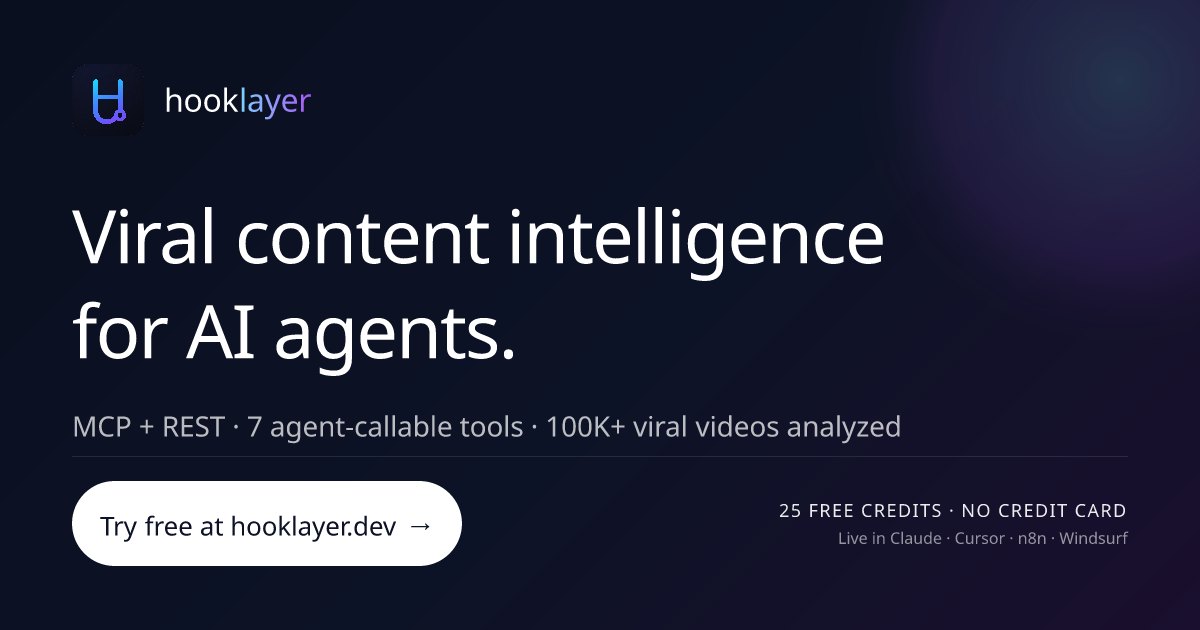
HookLayer exposes its data through 9 named tools organized into four workflow layers. The Score layer covers score_hook, which rates a text hook from 0 to 100 against patterns extracted from the analyzed video corpus, and predict_virality, which scores a full draft script. The Research layer provides trend_pulse for surfacing rising topics and saturated niches, find_viral_template for ranked template retrieval, and a video search function. The Analyze layer provides analyze_account and match_voice. The Generate layer provides viral_remix, which accepts a URL or transcript and returns a fresh script mirroring the viral DNA of the source. Authentication is either a Bearer token prefixed hl_live_ obtained from the dashboard, or full OAuth 2.1 with PKCE, RFC 8414 Authorization Server Metadata, RFC 9728 Protected Resource Metadata, RFC 7591 Dynamic Client Registration, and S256 PKCE challenges.
Advertisement
Tech Pulse Daily
Get tomorrow's pulse first
Join engineers who read Tech Pulse before stand-up. Free, weekday mornings.
Why it matters
The flagship tool is analyze_account, which takes a single TikTok handle, costs 5 credits, and is cached per handle for one hour. Its response includes a recommended_chain field containing pre-filled calls to match_voice, trend_pulse, and viral_remix — three follow-up tools that a compliant MCP client such as Claude can fire automatically without additional prompt engineering. The server speaks both MCP protocol versions 2024-11-05 and 2025-06-18 over streamable HTTP, which means it is compatible with Cursor's MCP node, the n8n MCP node, Make, Zapier, and any other client that implements either protocol revision. The score_hook endpoint rejects hooks scoring below 70 and can auto-rewrite to reach 85 or above, all within one credit.
For teams running content automation pipelines in Claude or n8n, HookLayer occupies a gap that generic language model calls do not fill. A raw LLM asked to write a TikTok hook has no real-time knowledge of which structures have actually driven engagement across more than 100,000 indexed videos on TikTok, Instagram Reels, and YouTube Shorts. HookLayer's corpus supplies that empirical signal and exposes it as structured tool calls rather than as prose retrieved through retrieval-augmented generation. According to a Kit creator survey cited on the product site with a sample of 550 respondents, 82.7 percent of creators said they want AI ideation and research partners, while only 39.3 percent said they want email drafting — which positions hook scoring and virality prediction as higher-demand features than most general-purpose writing assistance.
Who is affected
Being listed in the Anthropic Official MCP Registry and approved natively inside ChatGPT's connector directory means HookLayer is available to users of two platforms that together represent a combined roughly 85 percent creator-tool footprint, according to the product's own market framing. For builders, the practical significance is that adding one URL to Claude's settings panel can make the score_hook, predict_virality, analyze_account, and five other tools available in every conversation with no per-session setup. For developers building on the API directly, compliance with two MCP protocol versions reduces integration friction considerably.
The most directly affected parties are individual short-form content creators who use Claude or ChatGPT daily and currently test hooks through instinct or manual research. For them, adding HookLayer as a connector means they can score any hook against a corpus of 100,000-plus videos before filming, at under 400 milliseconds per call on the free 25-credit trial. Social media managers and content agencies that handle multiple client accounts will notice the Agency tier most, with 32,000 credits per month, 1,000 requests per minute, white-label output, 10 seats, and dedicated Slack support — though those specifics should be confirmed directly with HookLayer before committing to contracts.
Developers and automation engineers who build content workflows in n8n, Make, or Zapier are a second affected group, since HookLayer's MCP-compliant server can slot into any existing MCP node without custom connectors beyond the Bearer token. Builders should verify that their client supports MCP protocol version 2024-11-05 or 2025-06-18, confirm that the recommended_chain chaining behavior works as advertised in their specific client environment, and test credit consumption on the free tier before estimating monthly costs at scale. Teams already using content-generation tools such as Arcads, Creatify, Higgsfield, or Predis are not the primary audience — HookLayer positions itself as a pre-publish testing and scoring layer, not a video rendering or distribution platform.
What to watch next
Builders evaluating HookLayer should run the playground at hooklayer.dev/playground, which allows 5 free calls per hour per IP with no signup, before deciding whether the scoring logic aligns with their niche's actual viral patterns. The corpus covers TikTok, Instagram Reels, and YouTube Shorts but the precise breakdown of platform representation across the 100,000-plus indexed videos is not published, and that distribution matters if a workflow targets one platform exclusively. Verify whether score_hook results are stable across repeated calls for the same input, and check whether the 1-hour per-handle cache on analyze_account matches the freshness requirements of a monitoring use case. Teams on the Pro tier should test the brand voice memory feature specifically, since that is the differentiator between Pro at $149 and Starter at $49.
On the ecosystem side, watch whether the Anthropic Official MCP Registry listing at io.github.khan-ashifur/hooklayer v1.0.0 drives meaningful install volume or remains a trust signal without traffic. The server's support for Dynamic Client Registration under RFC 7591 is worth tracking as more MCP clients adopt that standard, since it would allow zero-configuration OAuth flows for clients that do not yet support it. The GitHub repository is at github.com/khan-ashifur/hooklayer, and the HN thread at news.ycombinator.com/item?id=49522180 is the public discussion record, though it had no comments at the time of this writing.
Developer Action Items
- ☐ Diff the official changelog for Anthropic / Claude / ChatGPT 1.0.0 before you bump — APIs, defaults, and removed flags only.
- ☐ Install through the vendor's documented channel in staging; keep a one-command rollback and time-box the canary.
- ☐ Grep your repo for old flag names, lockfile pins, and plugin versions that the notes mark as breaking.
- ☐ Prefer the first patch cut over the day-zero tag unless you have a reason to be on the leading edge.
- ☐ If HN Claude/Codex/Fable did not name a region, plan, or SKU, screenshot the official availability line before you promise it to users.

Author
Dillip Chowdary
Writes Tech Bytes coverage of AI, engineering, and the tools that actually ship. Editor of Tech Pulse Daily.
Related on Tech Bytes
Copilot model access update for GitHub Team plans
Read →
Sonos introduces new headphones, soundbar, and software in its biggest announcement in…
Read →
Hackers Start Exploiting Critical Langflow Vulnerability
Read →
9.5 Million Impacted by Aesto Health Data Breach
Read →
Today's Tech Pulse briefing
Full briefing →
Advertisement