How Cloudflare addressed a cross-tenant data exposure vulnerability
External security researchers at Accomplish identified a vulnerability in Cloudflare Containers that could expose residual disk data from previous workloads.
By Dillip Chowdary • Sep 27, 2026 • Source: Cloudflare Blog
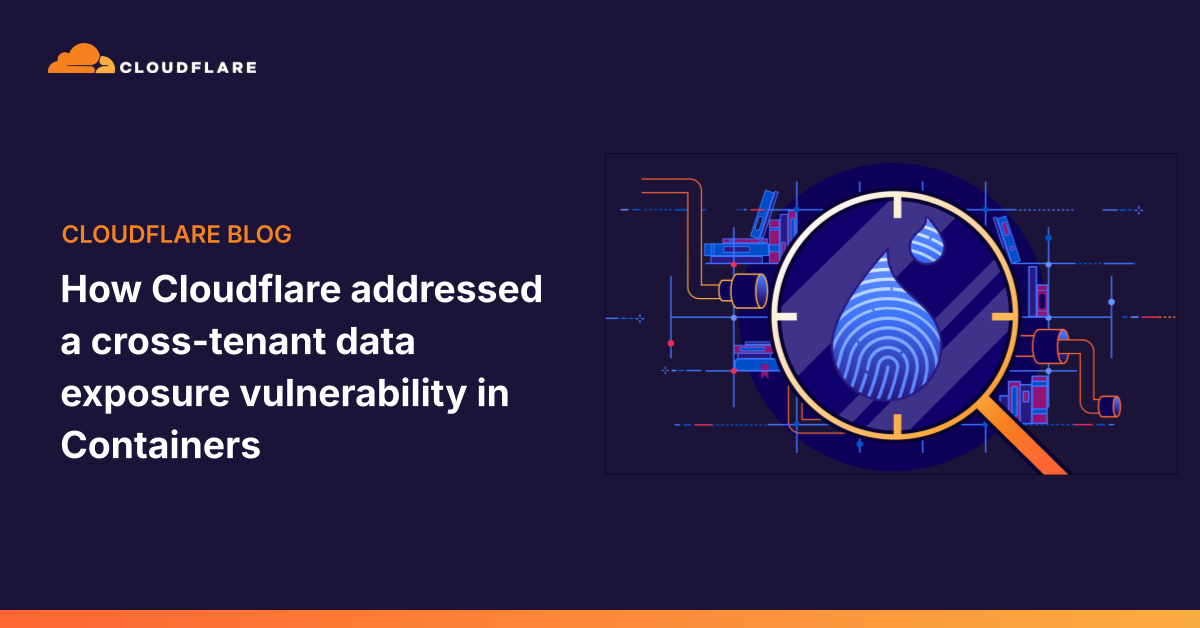
Cloudflare has patched a vulnerability in its Containers product that allowed residual disk data from one workload to remain readable by a subsequent, unrelated workload running on the same underlying infrastructure. The flaw was discovered and reported by external security researchers at Accomplish, who identified the mechanism by which tenant isolation could break down at the storage layer rather than the network or process layer.
This article covers how the vulnerability worked, which workloads and customers were exposed, and what steps Cloudflare took to investigate and remediate the issue. It is aimed at platform engineers, security teams, and developers who run containerized workloads on Cloudflare's infrastructure or who make architectural decisions about multi-tenant compute environments.
What broke in Cloudflare addressed a cross-tenant data
The core of the problem was that disk state from a completed container workload was not being fully sanitized before the underlying storage was reassigned to a new tenant's container. In a properly isolated multi-tenant system, every layer of the stack — networking, memory, and persistent or ephemeral storage — must be scrubbed or cryptographically partitioned between tenants. In this case, the sanitization step for disk data was incomplete, leaving residual artifacts that a subsequent workload could potentially access. Accomplish's researchers were able to demonstrate that this residual data was reachable under specific conditions, turning what might appear to be a routine resource-reuse optimization into a cross-tenant information disclosure path.
The vulnerability is notable because disk-layer isolation failures are often harder to detect than network-layer failures. A process that cannot reach another tenant's API endpoint may still be able to read data that was written to a shared storage volume in a prior session, particularly when storage is provisioned and deprovisioned at high speed to support short-lived container jobs. The combination of rapid workload cycling and incomplete cleanup is a known risk class in container platforms, and Accomplish's finding confirms it applied to Cloudflare Containers at the time of discovery.
Who is exposed by Cloudflare addressed a cross-tenant data
The exposure applied to workloads running on Cloudflare Containers where storage resources were recycled across tenant boundaries without complete sanitization. Any customer whose container wrote sensitive data to disk — credentials, intermediate computation output, user-specific content — during a workload session would be in scope. A subsequent workload assigned to the same physical storage could, in principle, recover that data before the platform's normal filesystem initialization completed. Cloudflare's investigation, prompted by Accomplish's disclosure, was focused on determining how frequently this storage reuse pattern occurred and whether any unauthorized access had already taken place.
The practical risk depends heavily on timing and workload density. Tenants running isolated, long-lived containers with dedicated storage allocations are less likely to have been affected than those whose workloads are short, ephemeral, and rapidly cycled. Security-sensitive workloads — those processing authentication tokens, private keys, or regulated personal data — represent the highest-risk subset, because even a small amount of residual disk state from those processes carries significant downstream consequences if it reaches an unintended reader.
Advertisement
Tech Pulse Daily
Get tomorrow's pulse first
Join engineers who read Tech Pulse before stand-up. Free, weekday mornings.
What to do now about Cloudflare addressed a cross-tenant data
Cloudflare has stated that it investigated the issue and took remediation steps following the disclosure from Accomplish. For customers, the immediate action is to review whether sensitive data was written to ephemeral container disk storage during the period before the patch was deployed. Workloads that relied on in-memory processing only, with no data written to disk, have a lower exposure surface. Teams that did write sensitive material to disk should assess whether that data could have been read by a co-located workload and, if necessary, rotate any secrets or credentials that were present in those sessions.
Beyond immediate remediation, this incident is a prompt to audit what data container workloads write to disk at all. Many developer teams treat ephemeral container storage as effectively private, but in shared-infrastructure environments that assumption requires verification against the platform's actual isolation guarantees. Checking the Cloudflare security advisory for specific guidance on affected time windows and recommended customer actions is the appropriate next step for any team running sensitive workloads on Cloudflare Containers.
How the Cloudflare addressed a cross-tenant data issue works
The technical mechanism centers on storage lifecycle management in a multi-tenant container runtime. When a container terminates, the platform must release its storage allocation back to a pool for reassignment. The secure approach requires overwriting or cryptographically invalidating the previously written data before that storage block is handed to a new tenant. The gap Accomplish identified was in this handoff sequence: the cleanup was not comprehensive enough to prevent a newly scheduled container from reading data written by its predecessor on that physical volume.
This class of vulnerability is sometimes called a "residual data" or "data remanence" issue. It does not require the attacker to break any encryption in transit or bypass network access controls — it relies entirely on the timing gap between one tenant releasing storage and the next tenant being assigned it. Cloudflare's remediation involved closing that gap by strengthening the sanitization step in the container lifecycle so that no readable data persists across tenant boundaries at the storage layer.
What is still unknown about Cloudflare addressed a cross-tenant data
The public summary does not specify the exact time window during which the vulnerability was present in production, which makes it difficult for customers to scope their own forensic reviews. Without a clearly defined start and end date for the exposure, teams cannot easily determine whether a particular workload session was at risk. Cloudflare has not yet published, in the available summary, whether any unauthorized access to residual data was confirmed during its investigation, leaving open the question of whether this was a theoretical finding or one with evidence of real exploitation.
Additional open questions include which specific storage backends or container configurations were in scope, and whether the sanitization fix applies uniformly across all Cloudflare Containers deployment regions. Security teams evaluating their exposure should watch for a detailed post-mortem or formal CVE entry from Cloudflare, which would supply the affected versions, timeline, and confirmation of scope that the initial summary does not yet provide.
Developer Action Items
- ☐ Inventory whether Cloudflare / Cloudflare runs in prod, CI, staging, or on laptops before you debate severity.
- ☐ Confirm the vendor's fixed build for Cloudflare / Cloudflare from Cloudflare Blog, then schedule the patch window.
- ☐ If you cannot patch today, isolate the service, rotate tokens that sat on the affected surface, and raise the logging floor.
- ☐ Record the decision and residual risk so the next on-call does not re-litigate whether you are exposed.

Author
Dillip Chowdary
Writes Tech Bytes coverage of AI, engineering, and the tools that actually ship. Editor of Tech Pulse Daily.
Related on Tech Bytes
Humans Are Reading Your ChatGPT Chats, Lawsuit Claims
Read →
Windows 11 KB5124010 update released with 46 changes and fixes
Read →
Hackers influence ChatGPT and Gemini to direct users to scam centers
Read →
Meta Connect 2026: The biggest news and announcements
Read →
Today's Tech Pulse briefing
Full briefing →
Advertisement