How Meta Uses AI Agents to Scale ML Innovations Across Ads Ranking Models
Meta deployed autonomous AI agents to handle over 60% of its ads ranking model updates, driving a 3x productivity boost and saving $45M in compute.
By Dillip Chowdary • Nov 18, 2026 • Source: Meta Engineering
At a glance
- Primary technology
- Ranking Engineer Agent and propagation agents
- Deployment date
- March 2026
- Workload share
- Over 60% of technique propagation handled by agents
- Compute savings
- Estimated $45M+ by end of year 2026
- Productivity gain
- 3x greater engineering productivity
- Compute reduction
- Median 4x reduction across select combinations
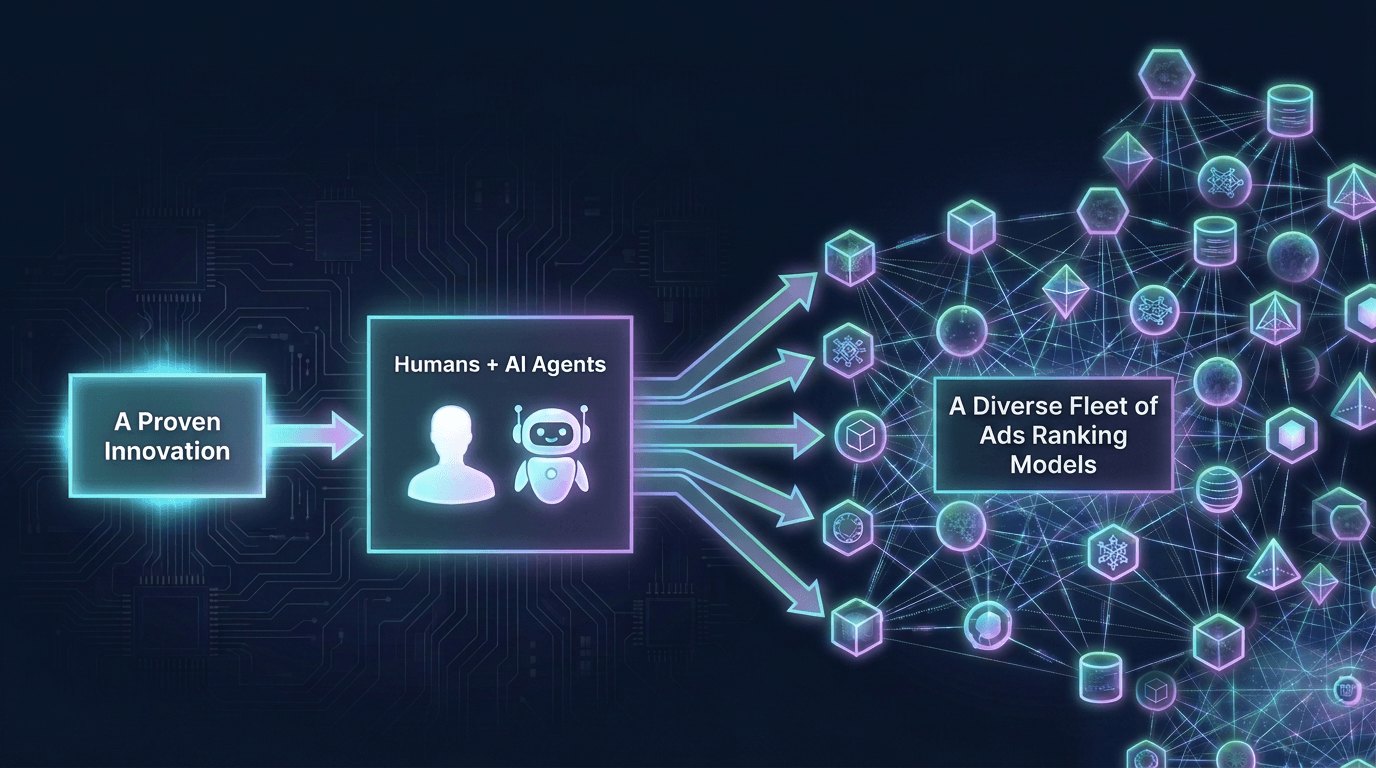
Meta deployed autonomous artificial intelligence agents to propagate machine learning updates across its ads ranking models, according to Meta Engineering's report. Since starting execution in March 2026, agents handle over 60% of all technique propagation across production models. Early results demonstrate a threefold boost in engineering productivity, a median fourfold reduction in training compute, and over $45 million in projected compute savings by the end of 2026.
This report examines how Meta propagates architectural enhancements and training optimizations across diverse recommendation models. Engineering leads and machine learning practitioners will discover how agentic workflows resolve non-deterministic design bottlenecks across hundreds of concurrent experimental training runs. The transition demonstrates how modular templates and autonomous agents solve the combinatorial explosion of technique-model combinations.
01Fleet diversity and technique shelf life
Meta powers its advertising recommendation systems with a large fleet of distinct ads ranking models. Each model serves specific product surfaces and advertiser objectives while operating under isolated data streams, unique neural network architectures, and rigid serving constraints. Researchers continually invent algorithmic techniques to enhance performance, including Wukong factorization layers, Interformer interaction networks, richer data representations, and training optimizations.
Because individual models feature customized architectures and runtime limits, a technique validated on one model almost never copy-pastes onto the next. Speed remains critical because machine learning techniques have a limited shelf life before new research supersedes them within a couple of development cycles. When deployment lags, potential gains disappear before the next generation of techniques arrives.
Propagating an expanding catalog of proven methods across hundreds of production models creates an exponential space of potential combinations. Both engineering hours and finite GPU compute budgets restrict how many adaptation paths teams can explore. Testing every combination through distributed training runs would quickly exhaust computing allocations on experimental attempts that yield suboptimal results.
02Standard model templates and human bottlenecks
Historically, domain experts managed every propagation attempt by studying target model architectures, generalizing code, and manually tuning hyperparameters. Although this manual process delivers strong results on high-revenue flagships, human bandwidth limits prevent it from scaling across the wider model fleet. Throughput remains capped while the backlog of candidate techniques grows much faster than engineering capacity.
To establish baseline automation, Meta introduced Standard Model Templates that assemble architectures from reusable, composable functional components. Over two years, this framework enabled the release of more than 5,000 technique-model combinations while reducing per-model engineering time by 92%. However, deterministic templates could not make complex judgment calls, such as tuning hyperparameter search spaces or diagnosing stalled training runs.
Note: Manual adaptation by domain experts remains the operational practice for Meta's highest-revenue ads ranking models. Specialized human tuning on these primary revenue drivers ensures maximum financial performance, while automated agent workflows manage technique propagation across the broader secondary model fleet.
03Three capabilities for autonomous system adoption
Advertisement
Tech Pulse Daily
Get tomorrow's pulse first
Join engineers who read Tech Pulse before stand-up. Free, weekday mornings.
Meta organized its technique propagation infrastructure around three core operational capabilities that bridge research breakthroughs and production deployment. Discovery continuously tracks proven methods to generate prioritized candidate lists ranked by expected impact. Generalization adapts algorithmic code across varied model architectures, while adoption executes distributed training experiments, monitors convergence metrics, and mitigates runtime faults.
AI agents supercharge these capabilities by integrating large language model reasoning with specialized machine learning tooling. Instead of requiring constant human intervention, agents diagnose unexpected training failures, navigate complex hyperparameter grids, and coordinate computing capacity across hundreds of concurrent jobs. This software architecture automates previously manual checkpoints into reliable end-to-end workflows that land validated models.
A shared organizational repository underpins the entire agent network by archiving data from previous training executions, model architectures, and technique outcomes. Because agents reference this accumulated historical record, they build upon prior learning rather than starting each adaptation from scratch. The system continuously refines its operational decisions as new training runs deposit empirical performance results into the store.
04Cross fleet discovery and shared knowledge bases
Discovery addresses two operational questions across the recommendation stack: which proven innovations exist, and how effectively each technique will transfer to other models. Previously, human domain experts answered both questions through individual assessments, reviewing organizational research and estimating architectural compatibility one model at a time. This manual review process created substantial delays between initial discoveries and production testing.
AI agents operate without individual human memory limitations by querying the shared institutional knowledge base across the entire model fleet simultaneously. The autonomous system systematically evaluates all active models, projects transferability scores, and outputs a prioritized candidate backlog ranked by expected commercial impact. Supervising engineers now focus on reviewing agent-generated recommendations rather than manually drafting cross-model compatibility assessments.
This automated candidate generation prevents wasted compute on low-confidence configurations. By evaluating historical compatibility patterns, agents eliminate unviable technique-model pairings before launching expensive multi-GPU cluster runs. The resulting discovery pipeline ensures finite computing capacity concentrates exclusively on high-probability architectural adaptations across production surfaces.
05Template optimization and bespoke model adaptation
Generalization re-implements an algorithmic technique so it functions reliably on models with disparate feature representations, architectures, and serving constraints. While core concepts transfer, physical implementations require substantial adaptation, ranging from hyperparameter adjustment to structural resizing. Generalization splits into template adaptation for standardized systems and bespoke adaptation for custom architectures, with agents actively supporting both execution paths.
For template-based architectures, agents formulate optimization hypotheses, execute multi-day experimental sweeps across representative model samples, and evaluate convergence anomalies. Validating an enhancement at the template tier automatically deploys it across all derivative models at a fraction of the compute required for individual model tuning. This automated cycle relieves engineers from supervising repetitive multi-day iteration loops.
On high-revenue models requiring bespoke engineering, agents assist human specialists by learning progressively from live adaptation attempts. The software navigates hyperparameter spaces and executes exploratory validation runs under developer supervision. By offloading computational exploration to autonomous systems, engineering teams preserve critical bandwidth while accelerating the propagation of verified algorithmic improvements.
Frequently asked questions
What is technique propagation in Meta's ads ranking models?
Technique propagation is the process of adapting and transferring proven machine learning improvements, such as Wukong factorization layers or training optimizations, across Meta's diverse fleet of ads ranking models.
How much compute does Meta save using AI agents for model propagation?
Meta achieves a median 4x reduction in training compute across select technique-model combinations and estimates more than $45 million in compute savings by the end of 2026.
What share of technique propagation do AI agents handle at Meta?
Since taking over execution in March 2026, AI agents handle over 60% of all technique propagation across Meta's ads ranking fleet.
Are Meta's highest-revenue ads ranking models completely automated by agents?
No, domain experts still manually adapt and tune techniques for Meta's highest-revenue models, though AI agents assist them by progressively learning during live adaptation attempts.
Sources

Author
Dillip Chowdary
Writes Tech Bytes coverage of AI, engineering, and the tools that actually ship. Editor of Tech Pulse Daily.
Related on Tech Bytes
Advertisement