How NVIDIA Open Source Tools Are Helping Researchers Build Next-Generation
NVIDIA open source 6G tools passed one million downloads across 8,000 research institutions, cutting robot task times by 52.6% and RAN power use by 45.6%.
By Dillip Chowdary • Nov 06, 2026 • Source: NVIDIA Blog
NVIDIA opened access to its Aerial wireless software framework alongside its Sionna simulation library twelve months ago, establishing an integrated open source suite designed to accelerate 6G network research. Over the past year, global developer adoption across both platforms expanded tenfold, pushing total downloads for the company's open source 5G and 6G software tools past one million. More than 8,000 academic and research institutions worldwide now run these toolkits to bridge neural network training, algorithmic simulations, and physical over-the-air radio frequency trials, according to NVIDIA Blog's report.
This report details how academic laboratories and telecommunications operators are utilizing these open software libraries to build AI-native network architectures, optimize uplink signal reception, lower base station power draw, and speed up end-to-end wireless simulations. The technical milestones will interest telecommunications engineers, edge computing developers, robotics researchers, and network infrastructure architects who design software-defined radio stacks for industrial automation, public safety communications, and future wireless cellular standards.
NVIDIA Source Tools Are Helping Researchers: what actually changed
Over the last twelve months, wireless research transitioned from disconnected mathematical modeling environments toward shared, GPU-accelerated software platforms that combine edge artificial intelligence with physical layer signal processing. NVIDIA AI Aerial and Sionna provide common software-defined pipelines where developers can model channel behavior, deploy neural receivers directly onto graphics processing units, and evaluate over-the-air transmissions using commercial hardware. By publishing these codebases under open source licenses on GitHub, the company unified link-level link simulation and edge inference on shared computing hardware.
This unified software strategy removed the traditional divide between cellular simulation tools and operational base station execution environments. Instead of implementing algorithms twice—first in mathematical scripting software and later in fixed-function digital signal processors—engineers now test identical neural network models across simulated links, edge compute devices, and live over-the-air testbeds. The resulting surge to more than one million software downloads reflects rapid consolidation around open radio access network frameworks that support custom neural network layers.
NVIDIA Source Tools Are Helping Researchers: how it works
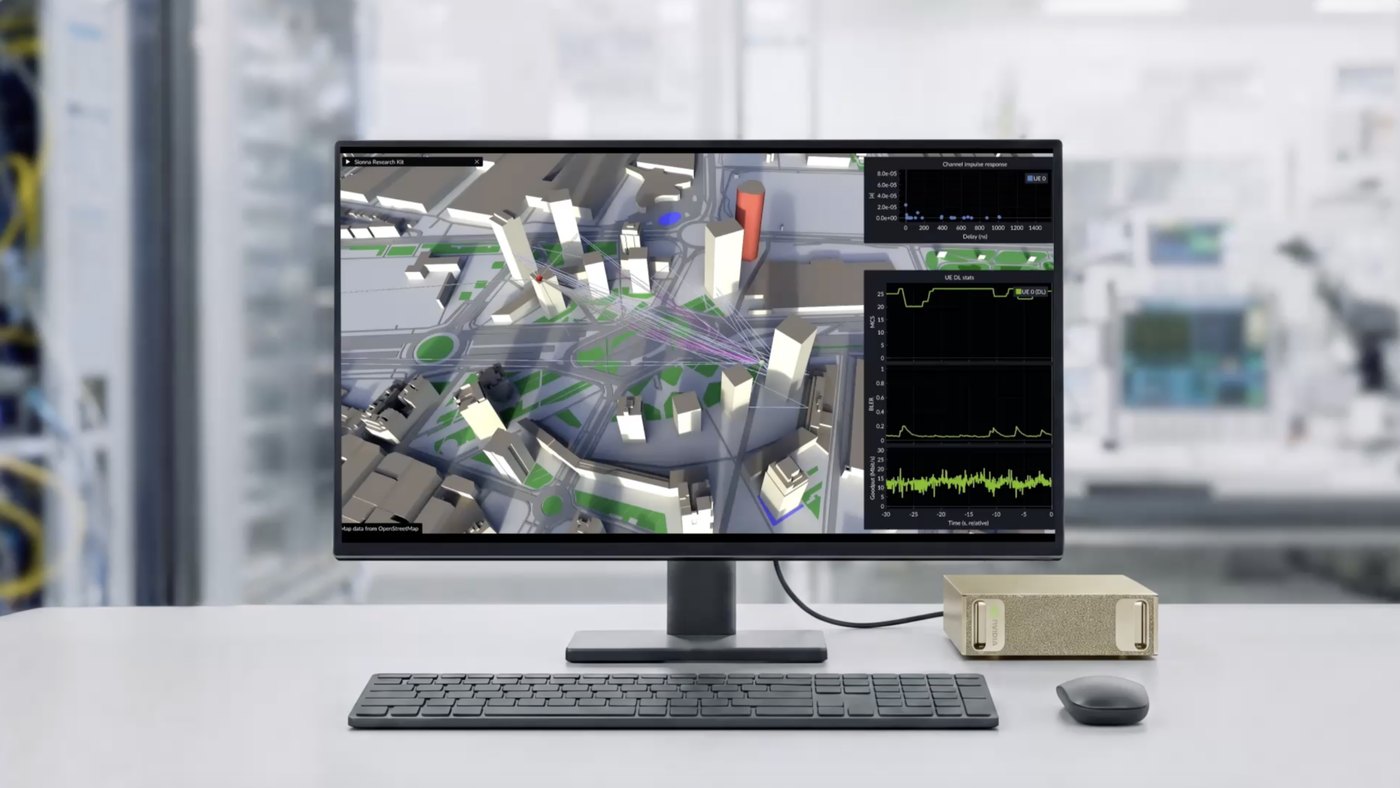
The software suite pairs Sionna's differentiable link-level simulation tools with Aerial CUDA-Accelerated RAN, known as ACAR, running on standard NVIDIA graphics processors. In industrial robotics trials, researchers at King's College London coupled a camera-fitted robotic manipulator to an NVIDIA Jetson AGX Orin module running Sionna, simultaneously executing edge machine learning inference and a software-defined 5G radio stack. Rather than streaming raw camera frames, the system implements goal-oriented semantic communications by broadcasting compact vector descriptions of detected items, spatial coordinates, and physical relationships, cutting robot task completion duration by up to 52.6 percent.
At the physical signal layer, telecommunications operator SoftBank embedded a machine learning neural receiver into Aerial CUDA-Accelerated RAN to process incoming uplink radio signals captured from an off-the-shelf commercial 5G handset. The neural receiver replaces fixed mathematical channel estimators with trained inference models that adapt to multipath distortion and environmental interference. In parallel work at ETH Zurich, engineers deployed the NVIDIA Aerial Testbed to tune neural receiver weights using physical site measurements, reducing block error rates by more than one-third compared with baseline pretrained weights.
Advertisement
Tech Pulse Daily
Get tomorrow's pulse first
Join engineers who read Tech Pulse before stand-up. Free, weekday mornings.
NVIDIA Source Tools Are Helping Researchers: why it matters
Traditional wireless networks rely on static channel estimation formulas and over-provisioned cellular capacity that waste electrical energy and degrade under sudden RF interference. By replacing rigid algorithmic blocks with trained neural receivers, operators can recover weak signals that would otherwise trigger packet drops, retransmissions, and latency spikes. SoftBank confirmed higher uplink throughput across every one of fifteen evaluated signal interference configurations when testing its neural receiver against standard receiver designs, achieving peak throughput gains of approximately 60 percent under severe channel distortion.
Network energy management also gains concrete operational efficiencies through predictive machine learning control loops deployed directly within the radio access network. Investigators at the University of Leeds built a predictive scheduling architecture running on an NVIDIA DGX Spark platform that forecasts traffic volume ten minutes into the future. The system verifies that neighboring active cells can absorb ongoing device handovers before powering down excess base station hardware, cutting radio access network energy consumption by 45.6 percent against full-power baseline measurements without dropping subscriber sessions.
NVIDIA Source Tools Are Helping Researchers: who is affected
University laboratories, telecommunications service providers, and simulation software maintainers are already restructuring their development workflows around these open source GPU toolchains. Teams managing physical robotics deployments benefit from goal-oriented semantic communication frameworks that detect dropped objects, recover from execution errors, and run real-time collision checks against digital twin models before motors engage. Field emergency responders relying on drone video feeds during search operations similarly gain steadier connectivity through neural receivers that decode corrupted uplink signals in degraded radio environments.
Network simulation engineers are also seeing operational timelines shorten dramatically when evaluating large cellular topographies. The Centre Tecnològic de Telecomunicacions de Catalunya integrated GPU-accelerated radio channel models running on ACAR into its open source 5G-LENA cellular network simulator. Calculating signal propagation across hundreds of concurrent antennas and client receivers previously required three hours of compute time; the integrated GPU channel model completed the identical simulation workload in 10 to 20 minutes while maintaining exact statistical distribution accuracy.
NVIDIA Source Tools Are Helping Researchers: what to watch
The broader research community is tracking further open source contributions and field demonstration data scheduled for presentation during the 6G Developer Sessions at NVIDIA GTC in Washington, D.C. Telecommunications carriers will watch whether softwarized radio architectures running on commercial server hardware can match the extreme low-latency processing budgets mandated by upcoming 3GPP 6G specifications. Technical validation will center on whether neural network receivers can run inference within sub-millisecond slot deadlines without excessive power penalties across dense urban cell towers.
Academic institutions and independent developers can clone both NVIDIA AI Aerial and NVIDIA Sionna repositories directly from GitHub to inspect the underlying software-defined radio pipelines. Future integration milestones will focus on broader interoperability between third-party open source network simulators like 5G-LENA and real-time physical layer testbeds. As field engineers gather empirical radio data from operational deployments, the focus shifts toward continuous automated retraining of neural receiver weights to handle seasonal foliage changes, new architectural structures, and dynamic interference profiles.
Developer Action Items
- ☐ Verify the claim on the official Nvidia / GitHub / Framework page (or NVIDIA Blog), not from this recap alone.
- ☐ Name the surface that moved — API, policy, model, hardware, or commercial terms — before you Slack the thread.
- ☐ Assign one owner a day to read the primary material and decide: this-sprint, this-quarter, or noise.
- ☐ Do not change production on day-one coverage. Watch the vendor changelog and one independent write-up first.
NVIDIA Source Tools Are Helping Researchers FAQ
What are NVIDIA AI Aerial and NVIDIA Sionna?
NVIDIA AI Aerial is a software suite for building software-defined, CUDA-accelerated radio access networks, while NVIDIA Sionna is an open source library designed for link-level wireless simulations and AI model training.
How much did the open source 5G and 6G software tools grow in adoption?
Global developer adoption expanded tenfold over the past twelve months, surpassing one million total downloads across more than 8,000 academic and research institutions worldwide.
How does semantic communication improve robotics performance over wireless networks?
In experiments at King's College London using an NVIDIA Jetson AGX Orin, transmitting compact semantic descriptions instead of full camera images reduced robot task completion time by up to 52.6 percent.
What throughput and power improvements did researchers demonstrate using these tools?
SoftBank achieved up to a 60 percent uplink throughput improvement using an Aerial neural receiver, while the University of Leeds cut RAN power consumption by 45.6 percent using AI-driven sleep schedules.
Sources

Author
Dillip Chowdary
Writes Tech Bytes coverage of AI, engineering, and the tools that actually ship. Editor of Tech Pulse Daily.
Related on Tech Bytes
Advertisement