Hyve Smart Package Locker Review: Protecting Your Holiday Deliveries
Hyve launched a $297 smart package locker with a 7.4-cubic-foot steel-reinforced vault to protect home deliveries from porch piracy via PIN-code access.
By Dillip Chowdary • Oct 26, 2026 • Source: Wired
Startup manufacturer Hyve released the Hyve Smart Package Locker, an electronic porch lockbox priced at $297 intended to prevent theft by securing deliveries in an app-monitored enclosure. As detailed in Wired's report, the unit replaces traditional mechanical drop slots with a single electronic hatch that couriers open using designated four-digit PINs. The hardware pairs with an indoor wireless bridge and mobile software to alert homeowners whenever the compartment lid opens, offering an alternative to recurring carrier hold fees or missing front-porch parcels.
This breakdown examines the construction, daily operating mechanics, software subscription tiers, carrier compatibility hurdles, and practical hardware constraints of the device. It is intended for homeowners, frequent online shoppers, and remote professionals who regularly handle high-volume deliveries from carriers such as FedEx, UPS, DHL, and Amazon while away from their properties.
Hyve Smart Package Locker Review: what actually changed
The locker moves away from the classic two-chamber mail container, where parcels slide across a cantilevered flap into an inaccessible bottom bin. Hyve instead relies on an electronically latched single storage cavity accessible through a top door controlled by digital keypad entry. The physical chassis is composed of steel framing combined with plastic exterior panels, available in gray or white color options. External measurements span 32 inches high, 20 inches wide, and 20 inches deep.
Because internal clearances are roughly 4 inches smaller in every dimension, the usable capacity sits at 7.4 cubic feet. Hyve rates this storage volume to accommodate roughly 80 percent of standard Amazon delivery packages, fitting parcels such as three-bottle wine shipments while leaving outsized cartons exposed outside. Unloaded, the locker weighs 40 pounds and ships flat without printed documentation, directing users via an enclosed QR code to a five-page PDF and video walkthrough that typically requires up to an hour of assembly.
Hyve Smart Package Locker Review: how it works
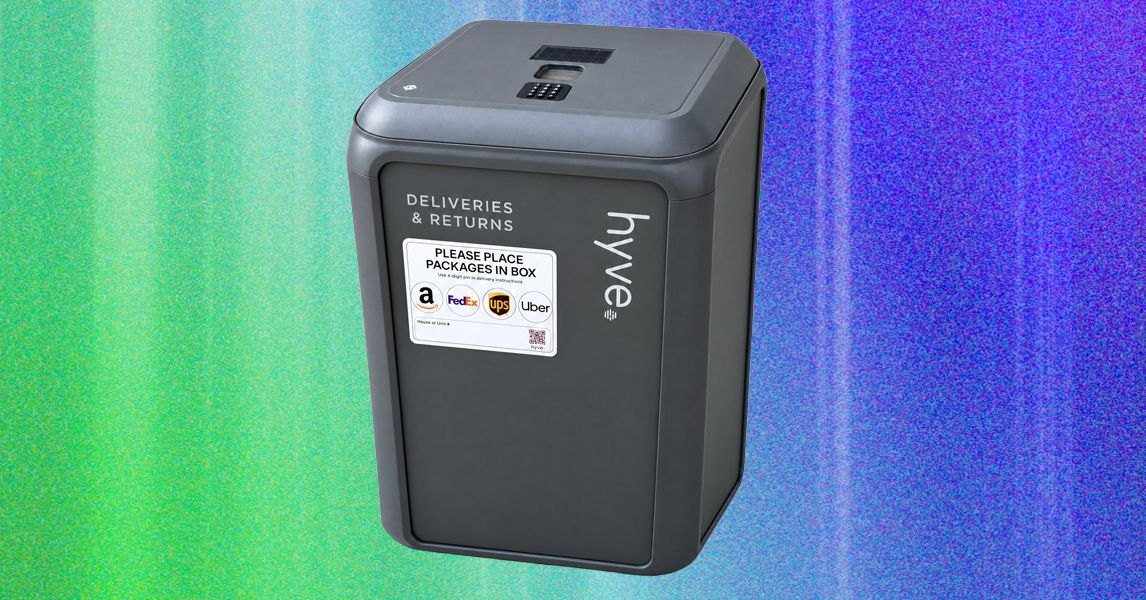
Day-to-day operation centers on an electronic latch powered by four AA batteries, supported by an integrated solar panel that trickle-charges an internal backup cell, along with an emergency USB-C port. The unit connects across exterior walls to a dedicated indoor Wi-Fi bridge plugged into a nearby wall outlet. In default configuration, the system uses a single master four-digit PIN for both package drops and owner retrievals, triggering a smartphone notification whenever the lid unlatches.
Users wanting segregated access must purchase the Essentials subscription tier for $5 per month or $50 per year, following a one-month included trial. Essentials lets customers assign unique PIN codes to distinct carriers and services including FedEx, UPS, DoorDash, Instacart, and Best Buy, logging which credential unlocked the box. For $15 per month, a higher-level Returns Plan adds scheduled courier pickups twice monthly directly from the locker, though that collection service is currently restricted to Los Angeles and Seattle.
Advertisement
Tech Pulse Daily
Get tomorrow's pulse first
Join engineers who read Tech Pulse before stand-up. Free, weekday mornings.
Hyve Smart Package Locker Review: why it matters now
Front-porch package security has grown urgent as major shipping services roll back automated convenience features. Earlier this year, FedEx discontinued its complimentary vacation package hold option without a formal public announcement, an adjustment confirmed directly by company representatives. Consequently, consumers attempting to hold parcels at carrier access points or retail shipping storefronts face fees that typically start around $5 per package and scale higher based on holding duration.
These storage charges accumulate rapidly for households receiving regular drops from multiple logistics providers during multi-day trips. Standard drop boxes can deter opportunists, but fixed lockboxes present spatial tradeoffs when multiple carriers arrive sequentially. Hyve designed its hardware to eliminate commercial holding fees by creating a semi-permanent receptacle on residential property, bundled with an included security bracket and tether cable to stop thieves from carrying away the 40-pound container itself.
Hyve Smart Package Locker Review: who is affected
The device primarily affects suburban homeowners and remote workers managing regular shipments from couriers like FedEx, UPS, Amazon, and on-demand delivery apps. However, user experiences hinge entirely on driver compliance. Because the single-chamber interior remains fully accessible once unlatched, early deliveries occupy space needed by subsequent couriers, and nothing physically stops an unscrupulous delivery worker with a working PIN from taking items deposited earlier by another service.
Furthermore, integrating access codes into modern carrier accounts requires manual setup by the homeowner. Delivery address preference forms on FedEx and UPS websites have transitioned from free-form text instructions to simplified drop-down selection menus. Neither carrier offers a dedicated lockbox delivery option in their forms, forcing customers to place four-digit codes into gate-code fields that drivers operating on tight delivery routes may overlook or disregard entirely.
Hyve Smart Package Locker Review: what to watch
Prospective buyers must monitor component reliability and geographical service rollouts before committing to the ecosystem. While Hyve estimates four fresh AA batteries will run the locker for five to six months, early operational testing revealed complete battery depletion within three weeks, requiring emergency auxiliary power from a USB-C battery pack to restore access. Ongoing software firmware updates and power-management improvements will determine whether long-term maintenance remains manageable.
Regional availability for the Hyve Returns Plan also remains narrow. Hyve continues tracking customer distribution across the United States to plan additional metro coverage, but expansion beyond Los Angeles and Seattle is expected to be gradual. Finally, consumer adoption depends on whether major shipping companies add standardized lockbox prompts to their official delivery settings, ensuring couriers consistently use customer PINs rather than leaving parcels on bare doorsteps.
Developer Action Items
- ☐ Diff the official changelog for Amazon 7.4 before you bump — APIs, defaults, and removed flags only.
- ☐ Install through the vendor's documented channel in staging; keep a one-command rollback and time-box the canary.
- ☐ Grep your repo for old flag names, lockfile pins, and plugin versions that the notes mark as breaking.
- ☐ Prefer the first patch cut over the day-zero tag unless you have a reason to be on the leading edge.
- ☐ If Wired did not name a region, plan, or SKU, screenshot the official availability line before you promise it to users.
Hyve Smart Package Locker Review FAQ
How much does the Hyve Smart Package Locker cost?
The locker costs $297 at retail, which includes one month of the Essentials subscription plan.
How big is the Hyve locker and what can fit inside?
The exterior measures 32 by 20 by 20 inches, yielding an interior space of 7.4 cubic feet that fits roughly 80 percent of Amazon package sizes.
What happens if the locker batteries die?
The device features an emergency USB-C port to provide temporary power, alongside a solar panel for trickle charging an internal backup battery.
Where is the Hyve Returns pickup service available?
The $15 monthly returns service is currently available only to residents in Los Angeles and Seattle on a twice-a-month schedule.
Sources

Author
Dillip Chowdary
Writes Tech Bytes coverage of AI, engineering, and the tools that actually ship. Editor of Tech Pulse Daily.
Related on Tech Bytes
Advertisement