A developer built a harness so I can watch Claude edit my videos live
Synteq launched Agentcut, an open-source studio linking Claude Code and Codex to Remotion with 49 components, local file storage, and in-browser MP4 exports.
By Dillip Chowdary • Oct 24, 2026 • Source: agentcut.synteq.app
Synteq released Agentcut, an open-source video studio and terminal helper for coding agents. According to agentcut.synteq.app's report, the MIT-licensed tool connects to Claude Code or Codex, allowing developers to generate and edit Remotion video timelines locally using Node.js LTS 20.10 or newer.
This report details how Agentcut turns text prompts into multi-track video compositions, examining its local architecture, component library, and browser-based rendering engine. It is designed for engineers and creators seeking code-controlled video generation without cloud dependencies.
A developer built a harness so I can watch: what actually changed
The release introduces a local developer harness linking command-line coding assistants with an interactive browser video editor. Instead of generating uneditable raster footage via remote cloud models, the system instructs an agent to construct React components across a visible timeline. The setup requires Node.js LTS 20.10 or higher and launches automatically using the npx package runner. In benchmark tests, the rendering engine assembled a complex composition featuring seven tracks in 92 milliseconds, providing instant preview rebuilds in the local development workspace.
Project timelines are saved as transparent JSON files, such as projects/launch-video/layers.json, located directly inside the user workspace. Each file organizes assets into separate tracks for visual scenes and audio elements, with clips specifying component names, start times, durations, and property configurations. By treating video layers as structured declarative code rather than opaque media exports, users can inspect parameters, modify frame counts, and audit layout choices directly. Once verified, the entire sequence exports to MP4 format within the browser without external processing services.
A developer built a harness so I can watch: how it works
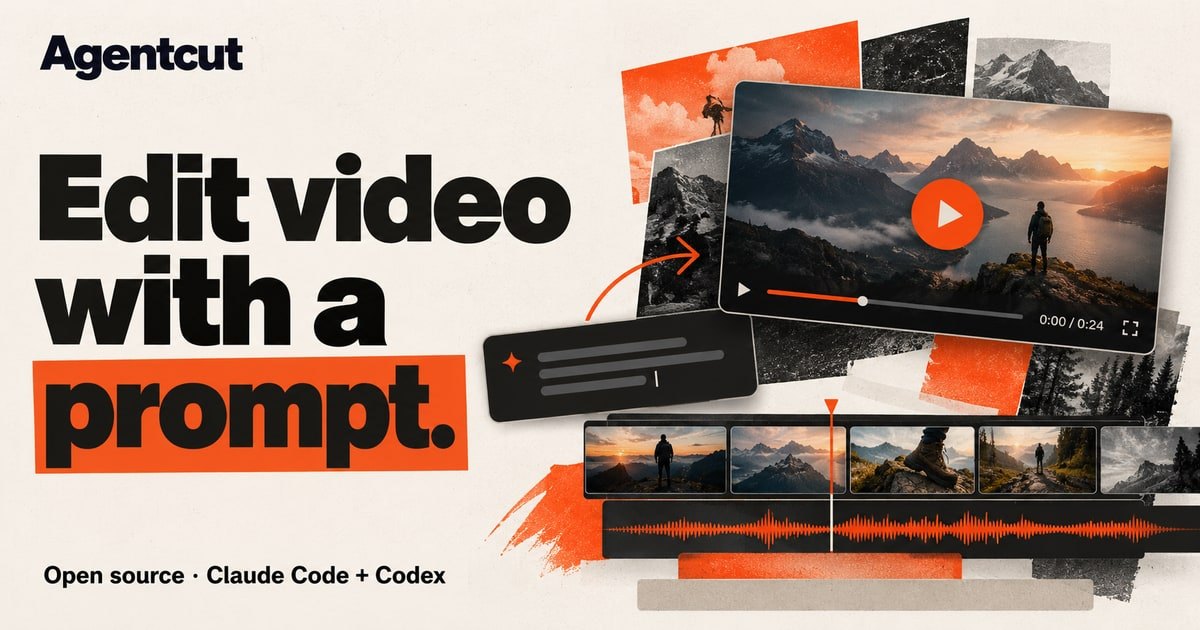
Operation follows a three-step workflow starting in the terminal, where users initiate the studio using npx -y agentcut. The utility automatically attaches to existing signed-in sessions for Claude Code or OpenAI Codex, preserving local credentials without requiring independent web logins. In the chat interface, the creator describes the video narrative, motion requirements, and sound elements. The selected coding assistant processes these instructions, writes real Remotion code, selects motion components from the library, and positions clips along the timeline while the preview rebuilds dynamically.
Once the initial sequence is assembled, creators can adjust the composition visually or through iterative prompts. Users can drag visual clips across tracks, adjust properties in the inspector panel, or click specific frames to request adjustments from the agent. The studio includes 49 motion components, covering kinetic titles, lower thirds, captions, and transitions. It also features eight project styles that alter typography, camera movements, and textures across all layers simultaneously. The finished project exports to MP4 in both 16:9 widescreen and 9:16 vertical formats.
Advertisement
Tech Pulse Daily
Get tomorrow's pulse first
Join engineers who read Tech Pulse before stand-up. Free, weekday mornings.
A developer built a harness so I can watch: why it matters now
The software addresses data privacy and asset control by operating entirely on local developer hardware without an external backend. Proprietary cloud video generators process user footage on remote servers, introducing security vulnerabilities and obscuring timeline logic. Under Agentcut, user files, project directories, and model API keys remain on the local machine. Every scene is saved as a React component in the workspace, enabling engineers to open files in their local code editors, customize layout code, and maintain transparent version control across their repositories without subscription lock-in.
The release also demonstrates how language models can handle complex visual tasks when paired with structured code frameworks. While coding agents often struggle with visual timing in traditional video software, Remotion provides a declarative syntax that models can easily read and modify. Because the studio, terminal helper, and all 49 motion components are published under the open-source MIT license, developers have complete freedom to fork the code, construct custom motion components, and integrate programmatic video generation directly into automated build scripts and existing production deployment pipelines.
A developer built a harness so I can watch: who is affected
Software engineers and technical product teams creating release announcements and feature walkthroughs benefit directly from this tool. Instead of manually editing motion graphics in complex desktop software, teams can prompt agents to deploy domain-specific components. The library provides technical elements like Prompt Box, which simulates an interactive prompt typing characters before submitting, and Chat Thread, which renders conversational bubbles with animated typing indicators. For branding, Sticker Slam presents logos as die-cut stickers tilting across surfaces like brick walls or laptop lids, while Split-Flap Board animates airport-style character tiles.
Content creators producing statistical explainers and educational media also gain specialized visualization tools. The Stat Counter component animates numerical values rising toward a defined target, complete with optional progress rings and labels. In addition, the Kinetic Poster component builds Bauhaus designs using primary-colored geometric shapes and sliding color bars that reveal Swiss-style titles on rhythm. Because the engine supports beat-matched audio synchronization, voice-overs, and word-by-word captions, creators can assemble dynamic multimedia packages entirely from code, bypassing conventional timeline suites while preserving full manual control over every layer.
A developer built a harness so I can watch: what to watch
Technical implementation details to monitor focus on how well coding agents maintain layout accuracy across extended timelines. The baseline release demonstrates multi-layer editing across seven tracks, managing visual scenes, text overlays, sound effects, and audio tracks. In the JSON specification, scene durations are precisely defined, such as ninety frames per component block. Developers will watch whether Claude Code and Codex sustain logical track structures as projects scale, especially when coordinating precise frame offsets for beat-synced music, voice-over narrations, and entrance transitions across multi-minute compositions.
The development of the broader component ecosystem is another crucial factor. While Agentcut currently includes 49 core motion components and eight project styles, community contributors on GitHub can introduce new React components and styling presets. Observers should track how third-party developers extend the library with new transition effects, data visualization widgets, and automated rendering pipelines. The adoption rate among engineers and media creators will test whether browser-based Remotion environments can serve as a dependable alternative to traditional video editing suites.
Developer Action Items
- ☐ Diff the official changelog for OpenAI / Claude / Codex 20.10 before you bump — APIs, defaults, and removed flags only.
- ☐ Install through the vendor's documented channel in staging; keep a one-command rollback and time-box the canary.
- ☐ Grep your repo for old flag names, lockfile pins, and plugin versions that the notes mark as breaking.
- ☐ Prefer the first patch cut over the day-zero tag unless you have a reason to be on the leading edge.
- ☐ If HN Claude/Codex/Fable did not name a region, plan, or SKU, screenshot the official availability line before you promise it to users.
A developer built a harness so I can watch FAQ
What system requirements are needed to run Agentcut?
Users must install Node.js LTS version 20.10 or newer, then launch the helper using npx -y agentcut.
Which AI coding assistants are supported by Agentcut?
Agentcut works with existing local installations of Claude Code and OpenAI Codex, allowing users to switch models directly in the chat interface.
Does Agentcut send user video files or API keys to external servers?
No, the studio runs without a backend server, keeping all files, project folders, and API credentials strictly on the user's local machine.
Sources

Author
Dillip Chowdary
Writes Tech Bytes coverage of AI, engineering, and the tools that actually ship. Editor of Tech Pulse Daily.
Related on Tech Bytes
Advertisement