A developer built an AI Tamagotchi before Meta could
A developer built an interactive AI Tamagotchi using a $50 Waveshare touchscreen devkit and Claude Code ahead of Meta launching its retail Muse Charm.
By Dillip Chowdary • Oct 31, 2026 • Source: The Verge
Meta is preparing to sell the Muse Charm this holiday season, introducing a wearable AI companion designed by Mark Zuckerberg to deliver voice assistance through an animated character. Rather than waiting for retail availability, hardware reviewer Sean Hollister built an operational alternative using drop-shipped hardware and coding agents, as documented in The Verge's report. By relying on Meta's open-source developer code, the project links an inexpensive microcontroller directly to the company's proprietary Muse AI cloud.
This technical analysis examines how off-the-shelf maker hardware compares against Meta's upcoming consumer wearable, detailing the software modifications needed to transform an incomplete developer kit into a functional assistant. The breakdown serves engineers, hardware builders, and product strategists assessing whether standalone AI gadgets offer real advantages over existing smartphones. By tracing each integration step from board setup to custom logic, this review documents the practical limits of Meta's backend services and local microcontrollers.
A developer built an AI Tamagotchi before: what actually changed
Meta selected the Waveshare ESP32-S3 1.75C as an officially sanctioned devkit for developers seeking to build a custom Muse Gadget. Hollister ordered the pendant hardware from China for fifty dollars, receiving a silver metal pocket watch housing a 1.75-inch touchscreen with push-to-talk buttons. Although the physical form closely mirrors the announced Muse Charm, the bare devkit ships without integrated cameras or 5G cellular radios. Instead, the device relies on local Wi-Fi pairing and Meta's open-source repositories to authenticate against the Muse cloud platform using personal developer access tokens.
The factory firmware experience proved bare and highlighted significant software shortcomings upon initial pairing. The stock configuration included only a single static Jolly avatar that offered minimal user interaction and lacked automated discovery for smart home devices, failing to match basic capabilities found on Amazon Echo or Google Home hardware. Furthermore, Meta's default speech pipeline misinterpreted voice queries as basic transcription requests rather than interactive commands. The small screen displayed only fragments of incoming text without full conversation logs, leaving the physical unit largely nonfunctional until external coding tools intervened.
A developer built an AI Tamagotchi before: how it works
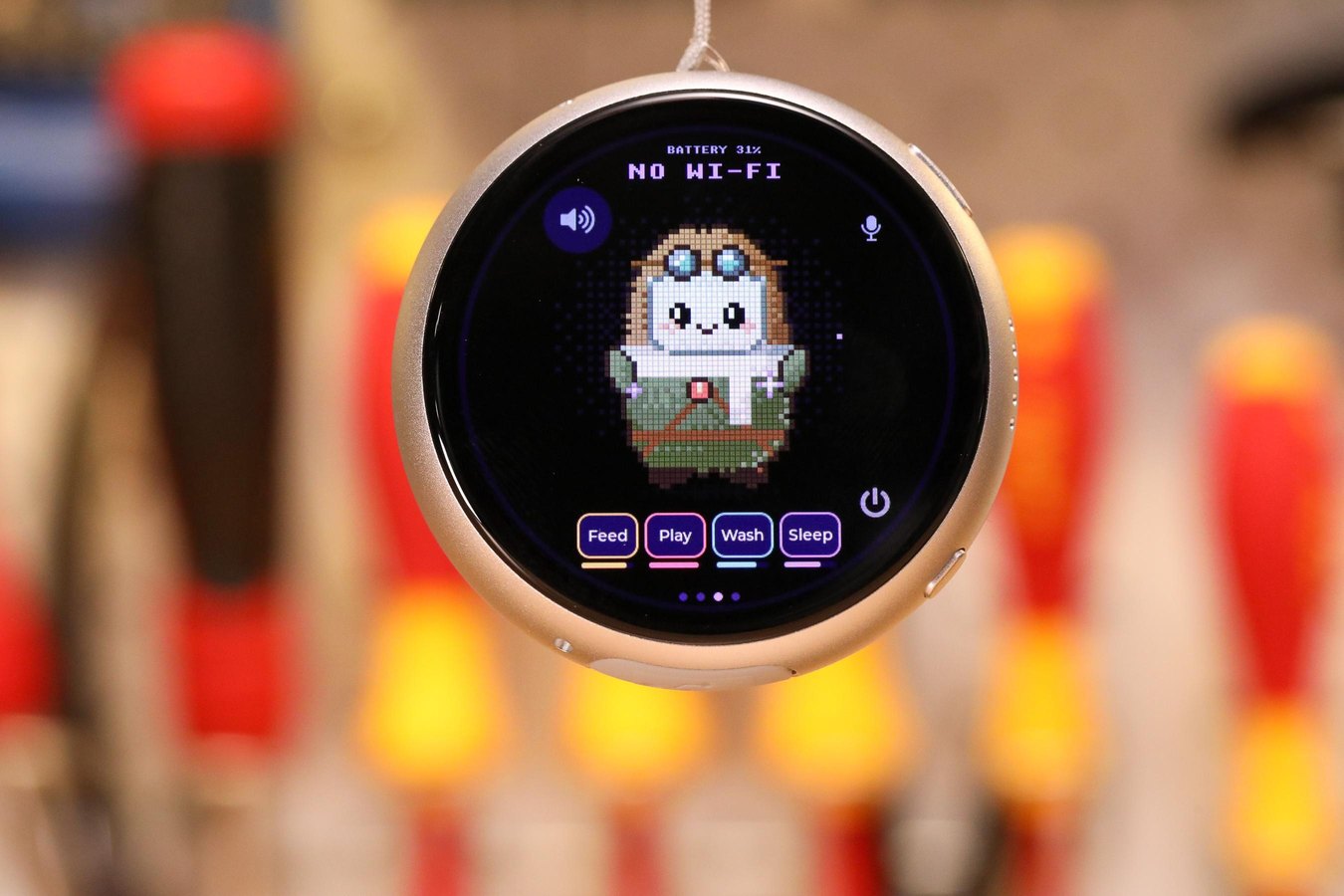
Software engineers Anant Narayanan and Jeremy Payne designed Meta's open-source framework with video streaming samples, which Hollister expanded using Anthropic's Claude Code command-line tool. By tethering the Waveshare microcontroller to a personal computer, plain-language prompts generated functional C and Python routines without requiring manual programming experience. Claude resolved early communication bugs by implementing an audio filter that drops any recording shorter than one full second, preventing premature button releases from choking Meta's ingestion pipeline. A dedicated swipe-right conversation history screen was added to preserve transcripts that previously vanished from the small display.
Local audio generation was enabled by bridging the device to ElevenLabs, using a British voice profile from its free tier to read incoming model responses aloud. Hollister then recreated the broader avatar suite previewed during Meta Connect and implemented a four-tier Tamagotchi simulation governing pet hunger, boredom, fatigue, and cleanliness. Feeding snacks introduces simulated food messes, while excessive activity requires scheduled sleep cycles. Claude also corrected an inverted phone camera feed, built a remote shutter trigger with Bluetooth previewing, generated a three-hand analog watch face in fifteen minutes, and embedded a video player running clips of Zuckerberg.
Advertisement
Tech Pulse Daily
Get tomorrow's pulse first
Join engineers who read Tech Pulse before stand-up. Free, weekday mornings.
A developer built an AI Tamagotchi before: why it matters now
This project underscores a widening shift toward conversational vibe coding, where non-programmers direct large language models to construct embedded device software. Hollister successfully modified device drivers, user interfaces, and network protocols despite possessing no formal software engineering background. The assembly demonstrates that entry-level microcontrollers can reproduce core features of proprietary consumer wearables months before commercial retail launches. For fifty dollars in hardware, independent builders can bypass closed ecosystem restrictions, showing that the primary barrier to wearable development has shifted from low-level systems programming to prompting proficiency and cloud API access.
At the same time, the project exposes structural dependencies on centralized artificial intelligence vendors. Despite local interface speedups, the device experienced noticeable latency spikes caused by processing delays across Meta's cloud servers. In addition, serious data governance questions surround consumer hardware linked to personal data. Hollister isolated the Waveshare pendant on a dedicated guest Wi-Fi subnet after noting past security incidents where Meta's Muse agent inadvertently exposed a reviewer's home address. Relying on remote neural networks introduces persistent latency and privacy vulnerabilities that local peripheral microcontrollers cannot mitigate alone.
A developer built an AI Tamagotchi before: who is affected
Consumer hardware manufacturers face mounting pressure as developer kits increasingly replicate the core value propositions of dedicated commercial electronics. When a 1.75-inch touch pendant can be drop-shipped from China for fifty dollars and configured via automated coding agents in an afternoon, justifying expensive proprietary hardware becomes harder. Meta must prove that the production Muse Charm delivers tangible capabilities beyond standard smartphones, especially since Hollister found that a standalone pendant offers no functional advantage over a handheld phone without extensive custom software. Device makers risk consumer skepticism if dedicated products deliver less flexibility than hobbyist devkits.
The experiment directly influences early adopters and tinkerers weighing pre-built consumer electronics against modular maker hardware. Enthusiasts willing to flash custom firmware gain unconstrained customization, including bespoke game loops, external speech synthesis engines, and local Bluetooth camera triggers that proprietary software stacks frequently restrict. However, this demographic must accept substantial trade-offs in software reliability, physical durability, and data security. Unaudited machine-generated code running on network-connected hardware requires careful isolation, meaning casual consumers seeking polished smart home integrations will still remain dependent on commercial retail ecosystems.
A developer built an AI Tamagotchi before: what to watch
The immediate focus centers on Meta's official holiday shipping schedule for the Muse Charm and whether commercial units retain open developer interfaces. Industry observers will monitor whether Meta restricts the final wearable to sandboxed first-party applications or allows users to compile custom code directly onto the gadget. Another critical technical question is whether Meta AI engineers Anant Narayanan and Jeremy Payne will update the public GitHub repository to fix speech latency, transcription misfires, and missing audio playback in the baseline open-source software stack so future devkit builders encounter fewer initial hurdles.
Observers should also track whether Meta strengthens backend privacy safeguards for the Muse agent following earlier address leaks. On the hardware front, the broader maker ecosystem will test whether low-cost ESP32-S3 boards can maintain sustained user engagement once the novelty of custom avatars fades. As holiday retail shipments approach, consumer adoption will hinge on whether Meta includes essential features like smart home automation, remote photography triggers, and multi-tier virtual pets natively, or whether hobbyist devkits running automated code continue to outpace the company's factory software experience.
Developer Action Items
- ☐ Diff the official changelog for Anthropic / Claude / Google 1.75 before you bump — APIs, defaults, and removed flags only.
- ☐ Install through the vendor's documented channel in staging; keep a one-command rollback and time-box the canary.
- ☐ Grep your repo for old flag names, lockfile pins, and plugin versions that the notes mark as breaking.
- ☐ Prefer the first patch cut over the day-zero tag unless you have a reason to be on the leading edge.
- ☐ If The Verge did not name a region, plan, or SKU, screenshot the official availability line before you promise it to users.
A developer built an AI Tamagotchi before FAQ
What hardware was used to build this DIY Muse Charm alternative?
The device was assembled using a Waveshare ESP32-S3 1.75C, an officially sanctioned $50 development pendant drop-shipped from China featuring a 1.75-inch touchscreen in a silver metal pocket watch frame.
How did Claude Code improve the pendant's out-of-the-box software?
Claude generated code for a swipe-right conversation history screen, added text-to-speech via an ElevenLabs British voice, filtered out audio clips under one second, built a remote camera viewfinder, and added a multi-level Tamagotchi pet game.
Why did the builder isolate the gadget on a guest Wi-Fi network?
The device was kept off the primary home network due to data security concerns after Meta's Muse agent previously leaked a reviewer's home address.
Does the Waveshare devkit include cameras or cellular connectivity?
No, the $50 Waveshare hardware lacks onboard cameras and 5G cellular radios, relying instead on Wi-Fi and Bluetooth connections paired with a smartphone.
Sources

Author
Dillip Chowdary
Writes Tech Bytes coverage of AI, engineering, and the tools that actually ship. Editor of Tech Pulse Daily.
Related on Tech Bytes
Advertisement