A developer rewriting IBM SPSS Statistics in 100% Safe Rust, Alone
StatCraft delivers a clean-room rewrite of IBM SPSS Statistics in pure Safe Rust, pairing classic pivot tables with a local AI bridge on port 18493.
By Dillip Chowdary • Nov 08, 2026 • Source: github.com
StatCraft is an open-source statistical software package built entirely in pure Safe Rust as an independent alternative to proprietary data suites such as IBM SPSS Statistics, according to github.com's report. The project pairs an interactive graphical desktop workspace with a deterministic calculation engine designed to eliminate application crashes across demanding research tasks.
This report examines how the software structures its computational engine, graphical interface, and automated bridge for data analysts, university educators, clinical trial researchers, and psychologists. The clean-room implementation provides an exact SPSS replacement workflow that combines authentic pivot tables, classic syntax scripting, and local Model Context Protocol connectivity without relying on unsafe memory operations.
A developer rewriting IBM SPSS Statistics: what actually changed
The software eliminates proprietary licensing constraints by delivering an open-source statistical workstation written without unsafe memory blocks or panic invocations. The architecture enforces zero panic, unwrap, or expect calls across its entire codebase, ensuring that division by zero, empty samples, or corrupted files produce structured Result error types instead of crashing the interface. The workspace mirrors the dual-view paradigm of IBM SPSS Statistics, offering a virtualized Data View grid alongside a Variable View metadata dictionary that tracks variable names, labels, missing values, column alignments, and measurement levels.
The data view handles live switching between raw numbers and descriptive value labels, while the variable view implements nine canonical SPSS variable formats. These formats include Numeric, Comma, Dot, Scientific, Date, Dollar, Custom Currency, String, and Restricted Numeric. Precision controls feature custom vector spinners, and measurement classifications display Scale, Ordinal, and Nominal levels with dedicated vector icons. All visual elements are drawn using native egui rendering to eliminate missing character squares, and the user interface isolates every display string inside Project Fluent localization catalogs in English and Russian.
A developer rewriting IBM SPSS Statistics: how it works
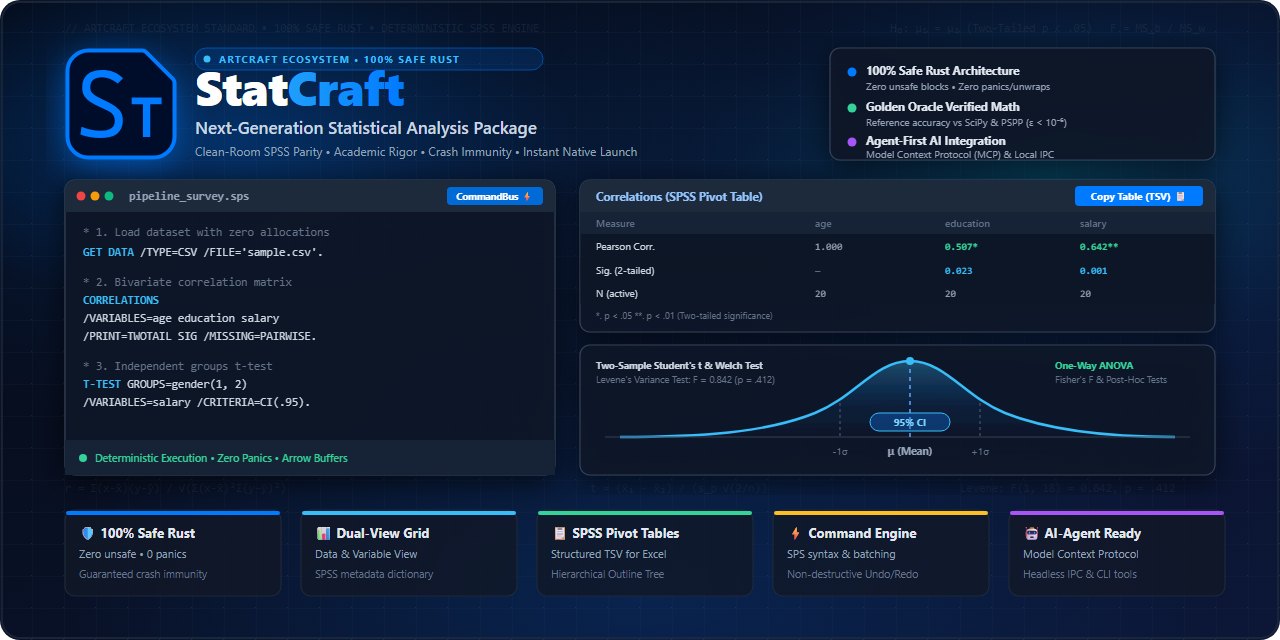
StatCraft organizes its internal operations around atomic engine commands rather than direct interface event handlers. Every analytical manipulation executed in the interface registers as an EngineCommand, supporting non-destructive undo and redo capabilities while generating serializable SPSS syntax files with the sps extension. The calculation layer operates through a seven-tier downward dependency hierarchy spanning L0 data codecs up to L6 desktop application logic. Pure mathematical calculations in the algorithm layer achieve precision within ten to the negative sixth power, verified against standard SciPy and SPSS analytical routines.
Analytical procedures in the current release cover descriptive statistics, frequency counts, one-sample t-tests, independent-samples t-tests, paired-samples t-tests, and one-way analysis of variance. For group comparisons, the engine runs Levene tests for equality of variances alongside Student and Welch t-tests. The Output Viewer renders results into hierarchical document outlines paired with multi-tier pivot tables featuring alternating row striping and right-aligned numeric data. Analysts can transfer these formatted results directly into spreadsheet applications using an integrated tab-separated value clipboard exporter structured specifically to avoid column shifts or automatic date conversions.
Advertisement
Tech Pulse Daily
Get tomorrow's pulse first
Join engineers who read Tech Pulse before stand-up. Free, weekday mornings.
A developer rewriting IBM SPSS Statistics: why it matters
Standard large language models frequently hallucinate mathematical calculations, skew sample averages, or fail to compute non-linear test statistics accurately when processing numerical research tables. StatCraft addresses this limitation by functioning as an exact calculation oracle that connects directly to autonomous artificial intelligence agents using a native Model Context Protocol server. The software exposes a local inter-process communication socket bound to port 18493, permitting systems like Claude, ChatGPT, Antigravity, and Ollama to inspect loaded datasets and execute verified statistical runs.
Researchers using this bridge can instruct connected artificial intelligence assistants using everyday language to evaluate survey groups, verify variance homogeneity, and interpret output values. Because the bridge operates entirely on the local loopback address at 127.0.0.1 without routing data to external endpoints, institutional healthcare data and proprietary enterprise files remain strictly on the host workstation. As the external agent issues background syntax routines, the desktop interface updates simultaneously, producing visible pivot tables, syntax audit trails, and exportable reports in real time.
A developer rewriting IBM SPSS Statistics: who is affected
University instructors teaching undergraduate research methods, academic psychologists running behavioral assessments, and clinical trial scientists evaluating experimental outcomes can transition away from costly commercial statistical software. Because the package reads and executes canonical syntax protocols such as GET DATA, DESCRIPTIVES, T-TEST, and ONEWAY, analysts can preserve existing institutional curriculum materials and automated batch files. The user experience maintains classic SPSS operational conventions, enabling researchers familiar with legacy software to navigate dialog boxes and output viewers without extensive retraining.
Development environments and resource-constrained workstations benefit from compilation constraints configured to prevent memory exhaustion, enforcing single-thread execution and single codegen units during builds. Data engineers managing cross-platform migrations gain codec access spanning comma-separated files, tab-separated tables, Excel workbooks, OpenDocument spreadsheets, and SPSS data containers including sav and zsav files. Software developers building autonomous data science agents gain programmatic control through standard input-output flags, allowing headless testing and automated pipeline execution without launching graphical windows.
A developer rewriting IBM SPSS Statistics: what to watch
The implementation demonstrates that mission-critical scientific software can be re-engineered in safe systems languages without sacrificing compatibility with entrenched enterprise formats. Observers should track how the analytical engine expands its algorithmic coverage beyond basic parametric comparisons, variance analysis, and descriptive distributions into non-parametric tests, linear regressions, and multi-factor models. As data science workflows increasingly incorporate autonomous agents, the adoption of port 18493 local socket bridging provides a concrete model for separating natural language interaction from deterministic mathematical verification.
The project also offers a clear reference for cross-platform interface development by utilizing egui vector painting and decoupled Fluent localization files instead of fragile platform fonts and web wrappers. Observers can monitor the stability of its command architecture across external tools by tracking headless integrations via the mcp flag in standard development environments. Continued verification against established statistical packages will determine whether this safe-memory rewrite can permanently replace proprietary statistical suites across academic laboratories, corporate research departments, and privacy-sensitive healthcare environments.
Developer Action Items
- ☐ Verify the claim on the official GitHub / IBM page (or Hacker News Front Page), not from this recap alone.
- ☐ Name the surface that moved — API, policy, model, hardware, or commercial terms — before you Slack the thread.
- ☐ Assign one owner a day to read the primary material and decide: this-sprint, this-quarter, or noise.
- ☐ Do not change production on day-one coverage. Watch the vendor changelog and one independent write-up first.
A developer rewriting IBM SPSS Statistics FAQ
What statistical procedures does StatCraft currently support?
StatCraft provides descriptive statistics, frequency tables, one-sample t-tests, independent-samples t-tests with Levene and Welch corrections, paired-samples t-tests, and one-way analysis of variance with Fisher F-tests.
How do autonomous AI agents interact with StatCraft?
External agents such as Claude, Antigravity, and local models connect through a built-in Model Context Protocol server running over a local socket on port 18493 or via standard input-output mode using the mcp flag.
How does StatCraft ensure application stability during data errors?
The application is written in 100% pure Safe Rust with zero unsafe blocks, panics, unwrap calls, or expect statements, returning structured Result error types whenever division by zero or malformed data occurs.
Sources

Author
Dillip Chowdary
Writes Tech Bytes coverage of AI, engineering, and the tools that actually ship. Editor of Tech Pulse Daily.
Related on Tech Bytes
Advertisement