Jensen Huang and the decline of the visionary showman founder CEO
Nvidia cofounder Jensen Huang stepped down from the five trillion dollar chipmaker after thirty-three years following dual chip smuggling and conduct scandals.
By Dillip Chowdary • Nov 14, 2026 • Source: The Verge
Nvidia chief executive Jensen Huang has departed the semiconductor manufacturer after thirty-three years leading the company. As detailed in The Verge's report, the resignation follows two chip smuggling controversies alongside allegations of three extramarital affairs, including one with an alleged Chinese intelligence operative. The departure removes the public architect of a five trillion dollar company that represents approximately six percent of the S&P 500 index.
This report details the structural reorganization, historical hardware wagers, supply chain stability, and leadership requirements facing enterprise infrastructure buyers and semiconductor engineers. Readers will find full coverage of the executive vacuum, component manufacturing agreements extending through 2027, and analyst evaluations without consulting external materials.
01Executive turmoil and sixty direct reports
Huang ran the graphics chipmaker without grooming internal deputies or outlining an orderly corporate succession protocol. Approximately sixty employees reported directly to the sixty-three-year-old executive, creating a centralized structure where every major technical decision required his personal involvement. Huang previously remarked that he wished to remain at the helm until age one hundred before continuing to govern as an automated robotic system.
IDC analyst Tom Mainelli explained that Huang built the organization around himself, ensuring that every internal workflow flowed directly through his office. Computer industry analyst Jon Peddie added that Huang and Nvidia functioned as identical entities since the company's inception thirty-three years ago. Moor Insights and Strategy chief analyst Pat Moorhead warned that customer hedging during this executive vacuum represents a serious operational hazard.
02Keynote showmanship and the trademark uniform
Huang established himself as big tech's final visionary founder CEO by cultivating an iconic public persona defined by showmanship and a signature wardrobe. He delivered high-profile product introductions while dressed in a recognizable black jacket, originally using branded softshell jackets before adopting a shimmering black leather coat. During sweltering public presentations, Huang routinely refused to remove the heavy outerwear, sweating visibly rather than abandoning the uniform.
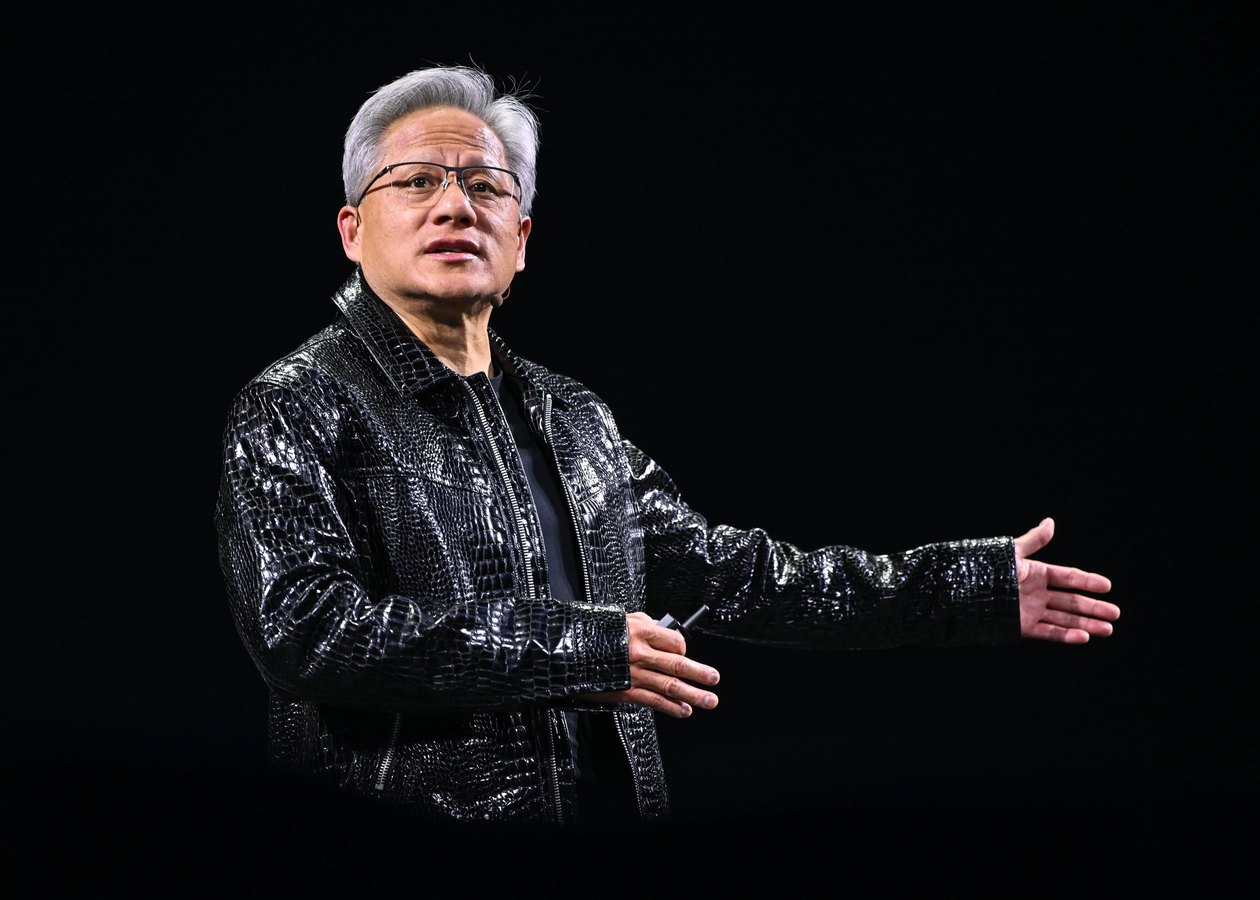
His presentation style filled arena venues, including a CES 2025 appearance where fourteen thousand attendees cheered his arrival under blue stadium lights. He illustrated parallel processing in 2008 by having the Mythbusters fire an eleven-hundred-nozzle paintball gun to paint the Mona Lisa in one shot. Huang consistently engaged audiences through live demonstrations spanning gaming physics, lighting, AI weather simulations, and robotics.
Advertisement
Tech Pulse Daily
Get tomorrow's pulse first
Join engineers who read Tech Pulse before stand-up. Free, weekday mornings.
03Existential gambles from Sega to Riva
Huang built Nvidia from an obscure startup founded in a Denny's diner in 1993 into a dominant semiconductor power through successive existential gambles. In 1996, the venture approached bankruptcy after engineering a failed graphics processor intended for the Sega Dreamcast game console. Despite failing to supply the promised silicon, Huang persuaded Sega executives to provide five million dollars in follow-up funding.
Huang staked that capital on developing the Riva 128 graphics accelerator, dismissing more than half of his one-hundred-person workforce and rushing directly to production. Nvidia held only one single month of operating payroll remaining when the hardware finally shipped to computer manufacturers. The gamble succeeded when the Riva 128 sold one million units in four months, establishing Nvidia's long-term relationship with TSMC and funding the GeForce lineup.
04The gross profit wager behind CUDA
Approximately eight years following the Riva milestone, Huang wagered Nvidia's entire gross profit on integrating a general-purpose computing platform named CUDA into consumer graphics cards. The framework permitted graphics hardware to execute complex scientific and mathematical workloads beyond traditional pixel rendering. Speaking with Lex Fridman, Huang acknowledged that baking the unrequested architecture into consumer cards elevated production expenses by fifty percent across the entire GeForce lineup.
Jon Peddie observed that zero initial customer demand existed for CUDA, noting that Huang pursued the initiative out of sheer conviction rather than market pressure. Mainstream software developers initially resisted the cost surcharge on gaming cards for computational features they had never requested. Defending that proprietary software ecosystem represents an essential strategic objective because global artificial intelligence infrastructure remains deeply dependent on CUDA.
05Roadmap lock-in and the successor search
Market researchers emphasize that Huang's departure will trigger an equity shock rather than immediate commercial collapse. Moorhead noted that manufacturing and product roadmaps remain firmly locked in place through 2027, preventing near-term disruptions to ongoing hardware deliveries. Creative Strategies analyst Ben Bajarin confirmed that upcoming processor families are currently undergoing tape-out, physical design, or active component ordering across global fabricators.
Nvidia maintains control over vital supply chains, including leading-edge wafers, high-bandwidth memory, and advanced CoWoS packaging alongside server rack partners. HotTech Vision and Analysis analyst Dave Altavilla emphasized that the firm retains deep engineering talent, mature software stacks, and customer relationships. Analysts Tom Mainelli and Bajarin agree that despite leadership friction, the underlying technology engine remains structurally sound.
The board faces the daunting challenge of recruiting an external chief executive because internal personnel show little interest in assuming Huang's position. Jon Peddie remarked that an outside leader will lack Huang's established contacts, risk appetite, and historical stature, likely subjecting company shares to volatility. The ultimate test will be whether new leadership can sustain inventive momentum once locked product roadmaps expire after 2027.
Jensen Huang and the decline of the visionary FAQ
Why did Jensen Huang resign from Nvidia?
Huang departed Nvidia following dual chip smuggling scandals and allegations involving three extramarital affairs, including one with an alleged Chinese intelligence operative.
How will Jensen Huang's departure impact Nvidia's chip roadmap?
Analysts confirm that Nvidia's technology roadmap and manufacturing orders remain locked through 2027, backed by long-term commitments for leading-edge wafers, CoWoS packaging, and high-bandwidth memory.
Who is replacing Jensen Huang as Nvidia chief executive?
Nvidia has not named an internal successor, and analysts expect the board to recruit an external executive because current staff members are hesitant to assume his role.
What was the Riva 128 gamble in Nvidia's early history?
In 1996, Huang laid off over half of Nvidia's one hundred workers and skipped standard prototyping to build the Riva 128 graphics accelerator, selling one million units in four months with only one month of payroll left.
Sources

Author
Dillip Chowdary
Writes Tech Bytes coverage of AI, engineering, and the tools that actually ship. Editor of Tech Pulse Daily.
Related on Tech Bytes
Advertisement