Jev vs. Claude as blind headline judge: six gates before either touches
Alex Vidovich and Zivana Zerjal released an 11-page study showing commercial text judges beat simple headline counts by only borderline margins in trading labs.
By Dillip Chowdary • Oct 11, 2026 • Source: alexvidovich.com

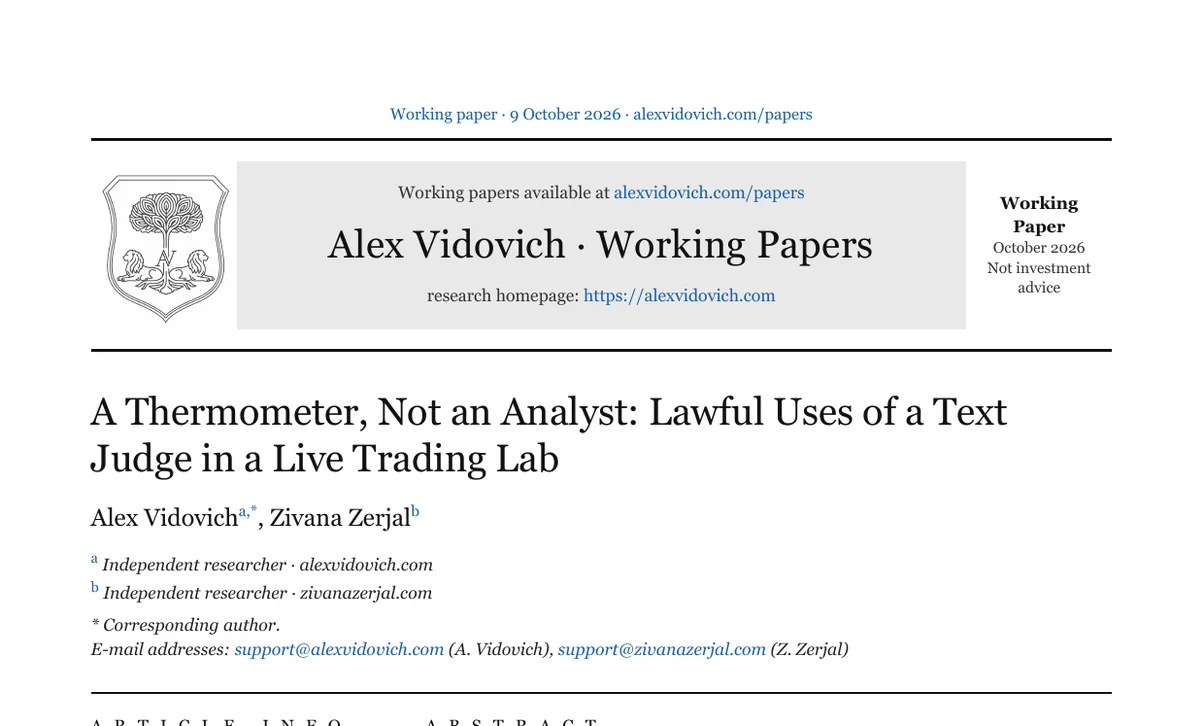
Independent researchers Alex Vidovich and Zivana Zerjal released an eleven-page working paper detailing a strict governance framework for deploying language models as headline judges alongside live trading strategies. Documented in alexvidovich.com's report, the evaluation demonstrates how a small commercial judge and a general conversational chatbot can be positioned strictly as passive observation instruments, likened to thermometers, rather than active decision analysts. The setup examines an environment where an intraday strategy and an overnight strategy operate concurrently across a single financial account, requiring strict separation between the text-reading apparatus and trade execution logic.
The evaluation outlines the comparative discipline required when testing pinned commercial text judges against general conversational interfaces on blind news rows. Designed for quantitative researchers, system architects, and trading engineers, the analysis focuses on diagnosing plumbing flaws and enforcing six verification tests before any text model outputs can influence operational workflows. The paper disclaims any financial return metrics, concentrating entirely on data integrity, prompt determinism, and look-ahead bias mitigation in quantitative pipelines.
The test: Jev vs Claude as blind headline judge
The testing methodology evaluates text models by asking typed questions about news headlines under strict laboratory constraints without granting the software access to underlying financial numbers. Under the six-gate framework developed across three days of testing, an evaluation pipeline checks whether a text signal reads plain factual records correctly against real labels, beats a trivial baseline count of headline volume, and suppresses retrospective memory of historical market events. Additional criteria mandate identical outputs across repeated identical inputs, strict visibility of the exact decision-time timestamp, and the benchmarking of every forward verdict against random flags.
Most of these operational boundaries were assembled directly in response to system breakdowns and corrupted pipeline plumbing observed during active deployment. By treating the evaluated model as a thermometer rather than an analyst, researchers forbid the language model from reading or modifying portfolio quantities, prices, or orders. The software is limited to inspecting headlines and generating post-close stamps that are counted forward into subsequent intervals. Testing the models on blind rows strips out metadata and forces the software to evaluate textual data solely within fixed evaluation constraints.
How Jev and Claude as blind headline judge each did
Running blind headline evaluations exposed modest analytical outputs across both system configurations, characterized by narrow statistical edges and fragile signal persistence. The tested commercial text judge successfully extracted a single target fact under one specific experimental configuration, but its performance margin over a naive count of incoming headlines remained borderline. Other tested effects fell entirely below defined evaluation thresholds, and several secondary signals decayed completely once subjected to out-of-sample forward verification rules.
General conversational chatbots tested across the blind rows faced comparable constraints when judged against deterministic operational benchmarks. Plumbing failures in the surrounding software corrupted several readings, highlighting how fragile pipeline architecture can distort text outputs before they reach downstream components. Because neither candidate demonstrated robust outperformance across varying setups, the researchers recorded every experiment and systemic failure in full, declining to endorse either configuration as a reliable autonomous trading analyst.
Advertisement
Tech Pulse Daily
Get tomorrow's pulse first
Join engineers who read Tech Pulse before stand-up. Free, weekday mornings.
Jev vs Claude as blind headline judge, side by side
Direct comparison between the small commercial judge and the general chatbot centers on structural stability, latency discipline, and resistance to look-ahead contamination. A small commercial model pinned to a static version offers predictable API response characteristics and defined parameter bounds, whereas general conversational systems introduce variability unless tightly constrained by input templates. Both paradigms remain vulnerable to hidden memory leaks where knowledge of past macroeconomic events distorts blind headline scoring.
| System Feature | Small Commercial Judge | General Chatbot |
|---|---|---|
| Role Assignment | Passive headline thermometer | Conversational text reader |
| Model Versioning | Pinned static release | General deployment endpoint |
| System Permissions | Post-close stamps counted forward | No access to live trading numbers |
| Signal Performance | Read one fact with borderline margin | Subject to pipeline plumbing errors |
| Gate Compliance | Tested across six verification gates | Evaluated on blind test rows |
Neither candidate is permitted to touch execution logic or system numbers within the trading laboratory. The side-by-side assessment indicates that operational viability depends far more on the rigors of external validation gates than on inherent model capability. Even when pinned to a specific build version, language models provide minimal standalone signal unless their outputs consistently surpass a simple headline count across randomized benchmarks.
See the Jev vs Claude as blind headline judge output
The primary output generated by the evaluation framework consists of timestamped text records and forward verdict rules logged after the daily market close. In the laboratory setup, outputs appear as discrete classifications answering typed questions about incoming headline text, stripped of any downstream numerical calculations. When an input prompt queries the significance of a news item, the judge outputs a structured record that the trading pipeline counts forward without permitting backward revisions.
Analysis of the logged outputs revealed that apparent analytical insights frequently collapsed under strict verification protocols. Aside from one isolated factual extraction that barely surpassed basic headline counting volume, the resulting signal strength proved marginal across the evaluated trading strategies. Pipeline logs also captured multiple plumbing breakdowns, demonstrating how unhandled formatting discrepancies and delivery latency compromised the validity of generated text records during live runs.
The verdict on Jev vs Claude as blind headline judge
The final assessment delivered by the working paper rejects the deployment of text-based language models as independent market analysts, restricting their function to passive measurement tools. Neither model configuration produced substantial alpha or showed sustained margins over standard headline counts, leading the researchers to present their six-test battery as a defensive pre-flight checklist rather than an endorsement of algorithmic trading gains.
The paper makes no claims regarding financial returns for either the intraday or the overnight strategy, focusing exclusively on reporting structural defects and negative results. Ensuring that models give identical answers twice, forget historical event outcomes, and adhere to decision-time date stamps represents the prerequisite for ethical research infrastructure. Until text models can clear all six verification gates simultaneously without plumbing degradation, quantitative practitioners must treat headline judges as fallible instruments requiring perpetual cross-examination.
Developer Action Items
- ☐ Diff the official changelog for Claude / Framework before you bump — APIs, defaults, and removed flags only.
- ☐ Install through the vendor's documented channel in staging; keep a one-command rollback and time-box the canary.
- ☐ Grep your repo for old flag names, lockfile pins, and plugin versions that the notes mark as breaking.
- ☐ Prefer the first patch cut over the day-zero tag unless you have a reason to be on the leading edge.
- ☐ If HN Claude/Codex/Fable did not name a region, plan, or SKU, screenshot the official availability line before you promise it to users.
Jev vs Claude as blind headline judge FAQ
What role does a language model serve in the trading laboratory?
The model operates strictly as a passive thermometer that answers typed questions about headlines, with no authority to prescribe actions or touch trading system numbers.
What are the six gates used to evaluate text judges?
The six gates require reading facts correctly against real labels, beating a basic headline count, showing no memory of historical events, repeating answers identically, enforcing decision-time timestamps, and testing forward rules against random flags.
Did the evaluated models generate profitable trading signals?
The researchers made no claims regarding trading returns, reporting only one fact read with a borderline margin over headline counts while other effects vanished or failed threshold bars.
Sources

Author
Dillip Chowdary
Writes Tech Bytes coverage of AI, engineering, and the tools that actually ship. Editor of Tech Pulse Daily.
Related on Tech Bytes
Advertisement