Launching Bill Payments in India, Helping People to Pay Everyday Household
We are launching Bill payments in India, making it easier for people to find, manage, and pay their everyday household and utility bills directly within.
By Dillip Chowdary • Sep 06, 2026 • Source: Meta Newsroom
What happened
Meta is bringing a new payments capability to WhatsApp users in India, letting people find, manage, and pay their everyday household and utility bills from within the app itself. The move extends WhatsApp's role as a payments platform in one of its largest markets, deepening a service that has already grown to handle person-to-person transfers and merchant transactions inside the same chat interface millions of Indians use daily.
This article covers what the bill payments feature does, how it differs from what WhatsApp already offered, which users and service categories it applies to, and what builders and product teams working in the Indian fintech or super-app space should pay attention to as the rollout unfolds.
Meta has announced the launch of bill payments inside WhatsApp in India. The feature is designed to let users find, manage, and pay household and utility bills without leaving the app. The announcement positions this as a convenience addition, reducing the friction of switching between messaging and separate banking or utility-specific apps. Meta framed the feature around everyday household bills, though the announcement does not specify an exhaustive list of covered bill categories at this stage.
How it works
The launch builds on WhatsApp's existing payments infrastructure in India, which the company has been expanding since receiving regulatory clearance for UPI-based transactions. Bill payments represent a logical next step beyond peer-to-peer transfers, moving the app closer to the kind of utility-first, multi-service experience that competing platforms in India have pursued for several years.
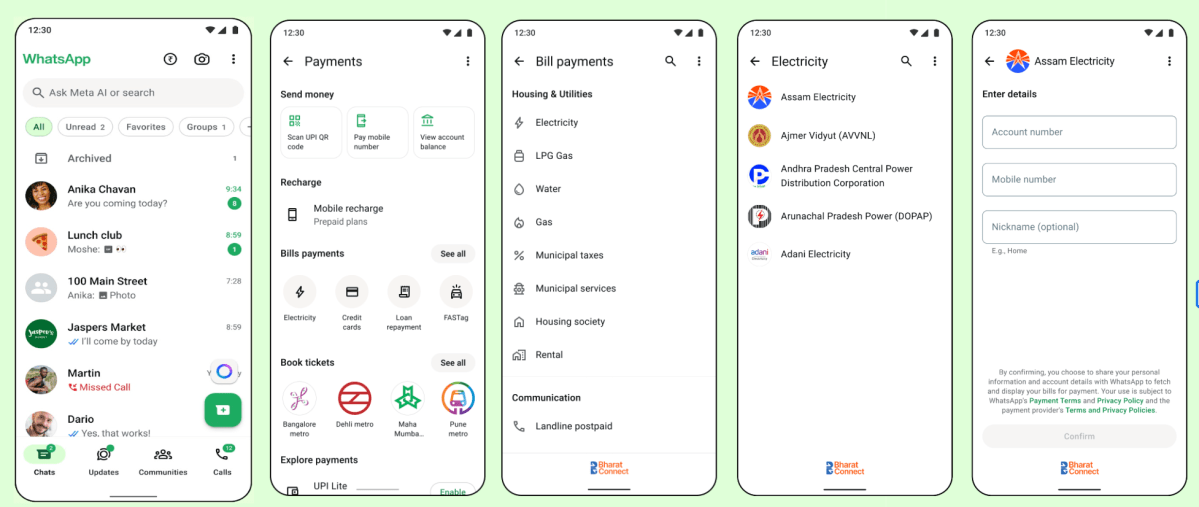
Before this update, WhatsApp Pay in India focused primarily on sending money to other users and paying at merchants who accepted UPI. The bill payments addition introduces a discovery and management layer, meaning users are not just completing a transaction but can also browse for bills, check what is due, and schedule or confirm payment from within the app's interface. That combination of find, manage, and pay marks a structural shift in the product beyond a simple payment rail.
Why it matters
Advertisement
Tech Pulse Daily
Get tomorrow's pulse first
Join engineers who read Tech Pulse before stand-up. Free, weekday mornings.
The underlying payment mechanism in India is UPI, which WhatsApp already uses for its peer-to-peer and merchant payment flows. Bill payments slot into that same infrastructure, so users are not being asked to add new bank credentials or authenticate through a separate system. The main change is on the product surface: a dedicated pathway for recurring household expenses now exists inside WhatsApp rather than requiring a redirect to a biller's own app or website.
Indian WhatsApp users who currently juggle multiple apps to pay electricity, water, gas, or other recurring household bills are the clearest audience for this change. If a person already uses WhatsApp Pay for sending money, the bill payment path lives in the same environment they already trust and have authenticated. The consolidation matters most to users in tier-two and tier-three cities, where WhatsApp often serves as a primary digital interface and where downloading and managing multiple utility apps can be a practical barrier.
Developers and product managers building fintech or consumer apps in India should note the competitive signal. WhatsApp's user base in India is enormous, and adding bill payment capability directly in a messaging app sets a higher convenience bar for standalone billers and aggregator platforms. Companies that rely on separate app installs or browser redirects to capture utility bill payments should assess whether their current acquisition and retention model holds when a large share of users can accomplish the same task without leaving WhatsApp.
Who is affected
Meta has not disclosed a phased rollout schedule or a specific date range within which all eligible users will see the feature. The announcement describes the launch as active in India, which suggests the rollout has begun, though it may not be visible to every user simultaneously given how Meta typically stages feature releases. Users in India should check their WhatsApp Pay section for a bills or payments option to see whether they have access.
To verify the feature on your own device, open WhatsApp, navigate to the Payments section, and look for a bill-related entry point. Because the feature connects to UPI and requires a linked bank account, users who have not yet set up WhatsApp Pay will need to do that first before the bill payment flow becomes available. No separate app download or account registration is required beyond what WhatsApp Pay already asks for.
What to watch next
The category of bills covered is the first thing to monitor as the rollout matures. Meta's announcement references everyday household and utility bills without enumerating specific providers, so watching which billers and categories appear in the interface will clarify how broadly the feature has been integrated with India's bill aggregation ecosystem. Regulatory filings with the National Payments Corporation of India may surface more technical detail about the scope of the rollout as it widens.
The second area to watch is whether Meta extends bill payments to other countries where WhatsApp Pay has received regulatory approval. India is the most developed market for WhatsApp payments by a significant margin, but the infrastructure Meta is building there could inform expansions elsewhere. Builders and investors tracking global super-app dynamics should follow both the Indian rollout and any signals from Meta about applying the same model to Brazil or other markets where WhatsApp payments have been approved.
Developer Action Items
- ☐ Map where Meta sits in your stack (SDK, API key, billing, data-processing addendum).
- ☐ Hold non-urgent migrations until the integration or use-of-proceeds roadmap is public — day-one coverage is not a ship signal.
- ☐ If you are mid-contract or mid-POC, ask the vendor what changes for existing customers this quarter.
- ☐ Write the single decision this forces: stay, dual-source, or exit.

Author
Dillip Chowdary
Writes Tech Bytes coverage of AI, engineering, and the tools that actually ship. Editor of Tech Pulse Daily.
Related on Tech Bytes
Search agent beats GPT-6 Astra on benchmarks, just days after release
Read →
Apple launches new Mac Studios with its ‘most powerful chip ever’ — the M5 Ultra
Read →
Claude Fable 5.1 is generally available in GitHub Copilot
Read →
Apple upgrading recent Mac mini orders to M6, M5 Pro models for free
Read →
Today's Tech Pulse briefing
Full briefing →
Advertisement