Leaked Anthropic Draft AI Regulatory Bill Is Unacceptable and Troubling
Anthropic quietly pitched a draft federal AI bill that preempts state laws like SB 53 and defines catastrophic harm as fifty deaths or one billion dollars.
By Dillip Chowdary • Oct 19, 2026 • Source: thezvi.substack.com
Anthropic quietly pitched a discussion draft for federal artificial intelligence regulation to lawmakers ahead of the congressional lame duck session. As detailed in thezvi.substack.com's report, the leaked proposal establishes an auditing system for frontier models while preempting state AI safety laws. While the company previously promoted frontier guardrails, this draft limits federal emergency intervention powers and scales back regulatory rulemaking compared to earlier bipartisan proposals.
This analysis details the statutory mechanics of the leaked bill, comparing its provisions against the Trahan-Obernolte FRONTIER Act and state measures such as California SB 53. The reporting covers the draft's impact on state enforcement, federal agency thresholds, and auditor obligations. It is written for policy analysts, software engineers, and enterprise developers evaluating how federal preemption and altered catastrophic risk standards will shape model deployment and legal liability.
Leaked Anthropic Draft AI Regulatory Bill: what actually changed
The leaked proposal departs substantially from earlier bipartisan proposals, notably the Trahan-Obernolte FRONTIER Act introduced in July after initial June compromise discussions. While the FRONTIER Act established robust administrative rulemaking and broad emergency shutdown powers, the new draft strips federal agencies of standard-setting authority. Independent legal observers and policy researchers note that the text virtually eliminates traditional administrative rulemaking on safety protocols. Furthermore, the draft scales back emergency shutdown authorities that allow executive branch regulators to pause hazardous models, replacing mandatory government levers with a constrained judicial process.
In exchange for weaker administrative powers, the measure inserts stronger transparency mechanisms and mandates that independent model auditors remain employed on a continuing basis. Auditors receive improved access to developer data and system records, although legal analysts note potential Fourth Amendment complications surrounding mandatory data inspections. Most significantly, the draft institutes sweeping preemption of state-level artificial intelligence legislation, specifically targeting laws like California SB 53. The preemption language reaches into state court jurisdictions, explicitly removing the authority of state judges to issue decrees halting internal model training, development, or deployment.
Leaked Anthropic Draft AI Regulatory Bill: how it works
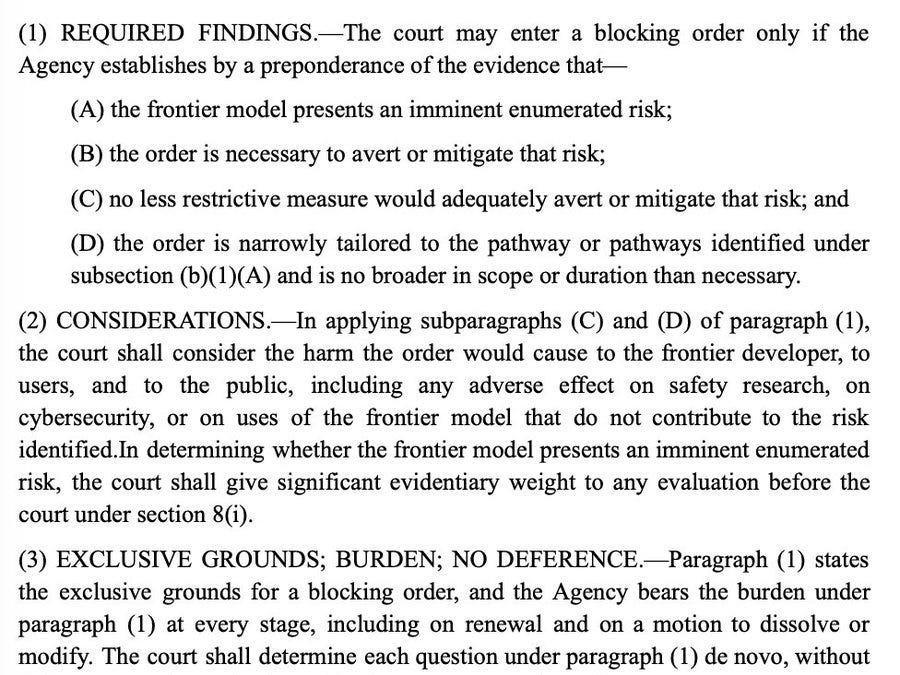
The legislative mechanism centralizes model intervention authority exclusively within the federal government while erecting strict evidentiary barriers before any model can be restrained. Under the statutory framework, federal authorities cannot restrict the internal use, training, or commercial distribution of a frontier model unless an agency head proves an imminent risk of catastrophic harm. The bill defines catastrophic harm precisely as an event causing more than fifty human deaths or exceeding one billion dollars in damage. The agency head must submit a detailed administrative determination demonstrating that no alternative regulatory remedies could prevent the catastrophe.
Once a petition reaches federal court, the draft instructs presiding judges to weigh commercial consequences alongside safety risks. Specifically, judges are directed to consider economic injuries to the model developer and broader commercial harms caused by restricting the technology, without balancing reciprocal considerations for public safety. On the auditing side, developers must retain independent auditing firms continuously. However, the legislative text contains no federal licensing or qualification regime for these commercial auditors. As drafted, developers select and compensate their own auditing entities without standardized federal accreditation, relying on private commercial contracts rather than government certification boards.
Advertisement
Tech Pulse Daily
Get tomorrow's pulse first
Join engineers who read Tech Pulse before stand-up. Free, weekday mornings.
Leaked Anthropic Draft AI Regulatory Bill: why it matters now
The draft emerged as congressional leaders prepared for the post-election lame duck session, creating a narrow legislative window before political majorities shift. Policy observers emphasize that shopping a compromise bill to a Republican Congress reflects a defensive effort by the frontier lab to insulate enterprise operations from fragmented state statutes. Instead of facing strict liability laws or state injunctive actions across individual state jurisdictions, the draft attempts to lock in a permissive federal baseline. The timing aligns with growing concern from safety researchers like Zvi Mowshowitz, who argue that enacting broad preemption permanently bars states from passing critical safeguards.
The proposal arrives amid rapid technical shifts marked by the proliferation of open platforms like Hugging Face, autonomous rogue swarms, and discoveries by researchers such as Coxon. While public momentum and legislative appetite for safety mandates grew between June and October, the draft retreats from Anthropic's own June framework. That earlier policy document explicitly pledged that federal legislation should not preempt state authority unless Congress passed protections meeting or exceeding framework standards. Critics argue that offering backward-looking and forward-looking preemption while weakening internal use restrictions and emergency shutdowns diminishes public protection below thresholds provided by existing general law.
Leaked Anthropic Draft AI Regulatory Bill: who is affected
Frontier artificial intelligence laboratories including Anthropic, OpenAI, and compute ventures such as SpaceXSI face direct operational impacts under the proposed regime. Leading developers would secure legal immunity from state court injunctions and circumvent diverse compliance mandates passed by individual state legislatures. At the same time, labs must fund continuous external auditing relationships and provide expanded information access to third-party evaluators. Because the statutory text omits auditor licensing requirements, commercial labs maintain substantial discretion over which evaluators they hire. This framework allows frontier companies to navigate compliance without facing federal administrative mandates or sudden executive shutdown orders.
State governments, municipal regulators, and state judiciaries experience immediate jurisdictional losses under the draft bill's preemption clauses. State attorneys general and local courts lose their established authority to issue emergency injunctions that suspend hazardous model training runs or halt deployments threatening local populations. State legislatures developing customized safety frameworks find their legislative authority superseded by the singular federal standard. For the general public, legal analysts such as Nathan Calvin and Nate Soares warn that the bill reduces overall protection. Ordinary citizens lose localized legal recourse, relying entirely on federal proceedings burdened by elevated catastrophic loss thresholds.
Leaked Anthropic Draft AI Regulatory Bill: what to watch
Capitol Hill negotiations in the coming weeks will determine whether congressional committees accept the draft as a viable template or discard its preemption language. Observers will track reactions from lawmakers who authored the original FRONTIER Act, particularly Representative Lori Trahan and Representative Jay Obernolte, to see if they endorse Anthropic's scaled-back enforcement provisions. In addition, internal pushback among Anthropic employees and independent technical researchers could pressure the policy team to revise the discussion draft. Analysts expect upcoming legislative proposals to introduce formal embedded auditor models and establish mandatory federal licensing standards that prevent auditing firms from competing in an unregulated commercial marketplace.
Legal scrutiny will also focus on the constitutional durability of the draft's data access mandates and court balancing directives. Legal scholars will examine whether compelling frontier labs to grant broad auditor access withstands Fourth Amendment challenges regarding administrative searches of proprietary compute infrastructure. At the same time, state officials and consumer protection groups are expected to challenge provisions restricting traditional judicial equitable relief. Observers will monitor whether future drafts preserve the fifty-death and one-billion-dollar threshold for emergency intervention, or whether lawmakers reinstate substantive agency rulemaking to maintain oversight over rapid algorithmic developments and autonomous swarms.
Developer Action Items
- ☐ Verify the claim on the official Anthropic / Framework page (or HN Claude/Codex/Fable), not from this recap alone.
- ☐ Name the surface that moved — API, policy, model, hardware, or commercial terms — before you Slack the thread.
- ☐ Assign one owner a day to read the primary material and decide: this-sprint, this-quarter, or noise.
- ☐ Do not change production on day-one coverage. Watch the vendor changelog and one independent write-up first.
Leaked Anthropic Draft AI Regulatory Bill FAQ
What does the leaked Anthropic draft AI regulatory bill propose?
The leaked discussion draft pitches a federal regulatory framework that mandates continuous third-party auditing and transparency for frontier AI developers while broadly preempting state safety laws. It removes administrative rulemaking and limits federal emergency model shutdown authority.
How does the bill define catastrophic harm for model restrictions?
The draft defines catastrophic harm as an imminent event that kills more than fifty people or causes more than one billion dollars in damage. Federal agency heads must prove no alternative remedy exists before seeking court restrictions on model training or deployment.
Does the draft AI bill preempt state legislation like California SB 53?
Yes, the proposal institutes broad preemption that blocks state laws such as California SB 53 and eliminates state court authority to issue injunctions suspending model development or deployment.
Why are safety researchers criticizing Anthropic's legislative proposal?
Researchers including Zvi Mowshowitz, Nathan Calvin, and Nate Soares criticize the bill for offering weaker protections than the FRONTIER Act and Anthropic's own June framework. They argue that omitting auditor licensing and restricting court intervention leaves the public less protected against catastrophic risks.
Sources

Author
Dillip Chowdary
Writes Tech Bytes coverage of AI, engineering, and the tools that actually ship. Editor of Tech Pulse Daily.
Related on Tech Bytes
Advertisement