Leaker claims iPhone 18 Pro chip will have 7 GPU cores and faster RAM
A Chinese leaker with some track record has posted images of claimed circuit diagrams of the upcoming iPhone 18 Pro models.
By Dillip Chowdary • Sep 06, 2026 • Source: 9to5Mac

What happened
A Chinese leaker with a stated track record in Apple component sourcing has published images of what they describe as circuit diagrams for the iPhone 18 Pro lineup. The diagrams, surfaced by 9to5Mac, carry two specific hardware claims: the A20 Pro chip inside the iPhone 18 Pro will feature 7 GPU cores, and the device will ship with a faster grade of RAM than what is currently in the iPhone 16 Pro. Both numbers are narrow enough that, if accurate, they would represent a meaningful step rather than a generational leap on paper — and that precision is what has drawn attention from developers and analysts who follow Apple silicon roadmaps.
This piece is for iOS and app developers, Apple platform engineers, and hardware enthusiasts who want to understand what a 7-core GPU configuration and faster RAM would mean in practice — and what to treat with appropriate skepticism until Apple speaks. The source is a single leaker posting circuit diagram photos, so the piece treats the claims as claims throughout, examines the mechanism behind each, and maps out who would feel the difference most if they prove correct.
A Chinese leaker posted photographs of circuit diagrams that purport to show the internal design of the iPhone 18 Pro. The images, which circulated ahead of any official Apple announcement, were picked up and reported by 9to5Mac. The leaker is described as having some prior track record, meaning at least some past claims from the same source have matched released products, though the degree and consistency of that track record are not detailed. The two headline figures extracted from the diagrams are a 7-GPU-core configuration for the A20 Pro chip and a RAM specification described as faster than the current standard in the iPhone 16 Pro line.
How it works
The photographs show what appear to be schematic-level drawings rather than final silicon layouts, so the information is one or more steps removed from confirmed engineering documentation. Circuit diagrams can reflect early reference designs that change before tape-out, or they can reflect late-stage plans that closely match the shipping product. At this point in the product cycle — no announced release date, no confirmed chip name from Apple — both interpretations remain open.
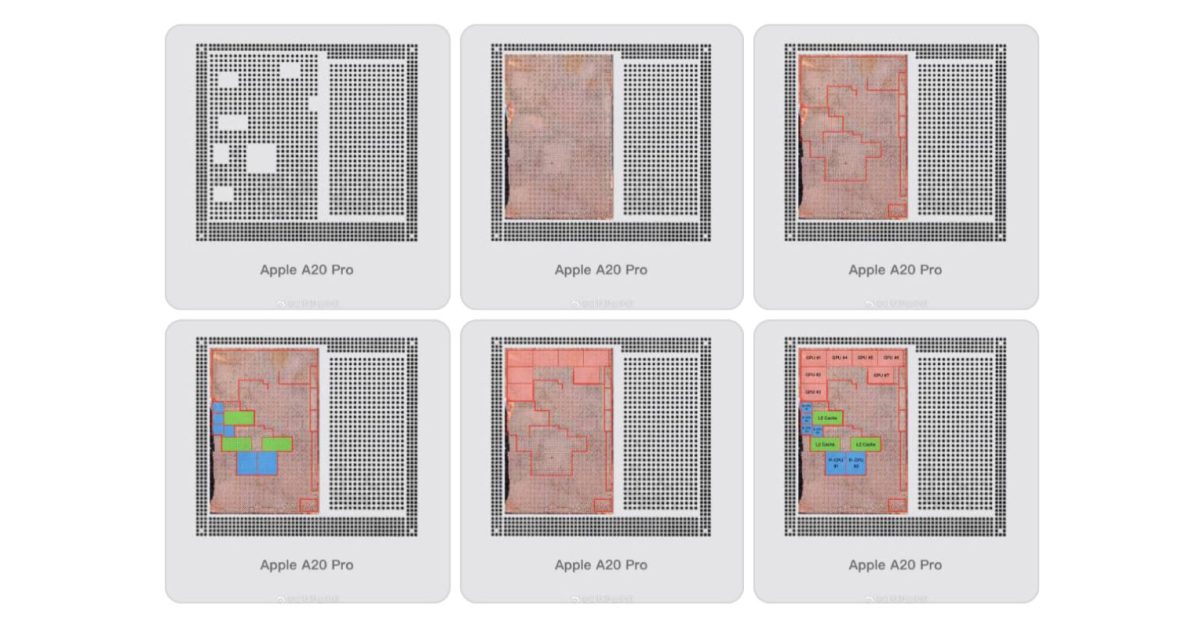
Apple's A-series chips integrate CPU, GPU, Neural Engine, and memory on a single package. The GPU core count directly governs how many parallel shader threads the chip can execute at once, which matters most for real-time rendering in games, augmented reality compositing, and compute-heavy tasks like on-device machine learning inference that are dispatched through Metal. Moving from the GPU configuration in the A18 Pro to 7 cores, if the diagrams are read correctly, would represent an incremental increase that Apple has used before to expand headroom without redesigning the underlying shader architecture.
Why it matters
Advertisement
Tech Pulse Daily
Get tomorrow's pulse first
Join engineers who read Tech Pulse before stand-up. Free, weekday mornings.
Faster RAM in this context almost certainly refers to LPDDR5X or a newer LPDDR generation running at a higher transfer rate than the chips Apple currently ships. Memory bandwidth is frequently the binding constraint for GPU-heavy workloads on mobile, meaning a faster bus can allow existing GPU cores to sustain higher utilization. The practical result for developers targeting Metal would be that larger textures and more complex scene graphs could stay resident without stalling the pipeline, which affects frame pacing before it affects peak frame rate.
GPU core count and RAM speed are two of the three most visible numbers Apple uses when pitching the Pro tier of its iPhone line to developers and creative professionals. If the 7-core GPU figure is accurate, it sets a floor for what Metal-based applications can target in the next iPhone 18 Pro generation and informs decisions about which graphical features to enable by default versus gate behind capability checks. Developers building apps that use ARKit, RealityKit, or Core ML on-device inference pipelines have a direct interest in knowing whether memory bandwidth improves alongside core count, because bandwidth often determines whether a workload fits on-device at all.
For the broader industry, the signal from leaked diagrams is that Apple is continuing a steady-increment strategy on the GPU rather than a large-step redesign. That pattern, if it holds, suggests the performance gap between the Pro and non-Pro iPhone tiers remains a meaningful product differentiator, which in turn affects how independent developers price and market Pro-only features in the App Store.
Who is affected
App and game developers targeting the iPhone 18 Pro will be the first to feel the change, particularly those building titles or tools that saturate current GPU bandwidth. Studio teams working on console-quality mobile games, computational photography pipelines, and real-time video effects are the most likely to see a perceptible difference from faster RAM and an additional GPU core if both claims prove true. Developers whose workloads are CPU-bound or network-bound will notice nothing from these particular changes.
Enterprise buyers who purchase Pro devices for field workers running on-device inference — medical imaging analysis, quality inspection, document digitization — may also care about the RAM speed claim, since larger model weights require higher bandwidth to load and activate quickly. On the consumer side, most users do not experience GPU core counts directly; they experience frame rate stability and camera processing speed, both of which could improve modestly if the hardware ships as described.
What to watch next
The most important near-term check is corroboration from a second independent source citing the same 7-core GPU figure and the same RAM specification. Single-source hardware leaks, even from leakers with prior accuracy, have a history of capturing real information at an early stage that is then revised before the final product ships. A second diagram or a supply-chain confirmation would move these numbers from plausible to probable. Developers should also watch for any Apple silicon session at WWDC or a platform state of the union that hints at new Metal capabilities, since Apple sometimes signals architectural directions without naming unreleased chips.
On the RAM side, the specific grade matters as much as the descriptor "faster." Whether the upgrade represents a move to a new LPDDR generation or simply a higher-binned version of existing silicon determines whether the bandwidth gain is incremental or substantial. Apple has not commented on the diagrams, and the iPhone 18 Pro has no confirmed release date. Builders should treat the 7-core GPU and faster RAM figures as working hypotheses to note in a roadmap document rather than specifications to build against today.
Developer Action Items
- ☐ Diff the official changelog for Apple / iOS before you bump — APIs, defaults, and removed flags only.
- ☐ Install through the vendor's documented channel in staging; keep a one-command rollback and time-box the canary.
- ☐ Grep your repo for old flag names, lockfile pins, and plugin versions that the notes mark as breaking.
- ☐ Prefer the first patch cut over the day-zero tag unless you have a reason to be on the leading edge.
- ☐ If 9to5Mac did not name a region, plan, or SKU, screenshot the official availability line before you promise it to users.

Author
Dillip Chowdary
Writes Tech Bytes coverage of AI, engineering, and the tools that actually ship. Editor of Tech Pulse Daily.
Related on Tech Bytes
Search agent beats GPT-6 Astra on benchmarks, just days after release
Read →
Apple launches new Mac Studios with its ‘most powerful chip ever’ — the M5 Ultra
Read →
Claude Fable 5.1 is generally available in GitHub Copilot
Read →
Apple upgrading recent Mac mini orders to M6, M5 Pro models for free
Read →
Today's Tech Pulse briefing
Full briefing →
Advertisement